How Roadway Grinding & Grooving Provide a Safer Driving Experience
The next time you cruise down a new stretch of highway or witness a jetliner touch down seamlessly, think about the invisible engineering that made that smooth, safe experience possible. That engineering is often the result of two precise, high-impact techniques: concrete grinding and grooving.
These processes are an important piece of modern pavement restoration, transforming worn-out, hazardous concrete into high-performance surfaces that enhance safety, reduce noise, and extend the lifespan of our essential transportation infrastructure from busy interstates to critical airport runways.
Diamond Grinding
When engineers talk about grinding, they are typically referring to diamond grinding, a technique designed to correct surface irregularities and improve ride quality.
What is Grinding?
Diamond grinding uses specialized equipment fitted with numerous diamond-tipped saw blades to shave off a thin, uniform layer of the concrete surface. This process is essentially like a massive, industrial-scale planer, correcting flaws across the entire slab.
Why is Grinding Necessary?
The goal of grinding is to restore the pavement's smoothness, which naturally degrades over time due to heavy traffic and environmental stress:
1. Eliminating Faulting: Grinding removes the vertical steps or "bumps" that develop at the joints between concrete slabs (known as faulting or warping). This is what creates the jarring "thump-thump" sensation on older highways.
2. Improving Ride Quality (IRI): The quality of a road is measured by the International Roughness Index (IRI). Grinding can drastically reduce the IRI, leading to a smoother, quieter, and more comfortable ride for drivers.
3. Noise Reduction: The newly textured surface resulting from grinding is smoother and more uniform than rough, faulted concrete, often leading to a noticeable reduction in tire-pavement noise.
Diamond Grooving
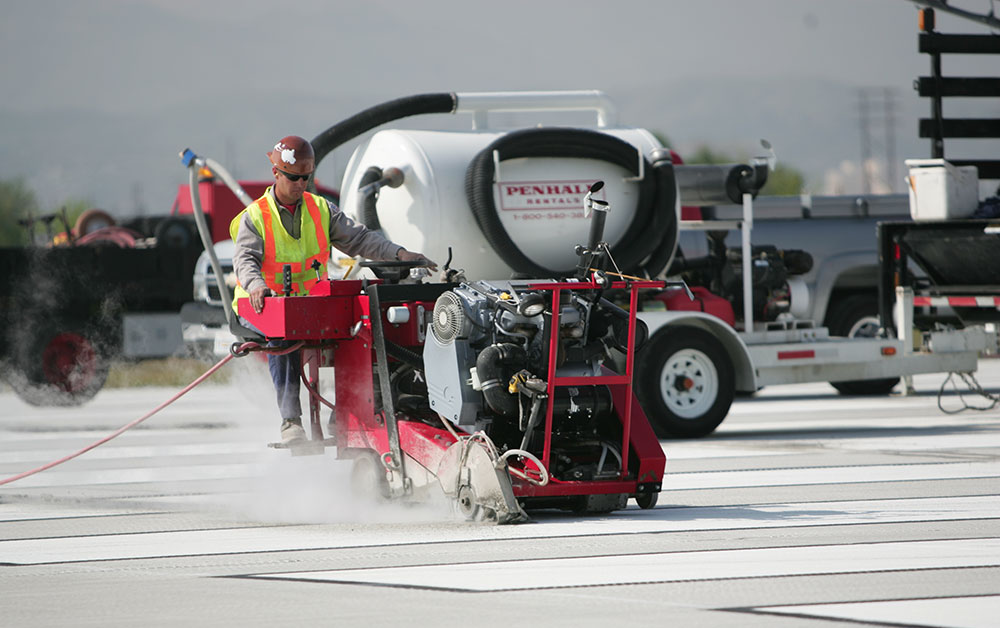
Grooving is the process of cutting deliberate, precise channels into the pavement. Unlike grinding, which focuses on smoothness, grooving's sole purpose is maximizing safety and performance, especially in wet conditions.
Safety Mechanics
Grooving works by applying two mechanical principles developed originally for airport runways.
1. Water Displacement: The grooves act as immediate drainage channels, pulling water, oil, or slush away from the point where the tire meets the concrete. This prevents the formation of a liquid film, which is the cause of hydroplaning at high speeds.
2. Mechanical Interlock: The diamond-cut grooves create sharp, vertical edges. These edges provide physical resistance for the tire tread to push against, offering essential mechanical grip and increasing the overall coefficient of friction, which is vital for braking and steering stability.
Patterns Matter
The direction of the grooves is customized based on the application.
Transverse Grooving: Cuts are made perpendicular to the direction of travel. This is crucial for runways and high-speed braking zones because it maximizes water evacuation along the path of movement.
Longitudinal Grooving: Cuts run parallel to the direction of travel. This is common on highways as it improves steering control and helps vehicles track cleanly through curves.
Concrete Grinding and Grooving Combined
While both processes can be used separately, the most comprehensive and effective pavement restoration projects utilize them in tandem:
1. Grind First: The pavement is ground to eliminate all bumps and dips, ensuring a perfectly smooth profile.
2. Groove Second: The high-traction safety pattern is then precisely cut into the newly leveled surface.
This sequence delivers the best long-term outcome: a smooth, comfortable ride (from grinding) combined with superior, all-weather skid resistance (from grooving).
What are the Benefits of Diamond Grinding and Grooving
The strategic investment in diamond grinding and grooving yields massive returns for public safety and infrastructure budgets:
Drastic Accident Reduction: Studies have repeatedly shown that the increased skid resistance and hydroplaning prevention provided by grooving can lead to significant reductions in wet-weather accidents.
Extended Pavement Life: By correcting surface flaws and restoring the integrity of the concrete structure, these techniques can add 15 to 30 years of service life to the pavement. This is often far more cost-effective and longer-lasting than simply laying down a new asphalt overlay.
Fuel and Vehicle Savings: Smoother roads reduce the dynamic load on vehicles, leading to less wear and tear on suspension systems, reduced tire wear, and better fuel economy for trucks and cars alike.
By using the unmatched precision of diamond cutting, engineers ensure that every mile of grooved and ground pavement meets the highest standards of safety, setting the stage for smoother travel and a more durable future for our roads and runways.