
At a Glance
Concrete cutting uses a diamond blade to make linear cuts, straight lines, curves, and geometric openings, through slabs, walls, pavement, and structural members.
Concrete coring uses a diamond-tipped drill bit to create circular, cylindrical holes through concrete for utility penetrations, test samples, drain installations, and anchor bolt locations.
The fundamental question is simple: do you need a line through the concrete, or do you need a round hole? That single distinction determines which method applies.
Both methods use diamond tooling, require water for cooling and dust control, and are affected by concrete thickness, PSI, and reinforcement type and density.
Many projects require both. A mechanical room renovation, a parking structure repair, or a bridge deck rehabilitation may call for coring at utility penetration locations and cutting to create access openings or remove damaged concrete sections.
In either case, a GPR scan before work begins is essential to locate rebar, post-tension cables, and embedded utilities that affect safety, tooling, and cost.
Penhall Company provides both concrete cutting and concrete coring services nationwide, with the full equipment range to handle any reinforcement condition, slab thickness, or access constraint.
The Core Distinction: Shape of the Opening
Concrete cutting and concrete coring are both diamond-tool methods for removing concrete. They use related technology, share many of the same variables, concrete hardness, reinforcement, thickness, site access, and are often performed by the same crew on the same project. But they serve fundamentally different purposes, and the distinction comes down to one thing: the shape of the opening required.
Concrete cutting creates linear openings. The output of a concrete saw is a straight or curved line through the material, a kerf, a slot, a geometric outline. When you need a door opening in a concrete wall, a section of slab removed for a new mechanical pit, a line of control joints cut across a fresh pour, or a structural beam cut for demolition, the answer is concrete cutting.
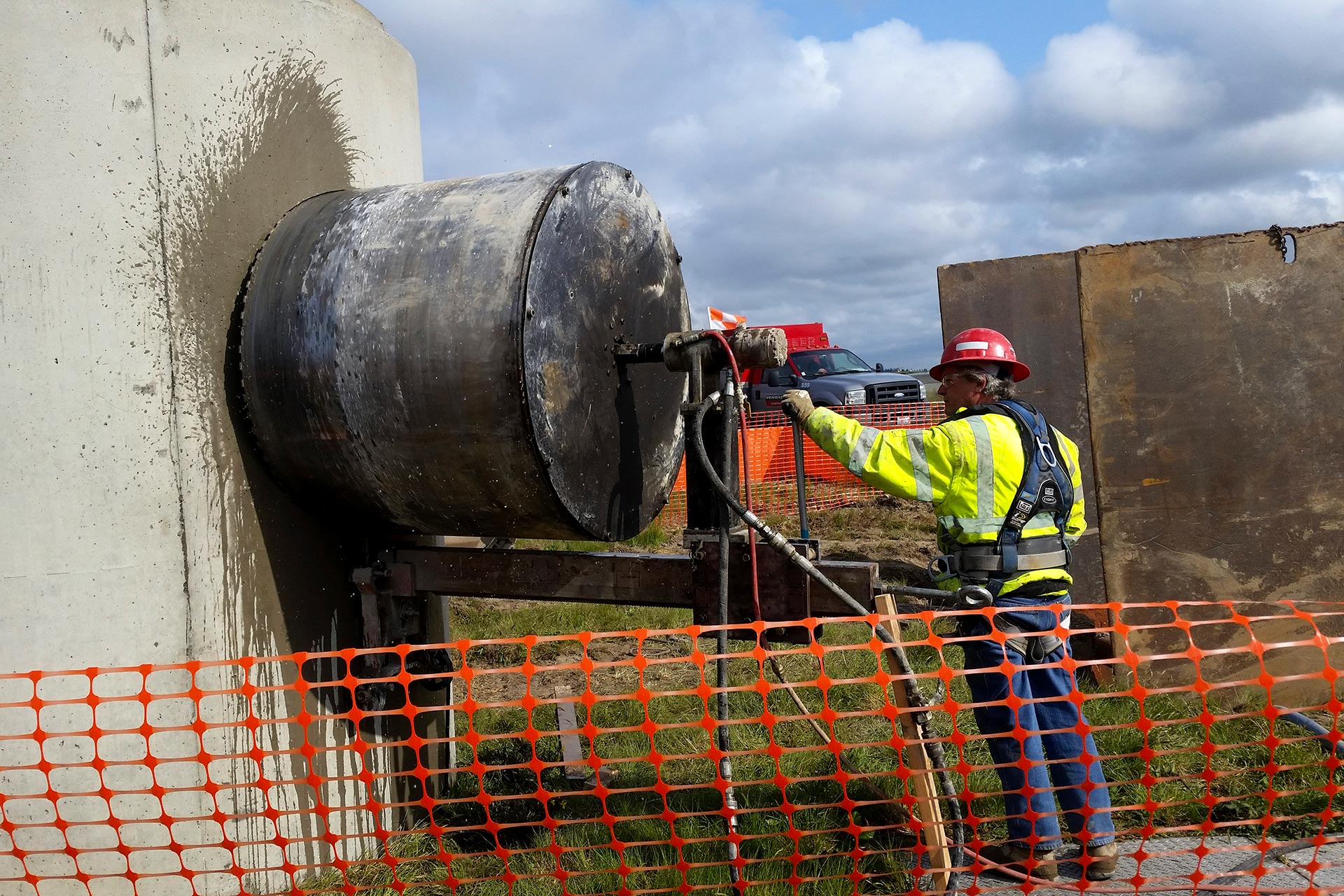
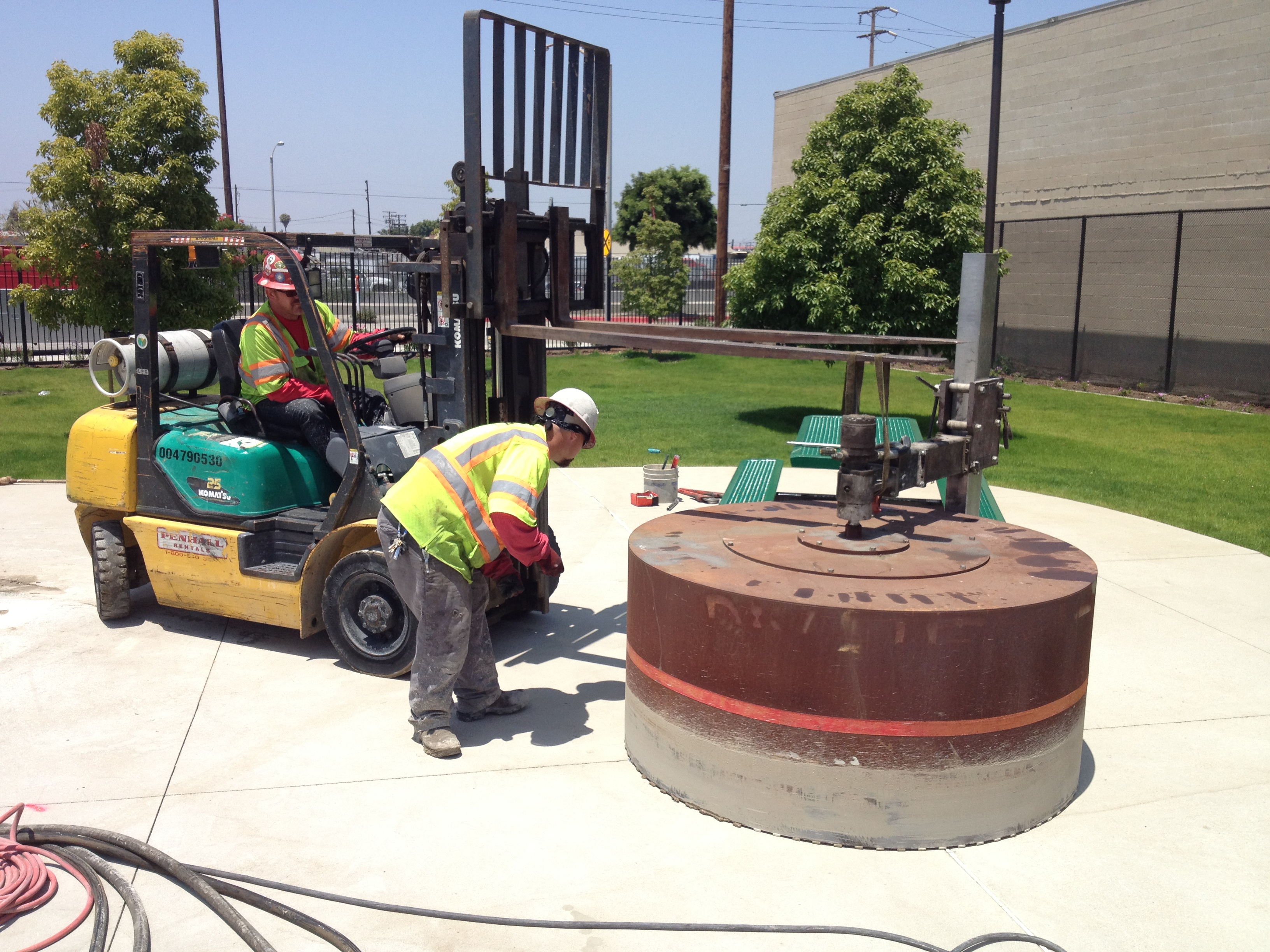
Concrete coring creates circular openings. The output of a core drill is a cylindrical bore through the material, a clean, round penetration of a specific diameter. When you need to run a pipe through a slab, install a floor drain, create a penetration for an anchor bolt, or extract a test sample to verify concrete compressive strength in the field, the answer is concrete coring.
In practice, the line between the two is occasionally blurred, a series of closely spaced cores can be used to outline a large irregular opening in situations where sawing is not accessible, for example. But in the vast majority of projects, the required shape of the opening is the deciding factor, and it makes the choice straightforward.
Concrete Cutting vs. Concrete Coring: Quick Reference
| Concrete Cutting | Concrete Coring | |
|---|---|---|
| Output shape | Linear cut — straight or curved lines through material | Circular hole — cylindrical penetration through material |
| Primary tool | Diamond blade (flat saw, wall saw, wire saw, hand saw) | Diamond core bit mounted on a drill rig |
| Typical use | Openings, demolition, control joints, slab removal | Utility penetrations, anchors, test cores, drain installations |
| Size range | Blade depth: fraction of an inch to 24+ inches | Diameter: 1 inch to 60+ inches |
| Direction | Horizontal, vertical, or angled linear path | Vertical, horizontal, or angled cylindrical bore |
| Water required | Yes — blade cooling and dust suppression | Yes — bit cooling and slurry management |
| Reinforcement impact | Rebar accelerates blade wear; PT cables require GPR pre-scan | Rebar accelerates bit wear; PT cables require GPR pre-scan |
| Structural removal | Can remove significant material; structural review may apply | Removes a defined cylindrical plug; structural review for larger diameters |
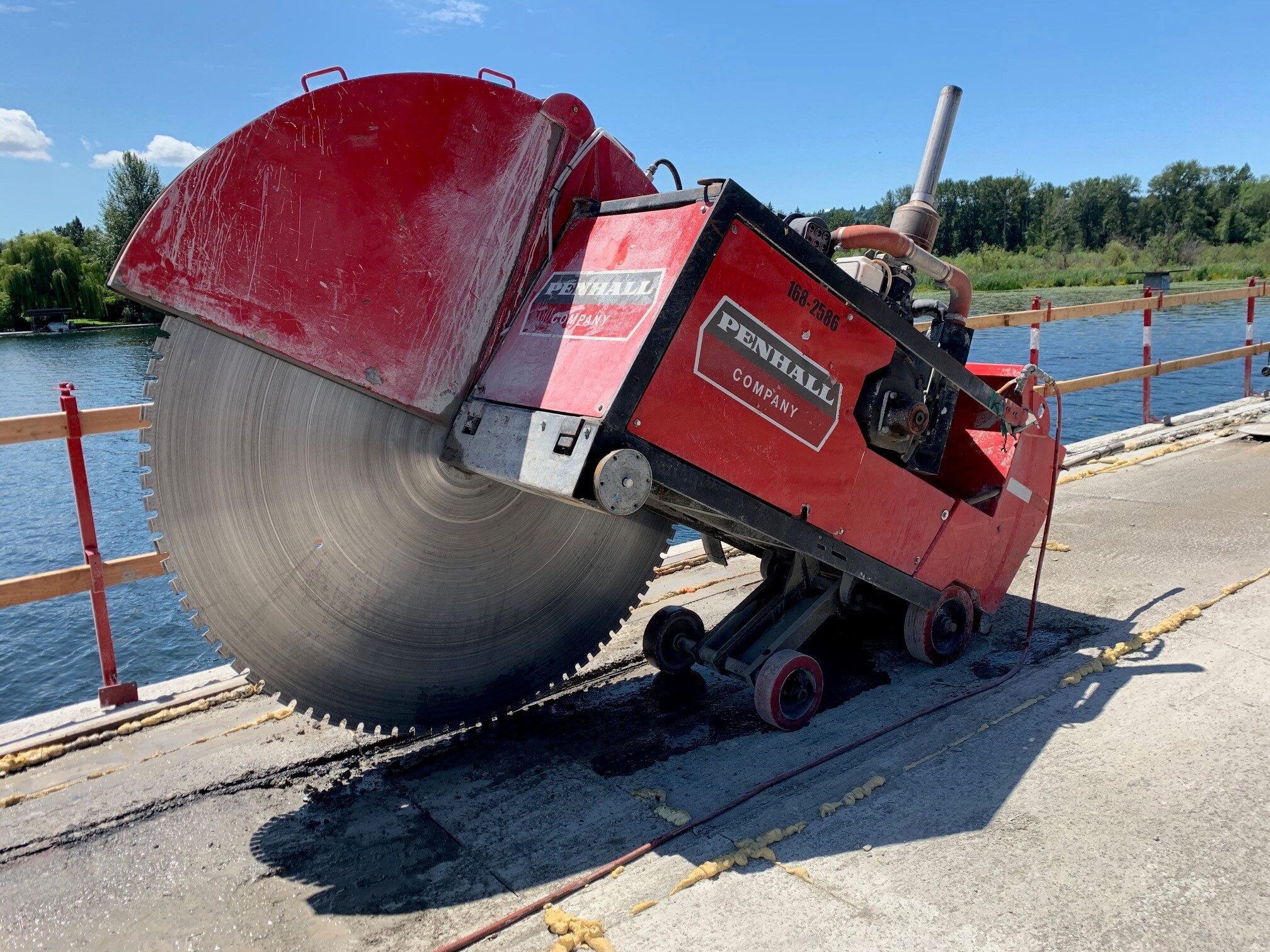
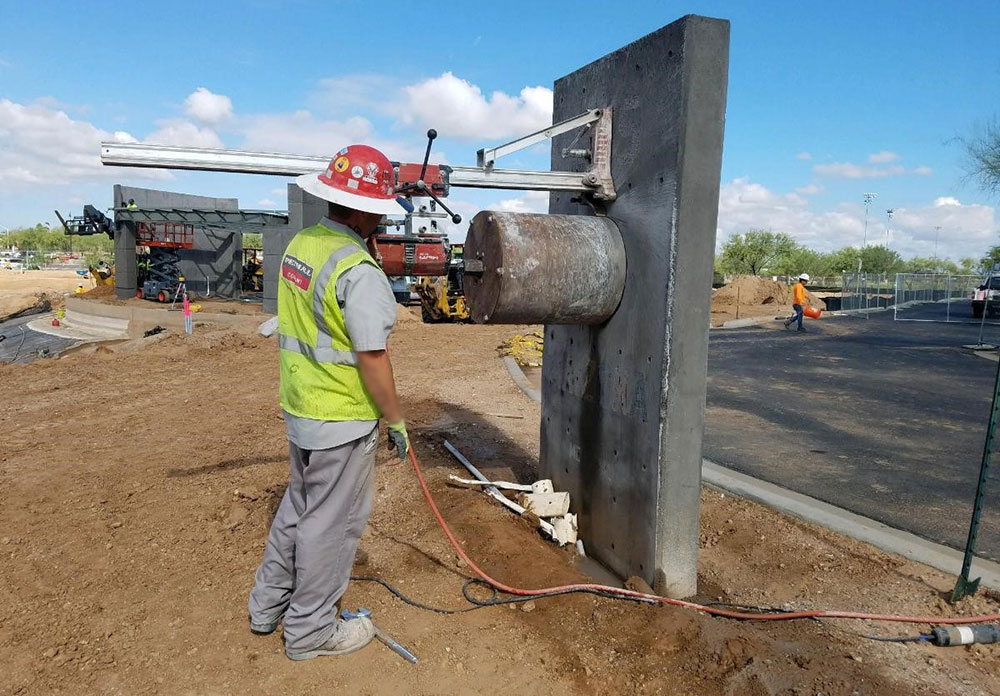
Concrete Cutting, What It Is and When to Use It
Concrete cutting encompasses several distinct sawing methods, each suited to different surface orientations, cutting depths, and project constraints. The unifying feature is the diamond blade: a steel core with diamond-impregnated segments on the cutting edge that grind through concrete, aggregate, and reinforcement. Water is applied continuously to cool the blade and suppress silica dust.
Flat Sawing (Slab Sawing)
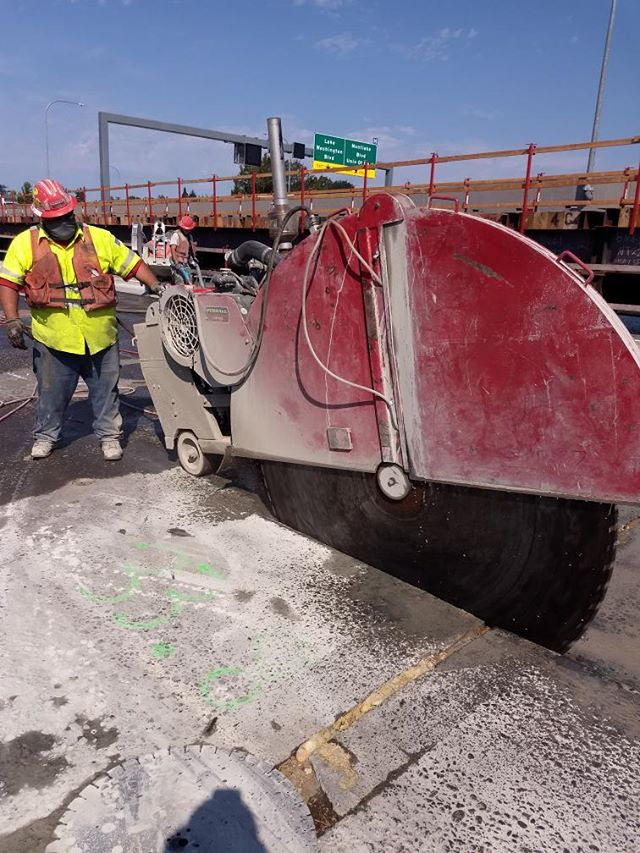
Flat sawing, also called slab sawing, is the most common form of concrete cutting, used to make cuts in horizontal surfaces: floors, slabs-on-ground, pavement, and bridge decks. A walk-behind or ride-on flat saw rides on the concrete surface and plunges the blade to the specified depth.
Flat sawing is used for:
- Installing control joints in fresh concrete slabs
- Removing damaged or deteriorated sections of pavement or flooring
- Creating trenches in slabs for new utility runs
- Cutting slab sections for selective removal or replacement
- Exposing rebar or embedded utilities for repair
Standard flat saws can cut to depths of 13–14 inches in a single pass. Greater depths require multiple passes or a transition to wire sawing. Flat sawing is priced per linear foot, with cost driven primarily by concrete thickness, PSI, and reinforcement density.
Wall Sawing
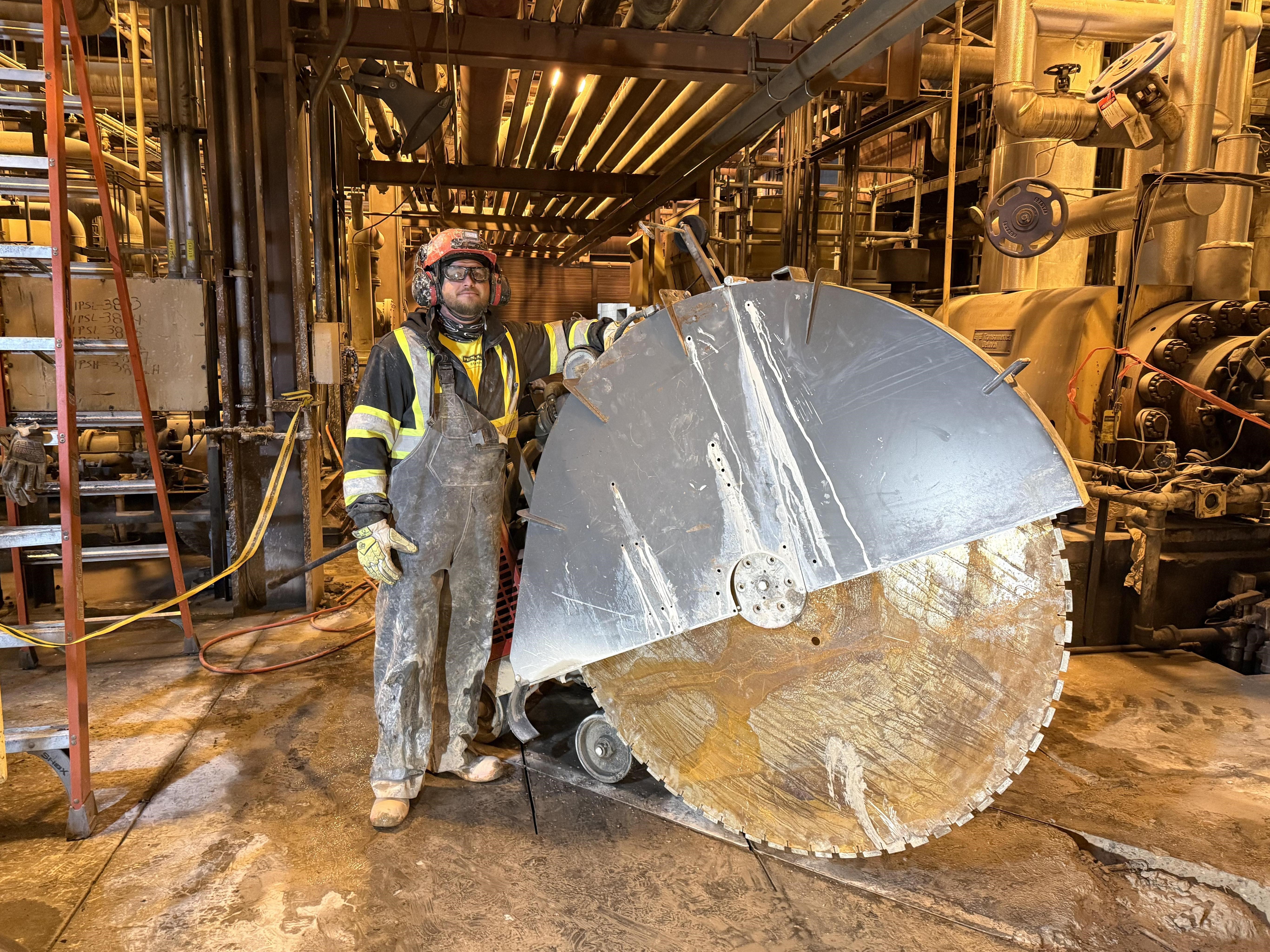
Wall sawing uses a diamond blade mounted on a track that is fixed to the vertical or overhead surface being cut. The saw travels along the track, making precise cuts in walls, columns, bridge piers, elevated slabs, and any other surface that cannot be accessed by a floor-based flat saw.
Wall sawing is used for:
- Creating door, window, and equipment openings in concrete walls
- Cutting openings in elevated slabs for new mechanical or structural penetrations
- Removing sections of concrete wall or column for demolition or renovation
- Precise cuts in bridge piers, abutments, and other infrastructure elements
Wall sawing requires more setup than flat sawing, the track must be anchored to the surface, and the saw must be positioned and calibrated, and it commands a higher per-linear-foot rate as a result. Maximum cut depth varies by equipment, but most wall saws can achieve depths of 24 to 30 inches or more with appropriately sized blades.
Wire Sawing
Wire sawing uses a continuous loop of diamond-impregnated wire, threaded through a series of guide pulleys and driven at high speed around the material being cut. Unlike blade-based saws, wire sawing has virtually no depth or size limitation, the wire can be configured to cut through virtually any thickness or geometry, including cuts that a blade cannot reach.
Wire sawing is used for:
- Large-scale concrete removal where blade depth is insufficient
- Cutting through massive structural elements: bridge piers, dam sections, foundations
- Complex cuts in confined geometries where a blade saw cannot be positioned
- Full-depth cuts through thick walls or slabs in a single pass
- Precision cutting in sensitive environments where vibration must be minimized
Wire sawing is the highest-cost cutting method on a per-linear-foot basis, but it is often the only viable option for the applications listed above. Its ability to cut any thickness, in virtually any orientation, and with minimal vibration makes it indispensable on major infrastructure and industrial projects.
Hand Sawing
Hand sawing uses a hand-held diamond blade saw, essentially a purpose-built concrete saw operated manually, to make cuts in locations where larger equipment cannot be positioned. It is used for shallow cuts, tight spaces, detail work, and areas with low overhead clearance.
Hand sawing is generally limited to depths of 5–6 inches or less, depending on the blade diameter. It is slower than machine-mounted sawing and more physically demanding on the operator. It is used primarily for supplemental cuts, detail work at the edges of larger machine-sawn cuts, and small scopes in confined areas where other methods are impractical.
When Concrete Cutting Is the Right Choice
Choose concrete cutting when the project requires any of the following:
- A straight-edged or geometrically defined opening in a slab, wall, or structural member
- Linear trench cuts for utility installation or repair
- Control joint installation in fresh or hardened concrete
- Removal of a defined section of slab or pavement
- Saw cutting to expose rebar, embedded utilities, or subsurface conditions
- Demolition cuts to separate structural elements prior to removal
- Any project where the required output is a line, a slot, or a polygon, not a circle
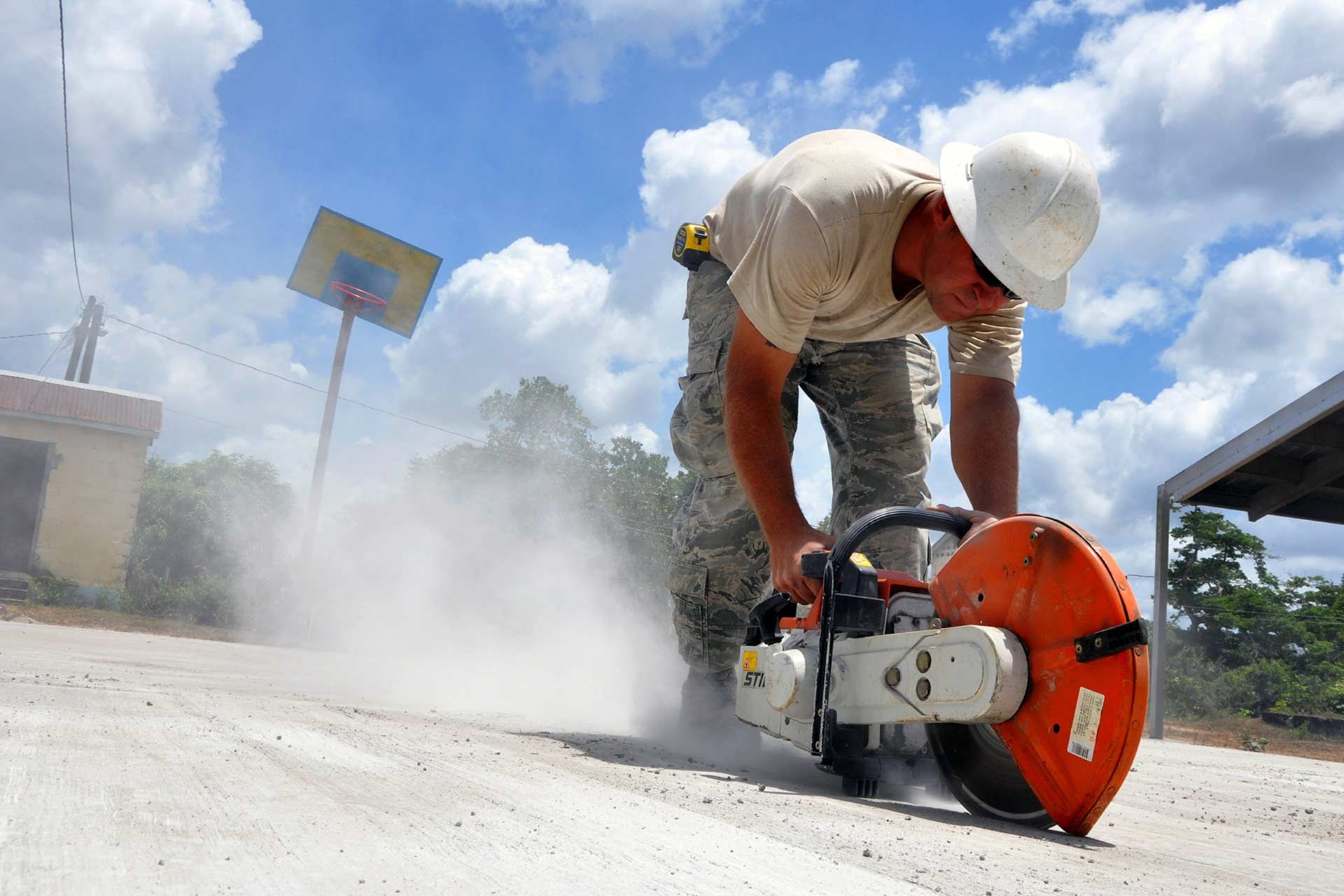
Concrete Coring, What It Is and When to Use It
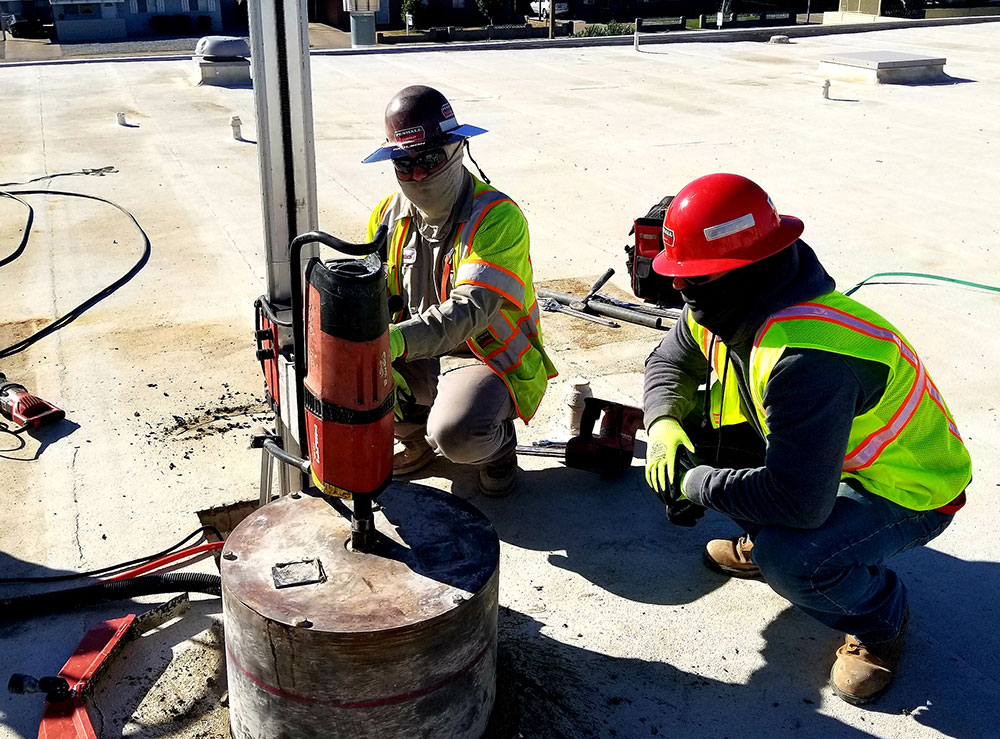
Concrete coring uses a hollow diamond-tipped core bit, mounted on a drill rig, to cut a clean cylindrical hole through concrete. The drill rig is anchored to the surface (usually with a vacuum base or mechanical anchor) to maintain precise position and consistent downward pressure throughout the drilling cycle. Water is fed to the bit continuously for cooling and slurry management.
The result is a clean, round penetration with smooth walls, the geometry required for pipe fittings, conduit sleeves, drain bodies, anchor bolt templates, and other round components. The concrete plug removed by the core bit can be extracted and, if needed, submitted as a test sample for compressive strength or petrographic analysis.
Core Diameter Range
Core bit diameters range from approximately 1 inch to 60 inches or more. This gives coring extraordinary versatility across application types:
- 1–2 inch cores: anchor bolt locations, small conduit penetrations, material test samples
- 3–6 inch cores: standard utility penetrations (electrical, data, small-diameter plumbing)
- 6–12 inch cores: medium-diameter pipe penetrations, HVAC sleeve installations, floor drains
- 12–24 inch and larger cores: large-diameter pipes, manhole frames, structural test samples, specialty penetrations
Core diameter is the single most immediate driver of concrete coring cost. Larger diameters require larger, more expensive bits, greater drill rig capacity, slower penetration rates, and more operator effort to manage the slurry volume generated.
Core Depth and Orientation
Core drilling can be performed vertically (through horizontal slabs), horizontally (through walls), or at any angle required by the geometry of the penetration. Drill rigs are designed to be repositioned and anchored in any orientation. Angled cores, those drilled at a non-perpendicular angle to the surface, require careful setup and are more time-consuming than standard perpendicular drilling.
Core depth is limited primarily by the length of the core barrel and the capacity of the drill rig to maintain straight, consistent alignment over longer penetrations. For very deep cores through thick walls, multiple core barrel extensions may be required, adding setup time and cost.
Test Coring
One specialized application of concrete coring is the extraction of test cores for structural analysis. A 4-inch diameter core extracted from a slab or beam can be submitted to a laboratory for compressive strength testing (ASTM C42), petrographic analysis, chloride content testing, or other analyses that inform structural assessment and repair planning.
Test coring is common in bridge deck rehabilitation, parking structure condition assessments, and post-incident structural investigations. The cylindrical plug extracted by the core drill is the test specimen, its integrity during extraction is critical, which is why core bit condition, drill rig stability, and operator technique all affect the quality of the sample.
When Concrete Coring Is the Right Choice
Choose concrete coring when the project requires any of the following:
- A round penetration for a pipe, conduit, drain, or other circular component
- An anchor bolt location requiring a precise-diameter hole
- A structural or material test sample for laboratory analysis
- A circular opening in a wall or slab where blade access is limited
- A clean-edged penetration where saw cutting would produce an irregular shape
- A penetration through a post-tensioned slab where the exact location must be confirmed by GPR and strategically positioned between PT tendons
- Any project where the required output is a clean, round, cylindrical hole, not a line
When to Use Both Cutting and Coring on the Same Project
Concrete cutting and coring are complementary methods, and many projects require both. Understanding how they work together, and how combining them in a single mobilization affects cost, is valuable for anyone planning or estimating concrete work.
Mechanical and Electrical Room Buildouts
A typical mechanical room installation in a commercial building might require coring through the slab above for pipe and conduit penetrations (coring, multiple diameters), saw cutting to create a new equipment access opening in the adjacent concrete wall (wall sawing), and flat sawing to trench the slab for below-grade drainage (flat sawing). All three methods, two cutting types and coring, are performed in the same space, often in close sequence.
Parking Structure Rehabilitation
Parking structure repair projects commonly combine test coring at representative locations to assess concrete condition (2–4 inch diameter cores for lab analysis), flat sawing to remove deteriorated slab sections and install control joints, and coring for new drain installation or anchor bolt placement. The coring informs the scope; the sawing executes the repair.
Bridge Deck Work
Bridge deck rehabilitation often involves test coring to assess delamination depth and concrete condition, followed by flat sawing or hydrodemolition to remove deteriorated concrete, and then coring for new anchor systems, drainage improvements, or instrumentation installation. Wire sawing may also be required for full-depth section removal at severely deteriorated areas.
New Construction Coordination
In new construction, cutting and coring are often required after concrete is placed to accommodate field changes: penetrations that weren’t sleeved during formwork (coring), openings that need to be enlarged or added after the pour (wall or flat sawing), and control joints that weren’t formed during placement (flat sawing). This is one of the most common scenarios where both services are needed on a single job site within a short time window.
The Mobilization Advantage of Combining Scope
Mobilization costs, travel, equipment transport, setup, are fixed regardless of scope. A crew that can perform both cutting and coring eliminates the need for two separate mobilizations. If your project requires both services, scheduling them together in a single visit is almost always the most cost-efficient approach. Penhall’s crews are equipped and trained for both methods, making combined-scope projects straightforward to coordinate.
Choosing the Right Method: Common Scenarios
“I need to run a 6-inch pipe through my concrete floor.”
Coring. A 6-inch pipe requires a clean, round penetration. Core an 8-inch hole (pipe diameter plus clearance for sleeve and sealant), position it using a GPR scan to avoid rebar and utilities, and you have a clean installation path.
“I need to create a doorway in this concrete wall.”
Cutting, specifically wall sawing. A doorway is a rectangular opening defined by straight cuts. A wall saw mounted on a track makes precise vertical and horizontal cuts to define the opening. The concrete panel is then removed, typically assisted by flat-saw relief cuts or hand saw detail work at corners.
“I need to remove a 10-by-10-foot section of this parking deck.”
Cutting, flat sawing to define the perimeter cuts, followed by a breaking or lifting operation to remove the slab section. If the slab is post-tensioned, a GPR scan is required first, and the PT tendons in the removal zone must be addressed per structural engineering guidance before sawing begins.
“My contractor says he doesn’t know if this slab is post-tensioned.”
Stop. Do not cut or core until a GPR scan confirms what is inside the slab. This applies whether you are cutting or coring. The consequences of cutting through an undetected PT cable are severe. A scan takes minutes and resolves the uncertainty completely.
“I need to install 40 anchor bolts through this concrete floor.”
Coring, small-diameter cores (typically 1–1.5 inch diameter) at each anchor location. Forty cores of the same diameter in the same facility is a highly efficient operation once the drill rig is set up and the locations are confirmed by GPR scan.
“I have a large concrete structure that needs to be partially demolished and the saw can’t reach the cutting plane.”
Wire sawing or a combination of wire sawing and coring. Wire sawing can access cutting planes that blade saws cannot reach, at virtually any depth or geometry. For very large or complex structural demolition, wire sawing is often the only method that can accomplish the cut.
The Role of GPR Scanning in Cutting and Coring Decisions
Regardless of whether a project requires cutting, coring, or both, the decision about where to cut or core is inseparable from knowledge of what is inside the concrete. Rebar density affects tooling cost for both methods. Post-tension cables are a life-safety concern for both. Embedded utilities, electrical conduit, plumbing, gas lines, data cables, create hazards that are equally relevant to a diamond blade and a core bit.
A GPR concrete scan performed before any cutting or coring begins provides the subsurface intelligence needed to plan work safely, position cuts and cores to avoid reinforcement and utilities, price the work accurately, and prevent costly and dangerous surprises in the field. Penhall offers GPR scanning as a standard pre-work service and recommends it before virtually every cutting and coring project, regardless of size or apparent simplicity.
The cost of a GPR scan is negligible compared to the cost of hitting an undetected PT cable, severing a live electrical line, or breaching a pressurized plumbing system. On any project where the concrete’s interior is unknown, scanning is not optional, it is the first step.
Penhall’s Concrete Cutting and Coring Services
Penhall Company provides both concrete cutting and concrete coring services across North America, backed by over 65 years of concrete industry experience and the equipment depth to handle any reinforcement condition, access constraint, or project scale.
Penhall’s integrated service offering means that projects requiring both methods can be executed under a single contract, with a single crew, in a single mobilization, eliminating coordination overhead and reducing total project cost. Penhall’s broader capabilities include:
GPR concrete scanning: pre-work scanning to locate rebar, PT cables, embedded utilities, and voids before any cutting or coring begins.
Hydrodemolition: high-pressure water concrete removal for bridge deck rehabilitation, parking structure repair, and other large-scale concrete removal where saw cutting is not the optimal method.
Selective demolition: controlled removal of reinforced concrete elements, including post-tensioned structures, with full structural coordination.
Structural repair: concrete restoration and repair services, including FRP strengthening, following cutting, coring, or demolition work.
With locations across the country, Penhall can mobilize quickly for projects in any region. Whether your project calls for concrete coring vs. concrete cutting, or both, Penhall has the equipment, experience, and safety program to execute it correctly.