At a Glance
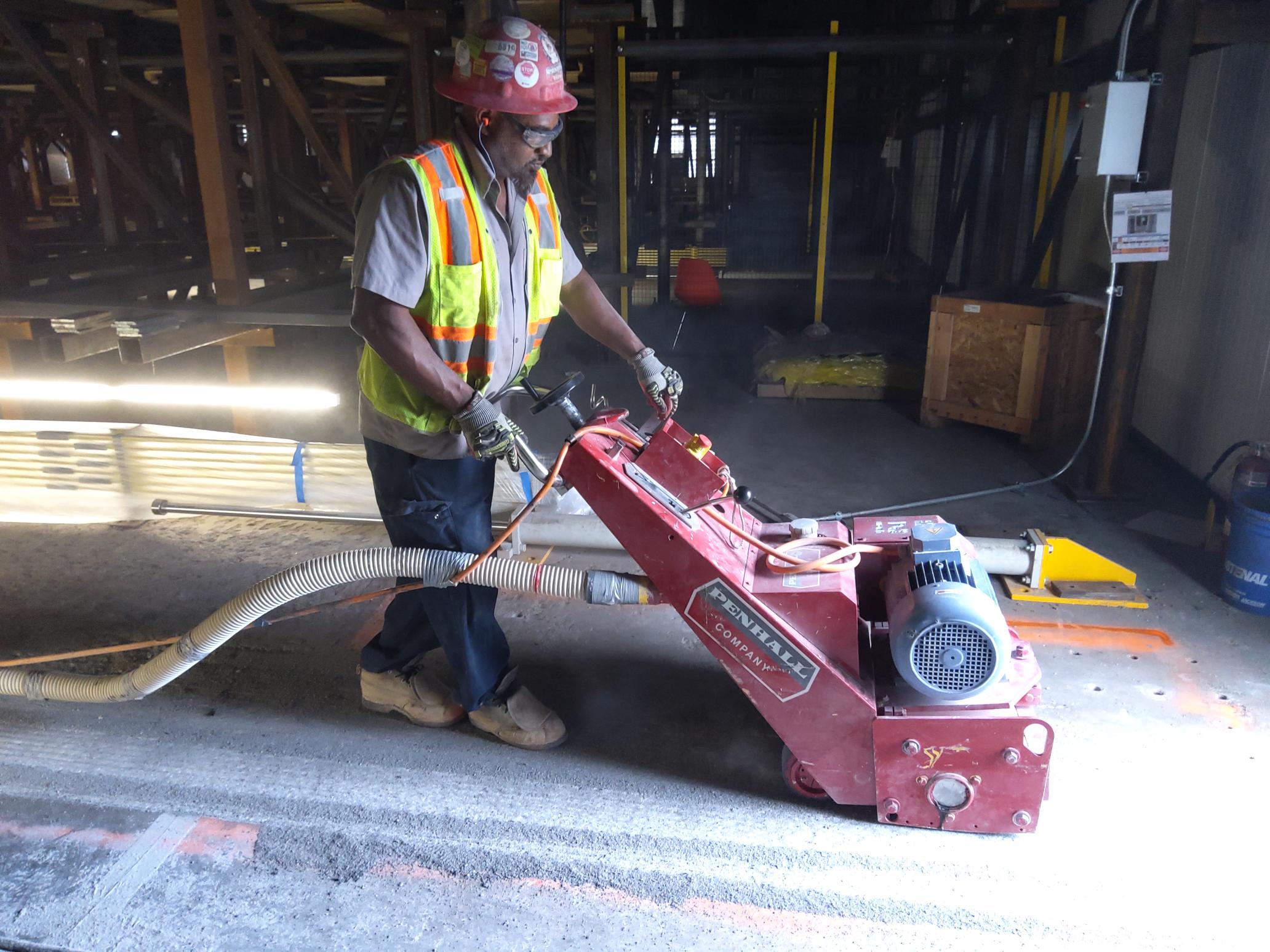
Concrete scarifying is a mechanical surface preparation method that uses a rotating drum fitted with hardened steel cutters, flails, or carbide-tipped teeth to aggressively mill the top layer of a concrete surface, removing coatings, adhesives, laitance, contamination, and deteriorated material.
Scarifying concrete produces one of the most aggressive surface profiles available from a mechanical preparation method, rated CSP 4 to 9 on the ICRI Concrete Surface Profile scale, the roughness required for thick overlays, high-build coatings, and heavy-duty repair mortars.
It is the method of choice when standard grinding or shot blasting cannot remove the material or achieve the profile depth required, particularly for thick epoxy coatings, stubborn adhesive residue, failed overlays, and carbonated or contaminated surface layers.
Concrete surface preparation is not optional, it is the single most important step in any overlay, coating, or repair project. Without a properly prepared, open-pore substrate at the specified CSP, even the best repair materials and coatings will delaminate prematurely.
Scarifying generates significant dust and requires effective dust collection. Job site dust management planning is a non-negotiable part of any scarifying scope.
Penhall Company provides professional concrete surface preparation services, including scarifying, grinding, and hydrodemolition, as part of a full-service offering that includes concrete cutting, coring, scanning, and structural repair.
Why Concrete Surface Preparation Is the Foundation of Every Repair
There is a saying in the concrete repair industry: the repair is only as good as the substrate it is bonded to. This is not a figure of speech. It is the mechanical reality of how overlay systems, coatings, sealers, and repair mortars work.
All of these materials bond to concrete through a combination of mechanical interlock and chemical adhesion. Mechanical interlock requires a surface with sufficient texture and open pores to allow the repair material to penetrate, anchor, and grip. Chemical adhesion requires a surface that is free of contamination, oil, grease, laitance, carbonation, existing coatings, that would create a weak boundary layer between the repair material and the concrete.
When either of these conditions is not met, delamination is not a possibility, it is a certainty. The only question is how soon. A coating applied over an unprepared slab may look perfect on day one. By month three, it is peeling. A repair mortar placed over laitance may pass initial testing. Within a year, it is popping off in sheets. In both cases, the failure was predetermined at the moment the preparation step was skipped or done inadequately.
This is why concrete surface preparation is not a preliminary step that gets scheduled when there is time, it is the step on which everything else depends. And among the range of available surface preparation methods, scarifying concrete occupies a critical niche: it is the method that can do what grinding and shot blasting cannot when the material to be removed is thick, bonded, or mechanically resistant, and when the required surface profile is aggressive.
What Is Concrete Scarifying?
Concrete scarifying, also called concrete planing, milling, or rotary cutting, is a mechanical surface preparation process in which a powered rotating drum, fitted with multiple rows of hardened steel cutting elements, is driven across the concrete surface to aggressively cut, mill, and abrade the top layer.
The cutting action is fundamentally different from grinding or shot blasting. Where diamond grinding uses abrasion to smooth and open the surface, and shot blasting uses kinetic impact to peen and fracture it, scarifying uses direct mechanical cutting: the teeth or flails on the rotating drum strike and cut into the concrete surface repeatedly at high speed, fragmenting and ejecting the material in their path.
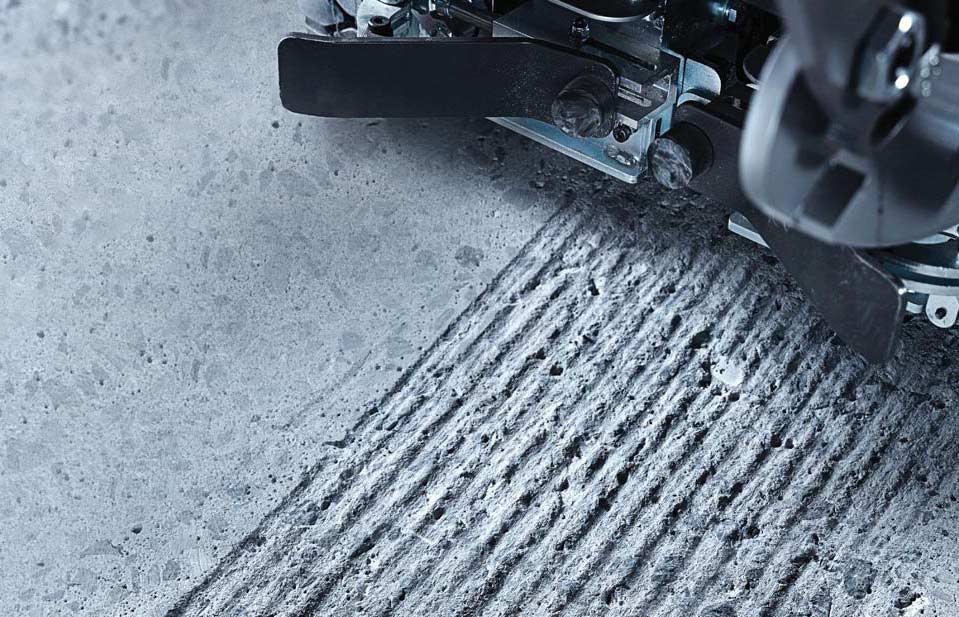
The result is a deeply textured, highly irregular surface profile with peaks and valleys that provide exceptional mechanical interlock for overlay materials and repair mortars. The surface looks rough and aggressive, because it is. That roughness is precisely the point.
How a Concrete Scarifier Works
A concrete scarifier, sometimes called a milling machine, planer, or rotary cutter, consists of the following key components:
- Cutting drum: a steel cylinder mounted horizontally across the width of the machine, driven at high rotational speed by the engine. The drum holds the cutting elements and is the heart of the machine.
- Cutting elements: hardened steel cutters, carbide-tipped flails, or star-wheel assemblies mounted on the drum in staggered rows. As the drum rotates, each cutter strikes the concrete surface in rapid succession. The type and configuration of cutting elements determines the aggressiveness of the cut, the surface profile produced, and the rate of material removal.
- Depth adjustment: the drum height is adjustable, controlling how deeply the cutting elements penetrate the surface. Typical removal depths range from 1/16 inch to 1/2 inch per pass. Multiple passes can remove more material.
- Dust collection: scarifying generates large volumes of airborne concrete dust. Professional scarifiers are equipped with integral shrouds and vacuum systems that capture dust at the source. Supplemental HEPA-filtered vacuum units are commonly used on enclosed job sites to meet OSHA silica exposure regulations.
- Drive system: scarifiers are available in walk-behind and ride-on configurations, with electric or gasoline/diesel power. Walk-behind units handle tight spaces and smaller areas; large ride-on machines cover broad floor areas efficiently.
As the machine advances across the floor, the rotating drum cuts parallel grooves into the concrete surface. The pattern of these grooves, their depth, width, and spacing, is determined by the cutter configuration. Overlapping passes in multiple directions can produce a more uniform texture for applications requiring a consistent profile across the entire surface.
Types of Cutting Elements
The cutting elements fitted to the drum are the most directly influential variable in the surface profile produced. The three main types used in concrete scarifying are:
- Star-wheel cutters (flails): multi-pointed star-shaped carbide-tipped cutters that rotate freely on spindles along the drum. They produce a highly aggressive, irregular profile and are the most common configuration for heavy concrete scarifying. The free rotation of each flail allows them to ride over hard aggregate rather than shattering, extending cutter life while maintaining aggressive material removal.
- Tungsten carbide tipped (TCT) cutters: fixed or semi-fixed carbide-tipped cutting discs that produce a more uniform groove pattern. Used when a more controlled, consistent profile is required, such as preparation for precision overlays or anti-slip texture applications.
- Milling bits (drum-style): larger carbide-tipped point-attack tools similar to those used in asphalt milling equipment, adapted for concrete. Used on large-scale ride-on machines for high-production material removal on bridge decks, pavements, and industrial floors.
What Concrete Scarifying Removes
Scarifying is particularly effective at removing materials and surface conditions that resist gentler preparation methods. The following are the most common targets:
Coatings and Adhesives
Thick epoxy coatings, urethane floor finishes, rubber-based adhesives, tile adhesive (mastic), and bituminous waterproofing membranes are among the most challenging materials to remove from concrete surfaces. These materials often bond tenaciously to the concrete and are too thick or too resilient for diamond grinding or shot blasting to remove effectively.
Scarifying cuts through these materials mechanically, lifting them from the surface in fragments. The cutting action is not dependent on the brittleness of the material being removed, it works on tough, flexible coatings as effectively as on brittle ones. This makes scarifying the method of choice for coating removal projects where other methods have been tried and failed or are known to be inadequate.
Laitance and Carbonation
Laitance is a weak, chalky layer of fine cement particles and water that rises to the surface during concrete placement and finishing. It is essentially the weakest part of the entire slab, a layer with low strength, low density, and high porosity that will prevent any overlay or coating from bonding properly to the sound concrete beneath it.
Carbonation is the process by which atmospheric carbon dioxide reacts with calcium hydroxide in the concrete near the surface, forming calcium carbonate. Carbonated concrete is chemically different from the deeper matrix and can reduce the alkalinity of the surface, affecting the cure behavior of cementitious repair materials applied over it.
Both laitance and carbonation must be removed before any repair or overlay work. Scarifying is one of the most effective methods for doing so, cutting through and ejecting the weak surface layer to expose the sound concrete beneath.
Contamination: Oil, Grease, and Chemical Residue
Industrial and commercial floors, in manufacturing plants, vehicle maintenance facilities, food processing facilities, and warehouses, are routinely contaminated with oils, greases, hydraulic fluids, chemical spills, and other substances that penetrate the concrete surface. These contaminants create a bond-breaking layer that prevents adhesion of coatings and repair materials.
Scarifying physically removes the contaminated surface layer, eliminating the contamination along with the concrete it has penetrated. In severe contamination cases, multiple passes may be required to remove the contaminated zone entirely. Chemical decontamination treatment may also be needed as a follow-up step, depending on the depth of penetration and the nature of the contaminant.
Deteriorated and Delaminated Surface Concrete
Spalled, delaminated, or structurally weakened surface concrete must be removed before repair materials are placed. Leaving weak or delaminated concrete in place and placing repair material over it is analogous to painting over a rust spot without treating the rust, the repair will fail at the weakest link.
Scarifying can remove deteriorated surface concrete efficiently over large areas, preparing the substrate for repair mortar, overlay systems, or further treatment. For more severe or deeper deterioration, hydrodemolition may be the more appropriate method, as it selectively removes weaker concrete while preserving sound material and does not introduce the micro-impact damage that mechanical scarifying can cause in already-compromised substrates.
Trip Hazards and Surface Irregularities
Minor surface irregularities, raised joints, and slight humps in concrete flatwork can create trip hazards for pedestrians and equipment operators. Scarifying, and its close relative, concrete planing, can level these irregularities by removing the high spots, restoring a safer, flatter surface profile. This is a common application in warehouse and industrial floors before the installation of new floor coatings or overlays.
Understanding Concrete Surface Profile (CSP)
The single most important measurable output of any concrete surface preparation process is the surface profile, the three-dimensional texture of the prepared surface, characterized by the height difference between peaks and valleys across the surface.
The International Concrete Repair Institute (ICRI) has developed a standardized scale called the Concrete Surface Profile (CSP) system, which classifies prepared surfaces on a scale from CSP 1 to CSP 10:
- CSP 1–2: very light profiles produced by acid etching, light grinding, or fine abrasive blasting. Suitable for penetrating sealers, thin-film coatings, and densifiers.
- CSP 3–4: moderate profiles produced by grinding, light shot blasting, or light scarifying. Suitable for thin-mil coatings, self-leveling overlays, and light-traffic floor systems.
- CSP 5–6: aggressive profiles produced by shot blasting, scarifying, or milling. Required for high-build coatings, broadcast epoxy systems, and medium-depth repair mortars.
- CSP 7–9: very aggressive profiles produced by heavy scarifying, heavy milling, or hydrodemolition. Required for thick overlays, structural repair mortars, heavy-duty polymer concrete, and full-depth repair systems.
- CSP 10: extreme profile from heavy hydrodemolition or aggressive demolition. Used for the thickest overlay systems and structural concrete replacement.
Scarifying concrete typically produces profiles in the CSP 4 to 9 range, depending on cutter configuration, drum speed, forward speed, and number of passes. This puts it among the most capable methods for achieving the aggressive profiles required by high-performance flooring systems and structural repair specifications.
Matching preparation method to the required CSP is not optional, it is specified. Overlay and coating manufacturers publish minimum required CSP values for their products. Installing a coating system over an inadequate surface profile voids the manufacturer’s warranty and virtually guarantees premature failure. Specifying the correct method requires knowing both the required CSP and the condition of the existing surface.
Concrete Surface Preparation Methods Compared
Scarifying is one of several mechanical concrete surface preparation methods. Understanding how they compare helps in selecting the right approach for each project:
| Method | Material Removal | Surface Profile | Best For | Limitations |
|---|---|---|---|---|
| Scarifying | Moderate–heavy | CSP 4–9 (aggressive) | Thick coating removal, failed overlays, high-build prep | High dust; aggressive profile may need grinding to refine |
| Shot blasting | Light–moderate | CSP 2–6 (controllable) | Large open floor areas, warehouse prep, coating adhesion | Less effective on coatings; round shot profile less aggressive |
| Diamond grinding | Light | CSP 1–3 (fine) | Flatness correction, light coating removal, polish prep | Limited material removal; not suitable for heavy overlays |
| Hydrodemolition | Heavy | CSP 6–9 (very aggressive) | Bridge decks, large-scale rehab, rebar cleaning | Water management required; specialized equipment |
| Milling / planing | Heavy | CSP 5–8 (aggressive) | Pavement, bridge decks, high-speed large-area removal | Rough profile; finish grinding often required |
| Acid etching | Light | CSP 1–3 (fine) | Residential and light commercial, smooth slabs | Chemical handling; not reliable on contaminated surfaces |
When to Use Concrete Scarifying
Scarifying concrete is the right choice in specific scenarios. It is not the universal answer to every surface preparation need, it is the appropriate tool when the work demands its particular combination of aggressive material removal and high surface profile.
Thick or Tenacious Coating Removal
When the material to be removed is thick, bonded, or resistant, heavy epoxy coatings, rubber-based adhesives, tar-backed vinyl tile, bituminous membranes, polyurethane traffic coatings on parking decks, scarifying is often the only mechanical method that can remove it efficiently. Shot blasting can struggle with thick, flexible coatings that absorb the impact energy of the shot. Diamond grinding may clog or glaze in adhesive residue. Scarifying cuts through these materials regardless of their toughness or bond strength.
Failed or Contaminated Overlays
When a previous overlay system has failed and must be removed, whether due to delamination, contamination of the original substrate, or simply age, scarifying provides the combination of material removal capacity and surface profile creation needed to both strip the old system and prepare the substrate for the new one in a single operation. This is one of the most common renovation scenarios in industrial and commercial flooring.
Heavy Industrial Floor Preparation
High-performance floor systems in food processing facilities, pharmaceutical plants, heavy manufacturing, and chemical processing environments require exceptionally well-prepared substrates. The combination of aggressive contamination, demanding service conditions, and the high cost of floor system failures makes thorough surface preparation a priority. Scarifying’s ability to remove contaminated surface concrete, open the pore structure, and achieve high CSP values makes it the preparation method of choice for these environments.
Bridge Deck and Parking Structure Surface Preparation
On bridge decks and parking structures, waterproof membrane systems and traffic-bearing overlays must bond to concrete that has been contaminated by deicing chemicals, exposed to chloride-driven corrosion, and subjected to heavy vehicle loads. The surface preparation requirements for these systems are demanding, and the consequence of failure, water infiltration, rebar corrosion, structural deterioration, is severe.
Scarifying is used for surface preparation on bridge decks and parking structures when the deterioration is limited to the surface layer and the objective is to create a bonding profile for membrane or overlay application. When deterioration is more extensive, involving delamination, corrosion around rebar, or deep chloride contamination, hydrodemolition is typically the preferred method, as it selectively removes deteriorated concrete to the depth required without damaging the surrounding sound material.
Skid Resistance Restoration
Concrete surfaces in pedestrian areas, ramps, loading docks, and vehicle lanes can become dangerously slippery as the original surface texture wears smooth under traffic. Scarifying restores skid resistance by cutting a new textured profile into the surface, creating consistent surface roughness that improves traction for both pedestrians and vehicles. This is a common maintenance application in parking structures, airport terminals, and industrial facilities.
When Scarifying Is Not the Right Choice
Scarifying is not appropriate for every surface preparation scenario. It should not be used when:
- A fine surface profile (CSP 1–3) is specified, such as for penetrating sealers, densifiers, or polished concrete systems, scarifying creates too aggressive a profile for these applications.
- The concrete substrate is severely deteriorated, delaminated, or structurally compromised, the impact of scarifying cutters can extend the damage zone rather than limiting it. Hydrodemolition or selective demolition is more appropriate in these conditions.
- Tight geometric constraints make machine access impossible, scarifiers require a minimum clearance envelope to operate. Hand-held grinders or other manual methods may be needed for corners, edges, and confined spaces.
- Vibration-sensitive equipment or structures are nearby, scarifying generates significant mechanical vibration and noise that may be unacceptable in certain occupied or sensitive environments.
Dust Management and OSHA Silica Regulations
Concrete scarifying generates large volumes of fine concrete dust, including respirable crystalline silica, the airborne particle that causes silicosis, a serious and irreversible lung disease. OSHA’s Silica Standard for Construction (29 CFR 1926.1153) establishes a permissible exposure limit (PEL) of 50 micrograms per cubic meter of air as an 8-hour time-weighted average, and an action level of 25 micrograms per cubic meter.
For scarifying operations, OSHA’s Table 1 specifies that the required engineering control is a dust collection system, either a vacuum system with HEPA filtration or a wet-suppression method, integrated with the scarifying equipment. Using a properly equipped scarifier with integral shroud and vacuum collection is the baseline compliance requirement.
In practice, effective dust management for scarifying projects includes:
- Integral vacuum shrouds on the scarifier that capture dust at the drum housing as it is generated.
- HEPA-filtered industrial vacuums connected to the scarifier’s shroud, capturing fine particles that would otherwise escape into the work area air.
- Containment barriers and negative air pressure in enclosed spaces to prevent dust migration to adjacent occupied areas.
- Worker respiratory protection (N95 minimum, P100 preferred) during any scarifying operation, even with engineering controls in place.
- Regular air monitoring on longer-duration projects to verify that exposure levels remain below OSHA’s action level.
Contractors who skip or underinvest in dust management on scarifying projects expose workers to a documented occupational health hazard and expose the project to OSHA citations, stop-work orders, and liability. Penhall’s Behavior-Based Safety (BBS) program ensures that dust management is planned and executed as a non-negotiable component of every surface preparation scope.
Scarifying vs. Hydrodemolition: Choosing the Right Removal Method
For large-scale concrete surface preparation and removal, particularly on bridge decks, parking structures, and infrastructure, the choice between mechanical scarifying and hydrodemolition is one of the most consequential decisions in the project planning process.
Scarifying is a fast, dry, highly portable method that works well when the preparation objective is surface profile creation and shallow material removal over a sound concrete substrate. It is the right choice when:
- The removal depth is limited (under 1/2 inch per pass in most applications)
- The substrate beneath the removal zone is sound and can withstand the mechanical impact of the cutting drum
- Dry operations are required or water management is impractical
- The surface to be prepared is accessible to wheeled equipment
Hydrodemolition, high-pressure water concrete removal, is the superior choice when:
- The removal zone extends to or past the rebar layer, requiring selective removal of deteriorated concrete while leaving sound concrete and rebar intact
- The substrate is deteriorated, delaminated, or variable in condition, and mechanical impact would extend rather than limit the damage zone
- A microfracture-free bonding surface is required, hydrodemolition does not create the microfractures in remaining concrete that mechanical scarifying can introduce
- Rebar cleaning is part of the scope, hydrodemolition cleans corroded rebar simultaneously with concrete removal
- The project involves bridge deck rehabilitation where long-term bond strength of the overlay is critical and specifications require the superior bonding surface that hydrodemolition provides
Many large rehabilitation projects use both methods in sequence: hydrodemolition for the primary concrete removal phase, followed by scarifying or grinding to refine the surface profile on the remaining sound concrete before overlay placement.
Penhall’s Concrete Surface Preparation Services
Penhall Company provides concrete surface preparation services as part of a comprehensive suite of concrete cutting, coring, demolition, and structural repair capabilities. Penhall’s surface preparation offering includes scarifying, grinding, and hydrodemolition, with the equipment range and field experience to match the right method to the specific requirements of each project substrate, coating system, and structural condition.
Because Penhall provides the full project workflow, from pre-work GPR scanning through concrete removal and surface preparation to structural repair and restoration, clients benefit from a single contractor who understands how each phase of the project affects the next. The surface preparation method selected at the planning stage affects the adhesion of the overlay placed three weeks later. Getting that decision right from the beginning is what Penhall brings to the project.
Penhall’s Behavior-Based Safety (BBS) program ensures that every surface preparation project, including dust-intensive scarifying operations, is executed with rigorous attention to worker health and job site safety.
With locations across the country, Penhall can mobilize quickly for surface preparation projects of any size or complexity, in any region.