• Skip to main content

CONCRETE CORING COMPANY

GRAFF COMPANY

  • About Us

    ABOUT PENHALL

    Penhall has been the United States' and Canada's go-to concrete services partner since 1957.

    • OUR STORY

    • LEADERSHIP TEAM

    • SAFETY

    • CAREERS

    • RESOURCES

    • FREQUENTLY ASKED QUESTIONS

    • SUSTAINABILITY

    CONTACT PENHALL

    Penhall Trucks

    We've handled projects of all types and sizes, with a track record of excellence going back more than 60 years. Contact us about your next project.

    TALK TO US
  • Services

    CONCRETE SERVICES

    Whether it's coring, flat sawing, wall sawing, or breaking and removal, we pride ourselves in our experience, expertise, top-of-the-line equipment, and unwavering commitment to safety.

    • CONCRETE CORING

    • CONCRETE CUTTING

    • DEMOLITION

    • HYDRODEMOLITION

    • STRUCTURAL REPAIR

    • GRINDING & GROOVING

    • BRIDGE SERVICES

    • SCARIFYING & SHAVING

    • BREAKING & REMOVAL

    • OPERATED EQUIPMENT RENTALS

    TECHNOLOGY SERVICES

    Our technology services provide industry-leading solutions in concrete scanning, private utility locating, digital x-ray imaging and fiber reinforced polymer, ensuring precision, safety, and efficiency.

    • CONCRETE GPR SCANNING

    • CONCRETE X-RAY IMAGING

    • PRIVATE UTILITY LOCATING

    • FIBER REINFORCED POLYMER

    LUNCH AND LEARN WITH PENHALL COMPANY

    Lunch & Learn

    We're excited to offer you an engaging and informative session that will introduce you to our range of services, industry expertise, and innovative solutions. As a leading provider in concrete cutting, coring, and demolition, Penhall Company is committed to delivering top-notch service and exceeding your expectations. Grab your seat, enjoy a delicious meal, and discover how partnering with us can benefit your projects.

    SCHEDULE A LUNCH & LEARN
  • Industries

    OUR PROJECTS

    Penhall Company has had the opportunity to work on some of the most challenging and wide-ranging projects in North America.

    • ALL PROJECTS

    • AVIATION

    • CHURCHES

    • COMMERCIAL

    • DOT / INFRASTRUCTURE

    • EDUCATION

    • ELECTRIC VEHICLE CHARGING

    • GRAFF

    • HEALTHCARE / HOSPITAL

    • HOSPITALITY

    • INDUSTRIAL

    • LOCK / DAM

    • POWER / NUCLEAR

    • RESIDENTIAL

    • WATER / WASTEWATER TREATMENT

    LATEST PROJECT

    Siemens Energy Foundation Demolition

    LOCATION: CHARLOTTE, NC
    SERVICE: WIRE SAWING, DEMOLITION, CONCRETE REMOVAL
    READ MORE
  • Locations
penhall menu logo
  • Careers
  • Contact Us
  • QUOTE REQUEST
  • This field is for validation purposes and should be left unchanged.
  • Site Contact Information

  • (XXX) XXX-XXXX
  •  
  • Job Site Location

  • After submitting this form a Penhall Company representative will be in contact with you to confirm your request. If this request is urgent, please call 1-800-PENHALL to be connected with the nearest Penhall branch. Upon submitting this form you will also receive occasional updates about our services and company announcements. You may unsubscribe from these e-mails at anytime. Grinding and grooving services are conducted by Emery Sapp & Sons, Inc. For specific inquiries related to grinding and grooving, click here or reach out to Chris Fitzpatrick at chris.fitzpatrick@emerysapp.com

  • About Us
    • Our Story
    • Leadership Team
    • Sustainability
  • Safety
  • Services
    • Concrete Services
      • Concrete Coring
      • Concrete Cutting
      • Demolition
      • Hydrodemolition
      • Structural Repair
      • Grinding & Grooving
      • Bridge Services
      • Scarifying & Shaving
      • Breaking & Removal
      • Operated Equipment Rentals
    • Technology Services
      • Concrete GPR Scanning
      • X-Ray Imaging
      • Private Utility Locating
      • Fiber Reinforced Polymer
  • Industries
  • Resources
    • Articles
    • Frequently Asked Questions
  • Contact Us
  • Find a Branch
  • Request a Quote
  • JOIN PENHALL COMPANY
  • Concrete Coring Company
  • Graff Company
×
  • About Us
    • Our Story
    • Leadership Team
    • Sustainability
  • Safety
  • Services
    • Concrete Services
      • Concrete Coring
      • Concrete Cutting
      • Demolition
      • Hydrodemolition
      • Structural Repair
      • Grinding & Grooving
      • Bridge Services
      • Scarifying & Shaving
      • Breaking & Removal
      • Operated Equipment Rentals
    • Technology Services
      • Concrete GPR Scanning
      • X-Ray Imaging
      • Private Utility Locating
      • Fiber Reinforced Polymer
  • Industries
  • Resources
    • Articles
    • Frequently Asked Questions
  • Contact Us
  • Find a Branch
  • Request a Quote
  • JOIN PENHALL COMPANY
  • Concrete Coring Company
  • Graff Company
penhall menu logo

Articles

Diamond Sawcutting

CALL FOR A QUOTE
1-800-736-4255

What Are Concrete Saws?

Concrete saws are specialized power tools used to cut through concrete, asphalt, brick, masonry, and other dense, stone-like materials. They are a core piece of concrete cutting equipment on commercial, industrial, and infrastructure job sites where precision, depth control, and safety matter.
Concrete cutting saws come in several sizes and configurations depending on the application. Handheld saws are often used for smaller openings and detail work, while walk-behind concrete saws are designed for flatwork such as slabs, roadways, and bridge decks. Track-mounted and remote-controlled saws are used for highly controlled or hazardous cutting environments where accuracy and operator safety are critical.
These saws can be powered by hydraulic, gasoline, diesel, or electric motors, with the power source typically determined by jobsite conditions, cutting depth requirements, and environmental considerations.

Types of Concrete Saws Used in Diamond Sawcutting

Different concrete saws are designed for different cutting scenarios. Common types include:

Handheld Concrete Saws

Compact and maneuverable, handheld concrete saws are used for wall penetrations, curb cuts, and limited-access areas. They are often paired with diamond blades for clean, controlled cuts.

Walk-Behind Concrete Saws

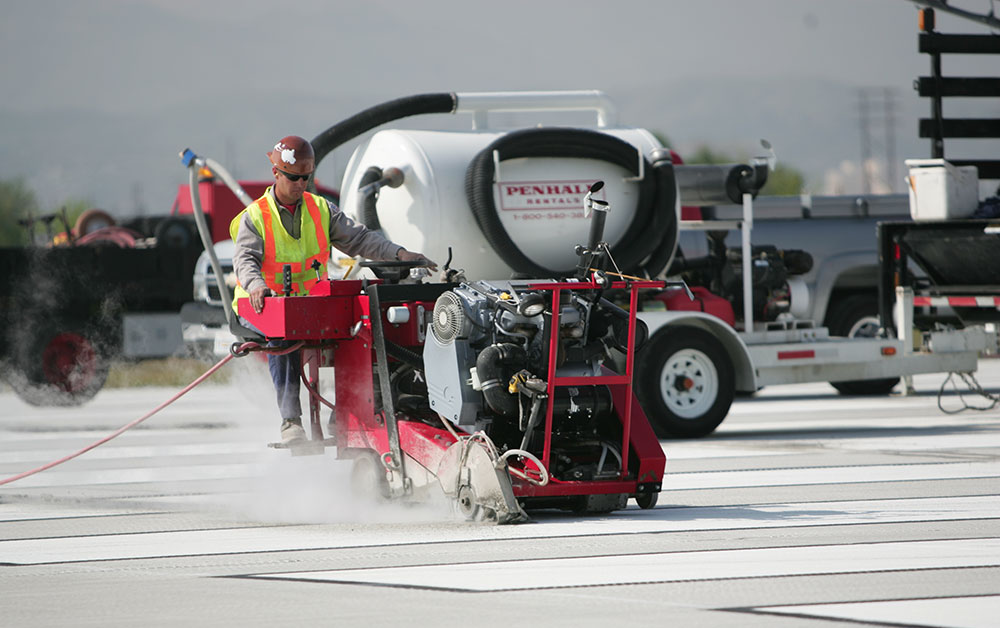
Walk-behind concrete saws are commonly used for slab cutting, expansion joints, trenching, and roadway work. These saws provide consistent depth control and are well-suited for long, straight cuts in horizontal surfaces.

Track-Mounted and Specialty Saws

For projects that demand extreme precision or operate in restricted or hazardous environments, track-mounted or remote-controlled saws are used. These systems are common in large-scale commercial and infrastructure projects.

Diamond Blades and Diamond Sawcutting Explained

Diamond sawcutting relies on diamond blades rather than traditional cutting edges. Despite the name, diamond blades do not “slice” material. Instead, they function as high-performance grinding wheels.

Diamond blades cut concrete by rotating at high speeds and grinding away material through abrasion. Industrial-grade diamonds are embedded into a metal bond along the blade’s edge, allowing the blade to maintain cutting efficiency even when encountering reinforced concrete and aggregate.

Common Diamond Blade Manufacturing Methods

Diamond blades are manufactured using several bonding techniques, each suited to different cutting demands:

Sintered Diamond Blades
The most common type used in professional concrete cutting. Diamonds are mixed with metal powders and bonded to a steel core through high heat and pressure, creating a durable blade designed for extended use.

Electroplated Diamond Blades
Diamonds are bonded to the blade surface using an electrical current. These blades offer fast cutting speeds but typically have a shorter service life.

Vacuum-Brazed Diamond Blades
Diamonds are welded directly to the blade surface without a metal bond. This method exposes more diamond surface area, allowing for aggressive cutting in specific applications.

Compared to abrasive or grinding wheels, diamond blades provide greater cutting efficiency, improved accuracy, and longer service life, making them the preferred choice for professional diamond sawcutting.

Safety Considerations and the Importance of Water-Fed Cutting

Concrete saws generate significant friction and heat during operation. Without proper controls, cutting can produce excessive dust, overheating, and premature blade wear.
Water-fed cutting systems are critical for safe and effective concrete saw operation. Continuous water flow serves several purposes:

  • Cools the blade to prevent overheating and warping
  • Reduces airborne silica dust for safer working conditions
  • Improves cutting efficiency and blade longevity
  • Produces cleaner, more controlled cuts

These safety considerations are one of the primary reasons professional concrete cutting services rely on specialized equipment and trained operators rather than general-purpose tools.

When to Hire a Professional Concrete Cutting Contractor

While concrete saws are powerful tools, diamond sawcutting is not a typical DIY or general contractor task. Projects involving structural concrete, reinforced slabs, tight tolerances, or safety-sensitive environments benefit from professional concrete cutting services.
A professional concrete cutting contractor brings:

  • Proper saw and blade selection for the material and depth
  • Dust and slurry control systems
  • Compliance with safety and environmental regulations
  • Precision cutting that protects surrounding structures

For complex or large-scale projects, working with an experienced provider like Penhall ensures accurate results while minimizing risk. Learn more about Penhall’s expertise in professional concrete cutting and diamond sawcutting services.

frequently asked questions

What is diamond sawcutting?

Diamond sawcutting is a concrete cutting method that uses diamond-embedded blades to grind through concrete, masonry, and asphalt with high precision and efficiency.

What materials can concrete saws cut?

Concrete saws can cut concrete, reinforced concrete, asphalt, brick, block, and other masonry materials when paired with the appropriate diamond blade.

Why is water used during concrete cutting?

Water cools the blade, reduces dust, improves safety, and helps produce cleaner, more controlled cuts during diamond sawcutting.

Are diamond blades better than abrasive blades?

Diamond blades are generally more efficient, longer-lasting, and more precise than abrasive blades, especially for professional concrete cutting applications.

How Roadway Grinding & Grooving Provide a Safer Driving Experience

The next time you cruise down a new stretch of highway or witness a jetliner touch down seamlessly, think about the invisible engineering that made that smooth, safe experience possible. That engineering is often the result of two precise, high-impact techniques: concrete grinding and grooving.

These processes are an important piece of modern pavement restoration, transforming worn-out, hazardous concrete into high-performance surfaces that enhance safety, reduce noise, and extend the lifespan of our essential transportation infrastructure from busy interstates to critical airport runways.

Diamond Grinding

When engineers talk about grinding, they are typically referring to diamond grinding, a technique designed to correct surface irregularities and improve ride quality.

What is Grinding?

Diamond grinding uses specialized equipment fitted with numerous diamond-tipped saw blades to shave off a thin, uniform layer of the concrete surface. This process is essentially like a massive, industrial-scale planer, correcting flaws across the entire slab.

Why is Grinding Necessary?

The goal of grinding is to restore the pavement's smoothness, which naturally degrades over time due to heavy traffic and environmental stress:

1. Eliminating Faulting: Grinding removes the vertical steps or "bumps" that develop at the joints between concrete slabs (known as faulting or warping). This is what creates the jarring "thump-thump" sensation on older highways.

2. Improving Ride Quality (IRI): The quality of a road is measured by the International Roughness Index (IRI). Grinding can drastically reduce the IRI, leading to a smoother, quieter, and more comfortable ride for drivers.

3. Noise Reduction: The newly textured surface resulting from grinding is smoother and more uniform than rough, faulted concrete, often leading to a noticeable reduction in tire-pavement noise.

Diamond Grooving

Grooving is the process of cutting deliberate, precise channels into the pavement. Unlike grinding, which focuses on smoothness, grooving's sole purpose is maximizing safety and performance, especially in wet conditions.

Safety Mechanics

Grooving works by applying two mechanical principles developed originally for airport runways.

1. Water Displacement: The grooves act as immediate drainage channels, pulling water, oil, or slush away from the point where the tire meets the concrete. This prevents the formation of a liquid film, which is the cause of hydroplaning at high speeds.

2. Mechanical Interlock: The diamond-cut grooves create sharp, vertical edges. These edges provide physical resistance for the tire tread to push against, offering essential mechanical grip and increasing the overall coefficient of friction, which is vital for braking and steering stability.

machinery doing airport runway grooving

Patterns Matter

The direction of the grooves is customized based on the application.

  • Transverse Grooving: Cuts are made perpendicular to the direction of travel. This is crucial for runways and high-speed braking zones because it maximizes water evacuation along the path of movement.

  • Longitudinal Grooving: Cuts run parallel to the direction of travel. This is common on highways as it improves steering control and helps vehicles track cleanly through curves.

Concrete Grinding and Grooving Combined

While both processes can be used separately, the most comprehensive and effective pavement restoration projects utilize them in tandem:

1. Grind First: The pavement is ground to eliminate all bumps and dips, ensuring a perfectly smooth profile.

2. Groove Second: The high-traction safety pattern is then precisely cut into the newly leveled surface.

This sequence delivers the best long-term outcome: a smooth, comfortable ride (from grinding) combined with superior, all-weather skid resistance (from grooving).

What are the Benefits of Diamond Grinding and Grooving

The strategic investment in diamond grinding and grooving yields massive returns for public safety and infrastructure budgets:

  • Drastic Accident Reduction: Studies have repeatedly shown that the increased skid resistance and hydroplaning prevention provided by grooving can lead to significant reductions in wet-weather accidents.

  • Extended Pavement Life: By correcting surface flaws and restoring the integrity of the concrete structure, these techniques can add 15 to 30 years of service life to the pavement. This is often far more cost-effective and longer-lasting than simply laying down a new asphalt overlay.

  • Fuel and Vehicle Savings: Smoother roads reduce the dynamic load on vehicles, leading to less wear and tear on suspension systems, reduced tire wear, and better fuel economy for trucks and cars alike.

By using the unmatched precision of diamond cutting, engineers ensure that every mile of grooved and ground pavement meets the highest standards of safety, setting the stage for smoother travel and a more durable future for our roads and runways.

What Is Concrete Coring? A Guide to Concrete Core Drilling

CALL FOR A QUOTE
1-800-736-4255

Concrete is the backbone of modern infrastructure, but constructing and maintaining complex buildings, roads, and bridges requires the ability to create precise, clean openings in this durable material. This is where concrete coring services come in, as highly specialized, controlled drilling techniques essential across the construction and engineering industries.

What is concrete coring?

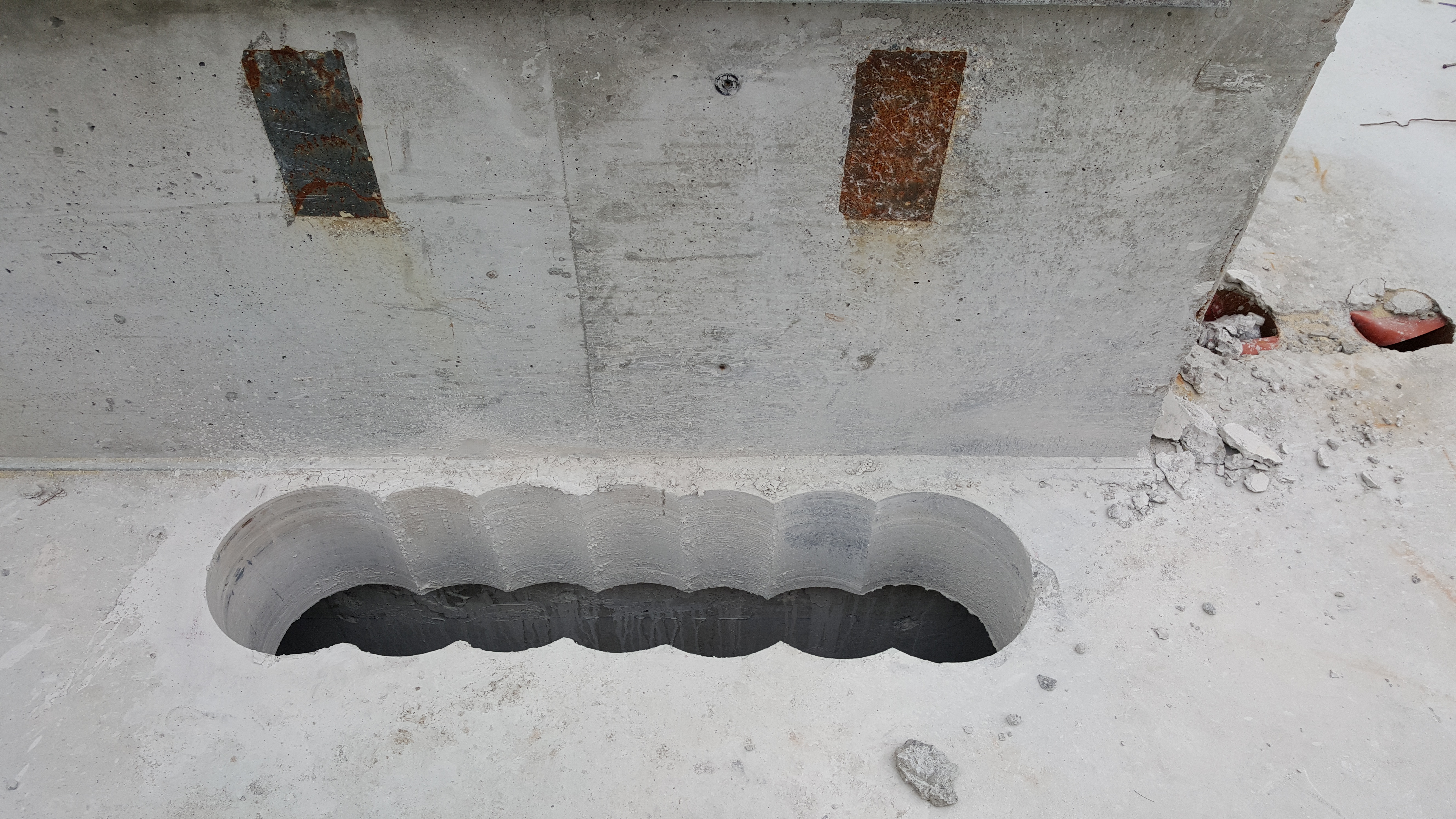
Concrete coring is a method of drilling perfectly round holes through concrete structures using a rotary drilling machine and a diamond-tipped cylindrical bit. The technique is named because it extracts a solid, cylindrical piece of concrete, known as a core sample, from the drilled opening.
The technique's primary purpose is to create openings for utility routing, post-setting, or to extract samples for structural testing. The historical shift from rudimentary hole-making methods to diamond coring marked a significant advance in construction efficiency and quality.

Importance and Versatility

Coring is overwhelmingly preferred over older, impact-based methods like jackhammering for several critical reasons:

Precision and Cleanliness: It creates a smooth, perfectly sized hole with minimal spalling or damage to the surrounding concrete.

Non-Destructive: Unlike jackhammering, coring is a low-impact technique that minimizes noise, dust, and, most importantly, avoids introducing micro-fractures into the remaining structure, thereby maintaining structural integrity.

Speed: Modern core drills are significantly faster and more efficient for creating numerous holes.

Applications and Use Cases

Mechanical, Electrical, and Plumbing (MEP)

This is the most common application. Coring creates the necessary pathways for:

Conduits and cables for electrical wiring.

Pipes for plumbing and fire suppression systems.

Openings for HVAC (heating, ventilation, and air conditioning) ductwork installation.

Structural Testing and Analysis

Core drilling is a crucial quality control measure for new and aging structures. Cylindrical core samples are extracted and taken to a laboratory for destructive testing to determine the concrete's compressive strength and composition. This ensures the concrete meets the specified engineering requirements.

Anchoring and Fastening

Precise holes are required for securely connecting new elements to an existing structure. Creating openings for chemical anchors, expansion bolts, and rebar dowels used in structural connections.

Civil Engineering and Infrastructure

Coring is essential for the maintenance and inspection of large infrastructure projects. Road, bridge, and dam maintenance requires extracting cores to check for internal defects, moisture content, or material degradation.

Demolition and Remediation

In highly controlled environments, coring can be used for creating controlled access openings and using large-diameter bits to remove structurally compromised sections without undue vibration.

Equipment and Tooling

Core Drilling Machines (Core Drills)

The machines are built to provide high torque and stable rotation.
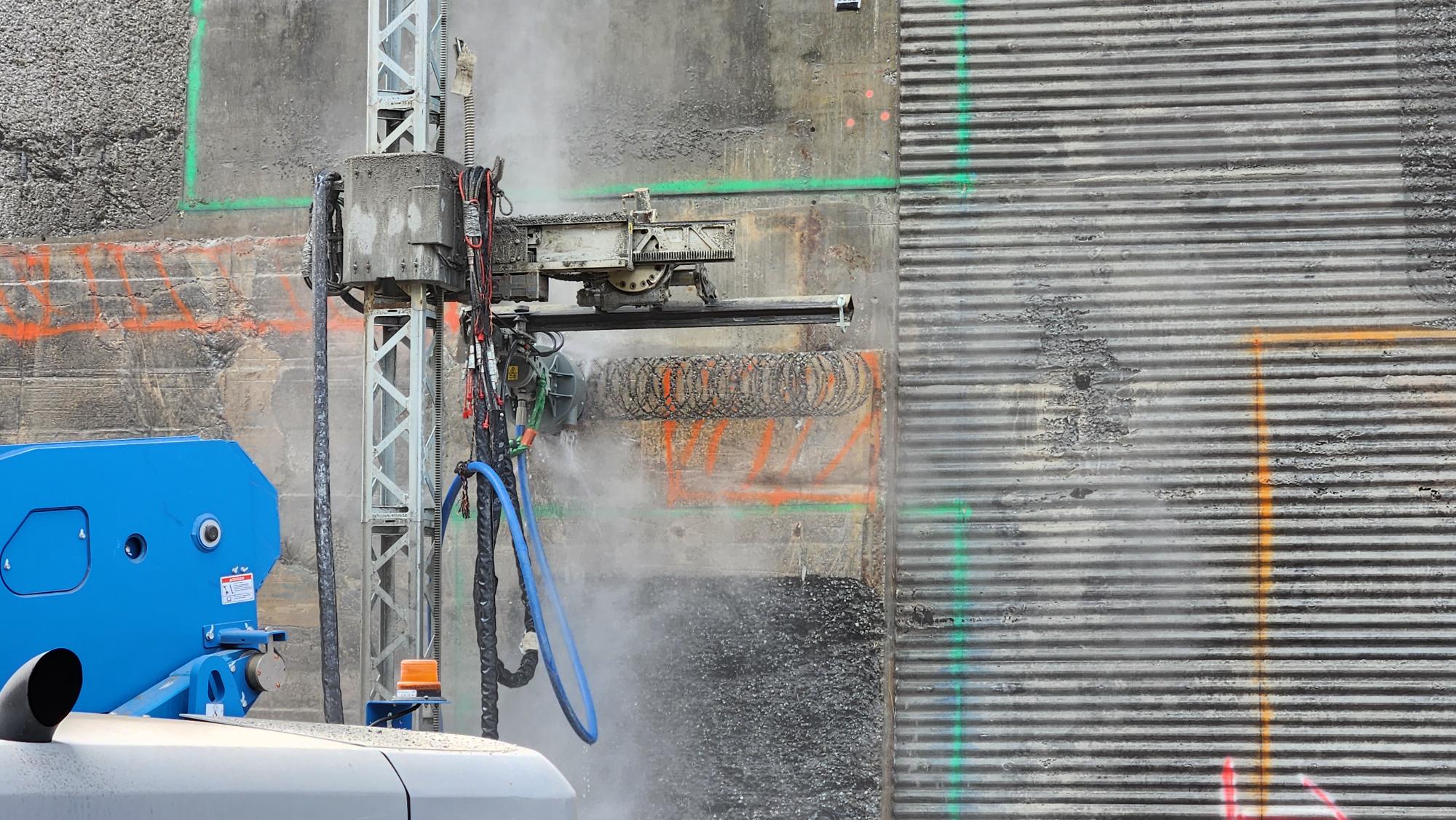
Handheld systems are used for smaller diameter holes (typically under 3 inches) and in areas with restricted access. Rig-mounted systems are anchored to the structure and feature a heavy-duty mast and carriage, necessary for larger, deeper, or non-vertical cuts.
They are commonly powered by electric motors, though hydraulic power is used for high-power, high-torque applications, and pneumatic power is used in sensitive or explosive environments.

Core Drill Bits

The bit is the heart of the coring operation.

Construction: The bit consists of a hollow steel tube (barrel) with cutting segments brazed onto the leading edge.

Segments: The cutting segments are made from a mixture of metal powders and industrial diamonds (a super-abrasive material). The bond (the metal matrix holding the diamonds) must be carefully matched to the concrete: a soft bond is used for hard, dense aggregate, while a hard bond is used for softer, abrasive material.

Sizes: Diameters range from a fraction of an inch up to over 60 inches for specialty applications.

Accessories

Essential accessories ensure safety, precision, and environmental compliance.

Drill Stands and Securing: Drill stands hold the rig; they are secured using mechanical anchors (often a bolt through a pre-drilled hole) or vacuum bases for non-penetrating securing on smooth surfaces.

Slurry Management: Nearly all concrete coring involves water. Slurry management systems—such as vacuum systems and containment rings—are crucial for collecting the watery concrete residue and preventing environmental contamination or slip hazards.

Sizes: Diameters range from a fraction of an inch up to over 60 inches for specialty applications.

Concrete Coring Techniques

Pre-Coring Assessment

Before a single hole is drilled, a critical assessment must take place.

Scanning: It is standard best practice to use Ground Penetrating Radar (GPR) or similar tools (e.g., pachometers or magnetic scanners) to scan the concrete for embedded hazards like rebar, post-tension cables, and live electrical conduits or pipes. Hitting these elements can be structurally catastrophic and extremely dangerous.

Marking: The precise center and depth of the hole are clearly marked on the surface.

Setup and Securing

The drill rig must be secured correctly to manage the immense torque generated during the process. The rig is anchored securely, and the mast is carefully leveled to ensure the hole is plumb (perfectly vertical) or at the required angle.

The Drilling Operation

Wet Coring: The primary method involves a continuous flow of water. The water cools the diamond segments to prevent overheating and premature wear, and it flushes the slurry (the fine cuttings) away from the cutting face, maintaining optimal cutting efficiency.

Dry Coring: Used sparingly where water runoff is strictly prohibited (e.g., active electrical rooms). It requires specialized, more expensive bits and a lower RPM to prevent overheating, often utilizing a dust-extraction vacuum.

Maintaining Constant Pressure and RPM: The operator must maintain a steady, optimal pressure and RPM (revolutions per minute) to maximize efficiency and bit life. Too little pressure causes the bit to glaze, and too much can damage the segments.

Safety and Best Practices

Safety is paramount, as concrete coring involves high-speed machinery and potential structural hazards.

Personal Protective Equipment (PPE)

All operators must wear:

Gloves

Eye protection (safety glasses or face shield)

Hearing protection (earplugs or earmuffs)

Waterproof clothing and steel-toe boots to manage wet conditions and falling debris.

Structural Integrity Concerns

The most crucial safety practice is pre-coring scanning to avoid cutting through post-tension cables (which can explosively release under tension) or large quantities of rebar, especially in columns and beams. Any coring job near critical structural elements requires consultation with a structural engineer.

Electrical and Utility Hazards

The pre-coring scan is essential to prevent electrocution or rupture of gas/water lines. Hitting a live electrical line is one of the most significant hazards in coring.

Ergonomics and Hazard Prevention

Proper machine setup is crucial for operator safety. The rig must be correctly anchored to manage torque (kickback) if the bit jams. A machine that isn't secured can spin violently, causing severe injury. Controlling water runoff is necessary to prevent slip hazards on the job site.

Concrete coring is far more than just drilling a hole; it is a specialized trade demanding precision, safety consciousness, and technical skill. It is the only way to introduce clean, controlled openings into concrete without compromising the structure's integrity.

Advancements continue to improve efficiency and safety. Robotic coring systems are emerging for remote operation in hazardous areas, and continuous improvements in diamond technology are leading to faster, longer-lasting core bits.

Ultimately, the successful execution of any coring job depends on a trained professional concrete contractor who understands the equipment, the material, and the critical importance of a thorough pre-coring scan.

CONCRETE SERVICES

Post-Tension Cables: The Unsung Heroes of Modern Construction

In the world of modern construction, there's an unsung hero that's been quietly revolutionizing the way we build: post-tension cables.

CALL FOR A QUOTE
1-800-736-4255

What Are Post-Tension Cables?

Post-tension cables are high-strength steel tendons embedded inside concrete to reinforce and strengthen structural elements such as slabs, beams, and decks. They are placed within the concrete during construction and tensioned after the concrete has cured, creating compressive forces that improve strength, reduce cracking, and allow for longer spans with less material.
Because post-tension cables are hidden inside concrete and placed under significant force, they are considered high-risk structural elements. Identifying their location before any concrete cutting, concrete coring, or drilling is critical for safety and structural integrity.

What Is a Post-Tension Cable and How Does It Work?

A post-tension cable is part of a post-tensioning system used to reinforce concrete. Unlike traditional reinforced concrete, where steel rebar provides passive reinforcement, post-tension cables are actively stressed after the concrete hardens.
Once tensioned, the cable applies compression to the concrete, counteracting tensile forces that would otherwise cause cracking or failure. This approach allows engineers to design thinner slabs, longer spans, and more efficient structures without sacrificing strength.
Post-tension systems are widely used in commercial, industrial, and residential construction, particularly where weight reduction and crack control are priorities.

What Are Post-Tension Cables Used For?

Post-tension cables are commonly used in structures where strength, durability, and flexibility are essential, including:

  • Parking garages
  • High-rise buildings
  • Office and mixed-use developments
  • Residential slabs and foundations
  • Bridges and elevated structures

In residential construction, post-tensioned slabs are often used in regions with expansive soils, where ground movement can cause cracking in conventional foundations.

Components of a Post-Tensioning System

A post-tensioning system is made up of several key components, each of which plays a critical role in the overall performance of the structure. At the heart of the system are the cables themselves, which are typically made of high-strength steel strands, wires, or bars. These cables are designed to withstand enormous tensile forces, with strength and durability characteristics that far exceed those of conventional reinforcement.

The cables are typically arranged in one of two configurations: single strands or multiple strands bundled together. In either case, the cables are coated with a corrosion-inhibiting grease and encased in a plastic sheathing to protect them from the elements and ensure their long-term performance.

The cables are anchored at each end by a device called a tendon. Tendons come in two main types: unbonded and bonded. Unbonded tendons are free to move within the concrete, while bonded tendons are grouted in place after tensioning. The choice between unbonded and bonded tendons depends on factors such as the specific application, environmental conditions, and design requirements.

The tensioning of the cables is accomplished using a jacking system, which applies a precise amount of force to the cables, typically using hydraulic or mechanical means. This force is then locked in place using anchors at each end of the tendon.

Finally, the space between the cables and the surrounding concrete is filled with a high-strength grout, which serves to protect the cables from corrosion and ensure effective load transfer between the cables and the concrete.

Where Are Post-Tension Cables Typically Located?

Post-tension cables are most often found inside concrete slabs, decks, beams, and transfer girders. In many buildings, they are installed in patterns that follow load paths rather than straight, evenly spaced lines.
Because they are encased in concrete and not visible at the surface, their presence is not always obvious. This is especially true in older buildings or structures where drawings are unavailable or outdated.

How Deep Are Post-Tension Cables?

The depth of post-tension cables varies depending on the structure’s design, slab thickness, and engineering requirements. Cables may be located closer to the bottom, middle, or top portion of a slab depending on the loads they are designed to resist.
Because depth and layout vary widely, assumptions about cable depth are unsafe. Professional assessment and scanning are the only reliable ways to determine cable location before cutting or drilling.

What Happens If You Cut a Post-Tension Cable?

Cutting a post-tension cable can have serious consequences. These cables are under extreme tension, and damaging one can result in:

Sudden release of stored energy

Serious injury or fatality to workers

Structural damage to the slab or building

Costly repairs and project delays

Can a Post-Tension Cable Be Repaired?

Post-tension cable repair is complex and highly specialized. It typically requires structural engineering review, controlled stress relief, and specialized repair systems designed for post-tensioned structures.
Because improper repairs can further weaken the structure or create hidden risks, post-tension cable repair should only be addressed by qualified professionals following engineered repair plans. This is not a DIY or field-improvised process.

How Do You Find Post-Tension Cables in Concrete?

Post-tension cables are located using professional concrete scanning and imaging technologies. These methods allow specialists to identify the presence, layout, and general depth of embedded cables before any cutting, coring, or drilling begins.

Professional detection is especially important when:

  • Construction drawings are unavailable or unreliable
  • Working in occupied or existing buildings
  • Performing structural modifications
  • Cutting near slab edges or load-bearing elements

Companies like Penhall provide advanced scanning and detection services to help teams locate post-tension cables and other embedded elements before work begins, reducing risk and preventing costly damage.

Before You Cut: Why Professional Detection Matters

Post-tension cables are integral to the structure’s performance and safety. Cutting or drilling without knowing where they are located puts workers, buildings, and project timelines at risk.

Professional detection ensures:

  • Safer job sites
  • Informed cutting and coring decisions
  • Protection of structural integrity
  • Compliance with safety best practices

When post-tension cables may be present, identifying them before concrete cutting is not optional. It is essential.

The Post-Tensioning Process: A Step-by-Step Guide

The post-tensioning process begins with careful design and planning. Engineers must calculate the precise tension levels and cable placements required to achieve the desired structural performance. This involves taking into account factors such as the loads the structure will be subject to, the span lengths, and the properties of the concrete and reinforcement.

Once the design is finalized, the first step in the installation process is to place the conduits or ducts that will house the post-tension cables. These are typically made of plastic or metal and are carefully positioned within the formwork before the concrete is poured.

After the concrete has been poured and allowed to cure to a sufficient strength, the post-tension cables are fed through the conduits. This is typically done using a specialized threading machine or by hand, depending on the size and complexity of the project.

Once the cables are in place, the tensioning process begins. The cables are anchored at one end and then stretched using a hydraulic jack at the other end. The amount of tension applied is carefully controlled and monitored to ensure that it meets the design specifications. After the desired tension level is achieved, the cables are locked off at the anchors, maintaining the tension within the structure.

The final step in the post-tensioning process is grouting. A high-strength grout is injected into the conduits, filling the space around the cables. This grout serves to protect the cables from corrosion and bond them to the surrounding concrete, creating a composite structure that acts as a single unit.

Advantages and Disadvantages of Post-Tensioning

Post-tensioning offers several significant advantages over conventional reinforced concrete construction:

Increased strength and span capabilities: By applying tension to the reinforcement after the concrete has hardened, post-tensioning allows for longer spans and thinner slabs compared to traditional methods. This can result in more open, flexible floor plans and reduced material usage.

Improved crack control and durability: The compressive forces introduced by post-tensioning help to minimize cracking in the concrete, leading to improved durability and a longer service life for the structure.

Flexibility in design: Post-tensioning allows for greater freedom in architectural design, enabling the creation of more complex and expressive structures.

However, post-tensioning also has some potential drawbacks:

Higher initial cost: The specialized equipment and expertise required for post-tensioning can result in higher upfront costs compared to conventional reinforced concrete.

Potential for corrosion: If not properly protected, post-tension cables can be vulnerable to corrosion, particularly in harsh environmental conditions. This can lead to costly repairs and maintenance over the life of the structure.

Challenges in repairs and maintenance: If issues do arise with post-tensioned structures, repairs and maintenance can be more complex and expensive compared to conventional reinforced concrete.

Safety Considerations and Regulations

Given the high forces involved in post-tensioning and the critical role that the cables play in the structural integrity of the building, safety is of paramount importance. Proper design and installation are crucial, and all work must be carried out by trained and certified professionals.

During the post-tensioning process, strict safety precautions must be followed to protect workers and ensure the integrity of the structure. This includes careful monitoring of the tensioning process, the use of appropriate personal protective equipment, and adherence to established safety protocols.

Post-tensioned structures are subject to a range of building codes and standards, which vary by jurisdiction. These codes typically specify requirements for materials, design, installation, and testing to ensure the safety and performance of the finished structure. Regular inspections and testing are also typically required to monitor the condition of the cables and anchorages over time.

Common Applications and Case Studies

Post-tensioning has found wide application in a variety of structures, from high-rise buildings and bridges to parking garages and residential homes. One of the most notable examples of post-tensioned construction is the Burj Khalifa in Dubai, the tallest building in the world. The tower's record-breaking height was made possible in part by the use of post-tensioned floor plates, which allowed for thinner slabs and more efficient use of material.

In the residential sector, post-tensioned slabs have become increasingly popular, particularly in areas with expansive soils. The ability of post-tensioning to resist soil movement and minimize cracking has made it an attractive option for homebuilders looking to provide a stable, durable foundation.

Other notable examples of post-tensioned structures include the Incheon Airport in South Korea, the Linn Cove Viaduct on the Blue Ridge Parkway in North Carolina, and the Alamillo Bridge in Seville, Spain. Each of these structures showcases the unique capabilities of post-tensioning in terms of span length, design flexibility, and structural efficiency.

Future Trends in Post-Tensioning Technology

As with any technology, post-tensioning continues to evolve and improve over time. One area of ongoing research and development is in the use of new materials, such as fiber-reinforced polymers (FRPs), which offer the potential for even greater strength and durability compared to traditional steel cables.

Another trend is toward more sustainable and environmentally friendly approaches to post-tensioning. This includes the use of recycled and recyclable materials, as well as designs that minimize material usage and embodied energy.

Finally, there is growing interest in the integration of post-tensioning with smart building technologies, such as sensors and monitoring systems that can provide real-time data on the performance and condition of the structure. This data can be used to optimize maintenance and repair strategies, as well as to inform future designs.

The Importance of Post-Tension Cables in Modern Construction

Post-tension cables have revolutionized the way we build, enabling structures that are stronger, more efficient, and more durable than ever before. From towering skyscrapers to humble residential slabs, post-tensioning has proven itself to be a versatile and valuable tool in the modern builder's toolkit.

As we look to the future, it's clear that post-tensioning will continue to play a vital role in shaping our built environment. With ongoing advancements in materials, design, and technology, the possibilities for post-tensioned structures are virtually limitless. So the next time you marvel at a soaring bridge or a sleek high-rise, take a moment to appreciate the humble post-tension cable – the unsung hero of modern construction.

Glossary of Terms

Tendon: A sheathed cable or group of cables used to apply post-tensioning forces to concrete.

Anchorage: A device used to lock off the tension in a post-tensioned cable at the ends of a tendon.

Grout: A high-strength cement-based material used to fill the space around post-tension cables, providing corrosion protection and ensuring load transfer.

Unbonded tendon: A post-tension tendon that is free to move relative to the surrounding concrete.

Bonded tendon: A post-tension tendon that is bonded to the surrounding concrete through grouting after tensioning.

Resources and Further Reading

For those interested in learning more about post-tensioning, the following resources provide a wealth of additional information:

Post-Tensioning Institute (PTI): https://www.post-tensioning.org/

American Concrete Institute (ACI): https://www.concrete.org/

"Post-Tensioning Manual" by the Post-Tensioning Institute

"Design of Post-Tensioned Slabs" by Bijan O. Aalami

"Post-Tensioned Concrete: Principles and Practice" by K. Dirk Bondy

These resources offer detailed technical information, design guidelines, case studies, and best practices for the use of post-tensioning in concrete construction. Whether you're a seasoned professional or just starting to explore this fascinating technology, these resources are an invaluable source of knowledge and inspiration.

frequently asked questions About Post-Tension Cables

What is a post-tension cable?

A post-tension cable is a high-strength steel tendon embedded in concrete and tensioned after the concrete cures to improve strength and reduce cracking.

What are post-tension cables used for?

They are used to reinforce slabs, decks, beams, and foundations in residential, commercial, and infrastructure projects.

How deep are post-tension cables in concrete?

Depth varies by design and structure. The only reliable way to determine depth is through professional scanning.

What happens if you cut a post-tension cable?

Cutting a cable can cause serious injury, structural damage, and costly repairs due to the sudden release of stored tension.

How can you find post-tension cables before cutting?

Post-tension cables are located using professional concrete scanning technologies prior to cutting, coring, or drilling.

CONTACT US TODAY

"*" indicates required fields

This field is for validation purposes and should be left unchanged.

Site Contact Information

(XXX) XXX-XXXX
 

Site Location

Location*

After submitting this form a Penhall Company representative will be in contact with you to confirm your request. If this request is urgent, please call 1-800-PENHALL to be connected with the nearest Penhall branch. Upon submitting this form you will also receive occasional updates about our services and company announcements. You may unsubscribe from these e-mails at anytime. Grinding and grooving services are conducted by Emery Sapp & Sons, Inc. For specific inquiries related to grinding and grooving, click here or reach out to Chris Fitzpatrick at chris.fitzpatrick@emerysapp.com

CONCRETE SERVICES

Ground Penetrating Radar vs. X-Ray: A Comprehensive Comparison

In the world of non-destructive testing and subsurface exploration, two technologies have emerged as powerful tools for revealing what lies beneath the surface: Ground Penetrating Radar (GPR) and X-ray imaging. While both methods provide valuable insights, they differ in their fundamental principles, applications, and suitability for various projects. This article aims to explore the key differences between GPR and X-ray, helping readers understand which technology best fits their needs.

CALL FOR A QUOTE
1-800-736-4255

The Fundamentals of Ground Penetrating Radar (GPR)

Ground Penetrating Radar is a non-invasive geophysical method that uses electromagnetic waves to create a detailed image of the subsurface. GPR systems emit high-frequency radio waves into the ground, which are then reflected by subsurface features and recorded by a receiver. The strength and timing of these reflections provide information about the depth, location, and properties of the subsurface materials.

GPR antennas come in various frequencies, each suitable for different applications. High-frequency antennas (900 MHz to 2.5 GHz) offer high resolution but limited depth penetration, making them ideal for shallow investigations such as concrete scanning. Low-frequency antennas (10 MHz to 500 MHz) provide greater depth penetration but lower resolution, making them suitable for deeper subsurface exploration, such as locating buried utilities or archaeological features.

The data collected by GPR is processed and visualized as a radargram, a two-dimensional image that represents the subsurface features along the survey line. Interpreting radargrams requires skill and experience, as the reflections can be complex and influenced by factors such as soil type, moisture content, and the presence of multiple layers or objects.

One of the key strengths of GPR is its non-destructive nature. It allows for subsurface investigation without the need for excavation or drilling, making it an attractive option for many applications. Additionally, GPR can provide real-time data, allowing for on-site interpretation and decision-making. It is also relatively fast, enabling the coverage of large areas in a short amount of time.

The Fundamentals of X-Ray Technology

X-ray technology relies on the use of ionizing radiation to create images of the internal structure of objects. X-rays are a form of electromagnetic radiation with shorter wavelengths and higher energy than visible light. When X-rays pass through an object, they are absorbed or scattered depending on the density and composition of the materials they encounter. This interaction creates a shadow image on a photographic film or digital detector, revealing the internal structure of the object.

X-ray systems come in various forms, each tailored to specific applications. Medical X-ray systems are designed for imaging the human body, while industrial X-ray systems are used for non-destructive testing of materials and components. These systems can range from portable handheld devices to large, fixed installations.

The process of acquiring an X-ray image involves placing the object between an X-ray source and a detector. The source emits a beam of X-rays that passes through the object, and the detector captures the resulting shadow image. The image, known as a radiograph, shows the internal structure of the object, with denser materials appearing lighter and less dense materials appearing darker.

One of the key strengths of X-ray technology is its ability to provide high-resolution images of dense materials, such as metals and ceramics. X-rays can penetrate these materials and reveal internal flaws, defects, and structural details that may not be visible from the surface. X-ray systems are widely available and relatively inexpensive compared to other advanced imaging technologies.

Key Differences Between GPR and X-Ray

Feature
Safety & Radiation Safer, uses non-hazardous electromagnetic waves Uses ionizing radiation, requiring safety measures such as area clearing, PPE, and jobsite closures
Depth & Penetration Penetrates 12-24 inches on average, up to 36 inches in concrete Limited to the thickness of the concrete being scanne
Imaging & Accuracy Produces radargrams that require skilled interpretation Provides clearer, more detailed images, often considered more accurate for structural details
Versatility & Applications Detects metallic and non-metallic objects, including plastic conduits and voids; works on slab-on-grade concrete Requires access to both sides of the concrete structure; designed specifically for concrete scanning
Speed & Efficiency Faster, covers larger areas quickly, provides real-time data Slower process, often requires off-site data development
Cost-effectiveness More cost-effective due to faster scanning, lower equipment and personnel costs, and fewer safety requirements More expensive due to specialized equipment, training, and additional safety measure

While both GPR and X-ray are used for non-destructive testing and imaging, they differ in several key aspects:

Type of Radiation

GPR uses non-ionizing electromagnetic waves in the radio frequency range, which are generally considered safe for operators and the environment. In contrast, X-rays are a form of ionizing radiation that can be harmful to living tissues. This difference has significant implications for safety and the required precautions during operation.

Penetration Depth

GPR's penetration depth depends on the frequency of the antenna and the properties of the materials being investigated. In general, GPR can penetrate deeper into the subsurface than X-rays, especially in soils and other porous materials. Low-frequency GPR systems can achieve depths of several meters, while high-frequency systems are limited to shallower depths, typically less than a meter.

X-ray penetration depth is primarily determined by the energy of the X-ray beam and the density of the materials being imaged. X-rays can penetrate dense materials like concrete and steel, but their penetration depth is generally limited to the thickness of the object being scanned.

Resolution and Image Quality

X-ray imaging typically provides higher resolution and clearer images than GPR, especially for dense materials. X-ray images can reveal fine details and internal structures with sub-millimeter accuracy. This makes X-ray imaging particularly suitable for detecting small defects, cracks, or inclusions in materials like concrete or metal components.

GPR, on the other hand, produces lower-resolution images that may require more interpretation. The resolution of GPR images depends on the frequency of the antenna and the properties of the materials being investigated. Higher frequencies provide better resolution but limited penetration depth, while lower frequencies offer greater depth penetration but lower resolution.

Target Materials

GPR is suitable for a wide range of materials, including soils, rocks, concrete, asphalt, and even water. It can detect both metallic and non-metallic objects, such as plastic pipes, voids, and changes in material properties. This versatility makes GPR a valuable tool for applications like utility mapping, archaeological surveys, and environmental investigations.

X-ray imaging is primarily used for dense materials like concrete, metals, and ceramics. It is particularly effective for detecting internal flaws, voids, and reinforcement details in concrete structures. X-ray imaging is also widely used in medical applications for visualizing bones and other dense tissues.

Safety Considerations

The use of X-rays requires strict safety measures to protect operators and bystanders from the harmful effects of ionizing radiation. This includes proper shielding, personal protective equipment, and adherence to radiation safety protocols. X-ray operations may require clearing the area and restricting access to the scanning site.

GPR, on the other hand, does not pose significant safety risks, as the electromagnetic waves used are non-ionizing and generally considered safe for human exposure. However, operators should still follow manufacturer guidelines and avoid direct contact with the antenna during operation.

Cost and Equipment

The cost and complexity of GPR and X-ray equipment can vary significantly depending on the specific application and system requirements. In general, GPR equipment is more affordable and widely available than X-ray systems. GPR systems can range from simple handheld units to advanced multi-channel systems with specialized software for data processing and interpretation.

X-ray equipment tends to be more expensive and specialized, especially for industrial applications. X-ray systems require a radiation source, detector, and appropriate shielding, which can add to the overall cost. Additionally, X-ray operations may require specialized training and certification for operators.

Applications of GPR and X-Ray

GPR and X-ray imaging find applications across various fields, each leveraging the unique strengths of the respective technologies.

GPR is widely used in:

Utility mapping and locating buried infrastructure

Archaeological surveys and cultural heritage preservation

Environmental investigations, such as locating underground storage tanks or contamination plumes

Geotechnical investigations, such as bedrock profiling and soil characterization

Concrete scanning for locating reinforcement, voids, or deterioration

Forensic investigations and law enforcement

X-ray imaging is commonly used in:

Medical diagnostics, such as bone imaging and dental radiography

Industrial non-destructive testing, such as weld inspection and component quality control

Security screening, such as baggage inspection at airports

Art and artifact analysis, such as examining paintings for hidden details or forgeries

Material science research, such as studying the internal structure of materials

Forensic investigations and law enforcement

Final Thoughts

Ground Penetrating Radar and X-ray imaging are both powerful tools for non-destructive testing and subsurface exploration. While they share the goal of revealing what lies beneath the surface, they differ in their fundamental principles, capabilities, and applications.

GPR offers a safe, versatile, and cost-effective solution for a wide range of subsurface investigations, providing real-time data and the ability to detect both metallic and non-metallic objects. It is particularly useful for applications that require deeper penetration and the mapping of larger areas.

X-ray imaging, on the other hand, excels in providing high-resolution images of dense materials, making it an invaluable tool for detecting internal flaws, defects, and structural details. However, the use of ionizing radiation requires strict safety measures and specialized equipment.

As technology advances, both GPR and X-ray imaging continue to evolve, with improvements in resolution, data processing, and user-friendliness. Hybrid systems that combine the strengths of both technologies, such as Xradar Guaranteed Concrete Scanning, are also emerging as potential alternatives for specific applications.

Ultimately, the choice between GPR and X-ray imaging depends on the specific requirements of the project, the materials being investigated, and the desired outcomes. Understanding the key differences between these technologies is crucial for making informed decisions and achieving the best results.

CONTACT US TODAY

"*" indicates required fields

This field is for validation purposes and should be left unchanged.

Site Contact Information

(XXX) XXX-XXXX
 

Site Location

Location*

After submitting this form a Penhall Company representative will be in contact with you to confirm your request. If this request is urgent, please call 1-800-PENHALL to be connected with the nearest Penhall branch. Upon submitting this form you will also receive occasional updates about our services and company announcements. You may unsubscribe from these e-mails at anytime. Grinding and grooving services are conducted by Emery Sapp & Sons, Inc. For specific inquiries related to grinding and grooving, click here or reach out to Chris Fitzpatrick at chris.fitzpatrick@emerysapp.com

IRVING, TX — JANUARY 3, 2023 – Penhall Company, the nation’s leader in concrete cutting and removal services, today announced it has acquired the equipment of COBRA Concrete Cutting of Pinellas, Inc., located in Pinellas, Florida. Penhall Company has hired the former COBRA Concrete Cutting of Pinellas, Inc., Operations Manager, Steve Milligan to manage our Pinellas location. The location offers a multitude of concrete solution services to the construction industry throughout Tampa, St Petersburg, Clearwater, and surrounding areas. Dan Curnow, a veteran of the Penhall Company and concrete cutting industry will help transition Steve Milligan, the current COBRA Concrete Cutting of Pinellas, Inc., Operations Manager, to Penhall Company.

“In a business where safety, customer service and reliable delivery of services are important, the asset purchase of COBRA Concrete Cutting of Pinellas, Inc., Pinellas, Florida, location, will enhance the Penhall Company’s service capabilities and expand our services throughout the greater Tampa markets,” said Greg Rice, President and Chief Executive Officer of Penhall Company. “We welcome Steve into our Red and Gray family.”

With over 40 branch/service locations throughout the US and Canada, Penhall Company serves a broad range of end markets including retail, military, government, hospitality, highway, residential, mining, refining, chemical and utilities. With the acquisition of the assets of the COBRA Concrete Cutting of Pinellas, Inc., Penhall Company positions itself to offer a full range of services to the Tampa, St Petersburg, Clearwater, Florida, and surrounding areas to include: Concrete Cutting and Coring, Concrete Breaking, Specialized Demolition, GPR concrete scanning, Digital X-Ray, Utility Locating, Fiber-Reinforced Polymer for concrete strengthening, Grinding and Grooving, and Bridge Services.

IRVING, TX — October 3, 2022 – Penhall Company, the nation’s leader in concrete cutting and removal services, today announced it has acquired the equipment of Capitol Drilling & Sawing located in Memphis, Tennessee. In addition, Penhall Company has hired the former Capitol Drilling & Sawing employees located in the Memphis office. The Memphis Office of Capitol Drilling & Sawing was formerly operated as Bluff City Cutting and Concrete, established in 1997. The location offers a multitude of concrete solution services to the construction industry throughout Memphis, Western Tennessee, and surrounding areas. Michael Totty, a veteran of the Penhall Company will help transition Norman Mitchell, the current Capitol Drilling & Sawing Operations Manager, and its other employees to Penhall Company.

“In a business where safety, customer service and reliable delivery of services are important, the asset purchase of Capitol Drilling & Sawing, Memphis location, will enhance the Penhall Company’s service capabilities and expand our services throughout the Memphis, Western Tennessee, and surrounding markets,” said Greg Rice, President and Chief Executive Officer of Penhall Company. “We welcome the employees of the Capitol Drilling & Sawing Memphis location into our Red and Gray family.”

With over 40 branch/service locations throughout the US and Canada, Penhall Company serves a broad range of end markets including retail, military, government, hospitality, highway, residential, mining, refining, chemical and utilities. With the acquisition of the assets of the Capitol Drilling & Sawing Memphis, Tennessee location, Penhall Company positions itself to offer a full range of services to the Memphis, Tennessee, and surrounding areas to include: Concrete Cutting and Coring, Concrete Breaking, Specialized Demolition, GPR concrete scanning, Digital X-Ray, Utility Locating, Fiber-Reinforced Polymer for concrete strengthening, Grinding and Grooving, and Bridge Services.

Penhall Company is excited to announce that we have expanded our technology service operations to three new markets and their surrounding areas: Baton Rouge, Louisiana; New Orleans, Louisiana; and Orlando, Florida. This is part of our ongoing effort to reach customers and clients throughout the United States and Canada. Clients in these new regions will now get to experience first-hand the advanced technology, expert knowledge, and reliable service that Penhall offers. 

Our Sale and Service representatives are ready to leverage Penhall’s technology services to help you complete your next project.

Penhall technology services include:

Private Utility Locating: We’re experts in private utility locating. We employ the latest locating technologies to quickly find and mark underground pipes, gas lines, cable lines, storage tanks and more. 

Concrete Scanning: Our crews use ground penetrating radar to locate materials embedded in concrete. This includes rebar, post-tension cables, pipes and conduits, and voids. We can locate and identify subsurface features with exacting precision. 

Digital X-ray Scanning: When you need a clear, unobstructed image of features embedded in concrete, turn to our digital X-ray scanning technology. Safe and highly effective, digital X-ray imaging is one of the best means of locating and identifying subsurface features in concrete. 

Scarifying & Shaving: We can shave and scarify concrete surfaces to give you the ideal finish. We can smooth concrete, level concrete, create textured concrete, and more. 

Grinding & Grooving: Penhall Company is North America’s largest provider of concrete grinding and grooving. We can grind and grove virtually any surface, from highways and bridge decks to airplane runways and racetracks. 

Bridge Services: We are experts in bridge widening and removal. Our goal is always the same: to ensure the safety of the millions of drivers in some of the most traffic-heavy regions. 

Penhall Company is here for your next construction project.

When you’re in need of a trusted construction partner, contact Penhall. We’re committed to helping you complete your project the right way—safely, efficiently, and on budget.

Visit our Locations Page to see every service region and to get in touch with a local rep!

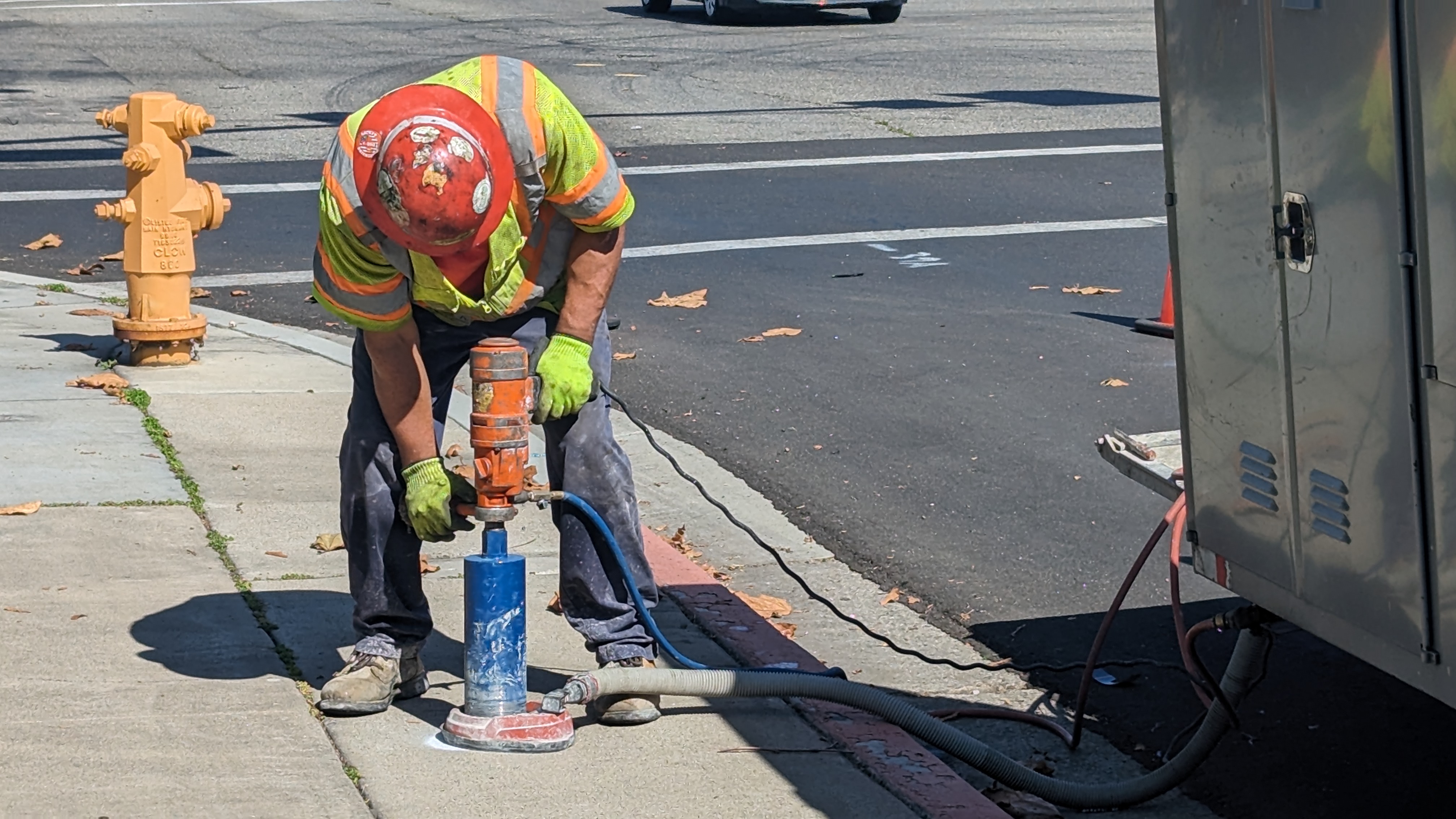
A diamond core drill is a cylindrically shaped drill bit at the end of an electrically powered handle. The tip of the drill is embedded with diamonds so as to grind down the material in a quick, time-and-cost-efficient manner.

Diamond core drilling is the method of using a high-speed power drill to remove a cylindrical block of material from a larger body.

Whether it’s concrete, asphalt, brick, or other masonry materials, diamond core drilling is the most effective way to remove a core. Because core drilling does not detrimentally cause vibration damage to or impact the surrounding structure, it is safe and particularly effective for making electrical, plumbing, and HVAC installation openings.

A variety of drill sizes make it easier to perform a job. There are many types of drills that can be used for core drilling, but there are three types that are most common:

  • Small, lightweight, hand-held drills that can drill up to three inches in diameter. In terms of appearance, these would look very much like large shop drills.
  • Medium-duty drills, which can drill holes ranging from one to eight inches in diameter using a 15 to 18 amp electric motor.
  • Heavy-duty drills, which are far larger with an 18 to 20 amp electric, pneumatic or hydraulic motor and are normally used for thick, heavily reinforced structures and drilling particularly deep cores. Usually, anything larger than a hand drill will require a water-cooling system in order to ensure that the drill does not overheat or get too hot.

What Is Concrete Profile Grinding? Your Complete Guide to Diamond Pavement Grinding.

Picture this: you're driving down a highway that was once so rough it rattled your teeth, but now it's smooth as silk. The secret behind this transformation? Diamond pavement grinding – a sophisticated technique that's quietly revolutionizing how we maintain our roads, runways, and concrete surfaces across America.

If you're a property manager, municipal engineer, or facility owner dealing with deteriorating concrete surfaces, you've probably wondered whether there's a cost-effective way to restore your pavement without the massive expense and disruption of complete replacement. The answer lies in understanding what diamond pavement grinding can do for your infrastructure challenges.

Understanding Diamond Pavement Grinding: More Than Just Surface Deep

Diamond pavement grinding is a precision restoration technique that uses diamond-tipped blades to remove a thin layer of pavement surface, correcting imperfections while creating a textured finish that enhances both safety and performance. Think of it as giving your pavement a professional makeover – removing the worn, damaged surface to reveal the strong foundation beneath.

The process employs specialized equipment featuring closely spaced diamond blades mounted on rotating drums. These aren't your typical cutting tools – we're talking about industrial-grade diamonds bonded to steel cores, with modern grinding heads spanning 3-4 feet in width and incorporating 50-60 diamond-tipped blades per linear foot. This precision engineering allows contractors to remove just 3-6 millimeters of surface material while creating longitudinal grooves that dramatically improve water drainage and tire traction.

What makes this technique particularly fascinating is its surgical precision. Unlike impact-based methods like carbide milling that essentially chip away at the pavement, diamond grinding operates through controlled cutting action. This means your pavement's structural integrity remains intact while surface problems disappear. California's Interstate 10 provides a stunning example of this longevity – sections treated with diamond grinding in 1965 continued to handle heavy traffic for over 60 years through repeated treatments.

The Science Behind the Sparkle: How Diamond Grinding Works

The magic happens at the molecular level, where diamond's exceptional hardness (rating 10 on the Mohs scale) allows these blades to cut through concrete and asphalt with remarkable efficiency. The blade configuration varies depending on your pavement's aggregate hardness – soft-bonded blades work best on hard aggregates like quartzite because they rapidly expose fresh diamonds as the bond erodes, while hard-bonded blades suit softer aggregates.

During the grinding process, operators carefully control blade spacing (typically 0.035±0.005 inches), cutting depth, and machine speed to achieve the desired surface texture. Closer blade spacings create finer finishes, while the longitudinal groove pattern that emerges serves multiple purposes. These parallel grooves and lands don't just look professional – they create what engineers call "macrotexture" that enhances hydroplaning resistance by giving water a clear path to escape from beneath vehicle tires.

This is where diamond grinding truly shines compared to alternatives. Traditional transverse tining creates grooves perpendicular to traffic flow, which can generate excessive tire noise and provide inferior drainage. The longitudinal pattern from diamond grinding reduces noise levels by 3-5 decibels while shifting acoustic energy to lower, less intrusive frequencies.

Transforming Performance: The Immediate and Long-Term Benefits

When you invest in diamond pavement grinding, you're not just fixing surface problems – you're fundamentally transforming how your pavement performs. The immediate improvement in ride quality can be dramatic, with studies showing up to 70% reduction in roughness measurements after treatment. But the benefits extend far beyond that initial smoothness.

Safety improvements are particularly impressive. The enhanced surface texture increases skid resistance by 15-41% according to studies from Arizona and Georgia DOTs, while the improved drainage reduces wet-weather accidents by 57% and all-condition crashes by 42%. These aren't just statistics – they represent real lives protected and insurance claims avoided.

From a structural standpoint, diamond grinding redistributes dynamic loads across the pavement surface, reducing stress concentrations that cause fatigue cracking. This effectively extends pavement life by 15-30 years, significantly outperforming asphalt overlays that typically last 10-15 years. The minimal thickness removal preserves your pavement's load-bearing capacity while concrete strength actually increases over time through continued curing.

Diverse Applications: Where Diamond Grinding Excels

Diamond pavement grinding isn't limited to highways. The technique proves invaluable across various infrastructure applications, each with unique requirements and benefits.

For highway rehabilitation, diamond grinding corrects joint faulting where differential settlement creates uneven slab edges, eliminates construction imperfections like curling from moisture gradients, restores friction in polished wheel paths, and repairs rutting damage from studded tires. Georgia DOT has successfully employed cyclical grinding every 5-7 years on undoweled pavements as a cost-effective alternative to expensive dowel retrofits.

Aviation infrastructure presents particularly demanding requirements where diamond grinding truly excels. Airport runways benefit from the technique's precision in eliminating localized depressions that cause aircraft bounce during landing. At Osan Air Force Base in Korea, grinding reduced roughness indices by over 70% while eliminating hydroplaning risks through optimized grooving patterns. The minimal downtime – just 40 days for a 9,000-foot runway – proves critical for single-runway facilities.

Specialized testing environments also rely on diamond grinding's precision. Automakers and tire manufacturers use diamond-ground tracks for vehicle dynamics testing, where uniform macrotexture enables repeatable traction and noise measurements. The process can replicate specific road textures, including European "whisper grind" configurations for acoustic studies.

Making the Right Choice: Diamond Grinding vs. Alternatives

When evaluating pavement restoration options, understanding how diamond grinding compares to alternatives helps you make informed decisions. Unlike carbide milling, which uses impact forces that can create microcracks and accelerate surface deterioration, diamond grinding's cutting action preserves aggregate integrity. This results in surfaces that maintain their texture 2-3 times longer than milled equivalents, with noise levels measuring 5-7 decibels lower.

Compared to asphalt overlays, diamond grinding offers elevation-neutral restoration that doesn't require bridge clearance adjustments or curb modifications. While rubberized asphalt initially matches grinding's noise reduction, it degrades within five years, whereas ground concrete maintains consistent acoustic performance for 15+ years. Life-cycle assessments show grinding reduces CO₂ emissions by 60% compared to overlays, primarily through avoided material production and transportation.

Feature
Surface Integrity Preserves aggregate, avoids microcracks Creates microcracks, accelerates deterioration N/A (new surface)
Texture Durability Maintains texture 2-3 times longer Shorter texture life N/A (new surface)
Noise Levels 5-7 dB lower Higher noise Initially matches grinding, degrades within 5 years
Elevation Elevation-neutral, no bridge/curb adjustments N/A Requires bridge clearance/curb modifications
Acoustic Performance Consistent for 15+ years N/A Degrades within 5 years
CO₂ Emissions Reduces by 60% (avoided material/transport) N/A Initially matches grinding, degrades within 5 years

Implementation Excellence: Ensuring Optimal Results

Successful diamond pavement grinding requires careful attention to several critical factors. Aggregate assessment determines blade selection – hard aggregates like quartzite necessitate soft-bond blades to maintain cutting efficiency, while softer aggregates work better with hard-bond blades. Texture specifications guide blade and spacer configuration to achieve target groove depth (typically 0.125-0.187 inches) and spacing (0.5-0.625 inches).

Quality control includes post-grinding profilograph testing to ensure compliance with smoothness standards, typically requiring a profile index of 7 inches per mile or less. For precision applications, contractors may employ two-pass operations that separate flush grinding for smoothness correction from grooving for friction enhancement.

The expertise required for optimal results makes contractor selection crucial. Look for companies with specialized diamond grinding equipment, experienced operators who understand aggregate characteristics, and quality control procedures that ensure specification compliance.

The Future of Pavement Preservation

As transportation agencies increasingly prioritize sustainable maintenance strategies, diamond pavement grinding's role continues expanding. Emerging innovations include laser-guided grinding heads for complex curvatures and nano-engineered diamond composites that extend blade life by 200%. These technological advances promise even greater precision and cost-effectiveness in the years ahead.

The technique's proven 60-year legacy on routes like California's I-10 underscores its viability as a cornerstone of sustainable pavement management. With aging infrastructure across America requiring cost-effective preservation solutions, diamond pavement grinding offers a path forward that balances performance, economics, and environmental responsibility.

Your Next Step Toward Superior Pavement Performance

Diamond pavement grinding represents more than just a maintenance technique – it's a strategic investment in your infrastructure's future. By choosing this proven technology, you're selecting a solution that immediately improves safety and ride quality while extending pavement life for decades to come.

Whether you're managing a municipal highway system, airport runway, or commercial facility, the benefits of diamond pavement grinding – from dramatic cost savings to environmental sustainability – make it a compelling choice for forward-thinking property owners and engineers.

Ready to transform your deteriorating pavement into a smooth, safe, and long-lasting surface? Contact our diamond grinding specialists today to discuss how this revolutionary technique can solve your specific pavement challenges while delivering exceptional value for your investment.

Airport runway grooving might not be something the average traveler notices, but this engineering innovation has revolutionized aviation safety over the past several decades. When aircraft land on wet runways, the risk of hydroplaning—where tires lose contact with the pavement due to water—becomes a serious concern. Runway grooving addresses this challenge with a surprisingly simple yet highly effective solution. But what exactly is this technique, and why has it become standard practice at airports worldwide?

What Is Airport Runway Grooving?
Airport runway grooving is a specialized pavement treatment process that involves cutting narrow, evenly spaced channels across runway surfaces. These precisely engineered grooves create drainage paths that quickly channel water away from beneath aircraft tires during wet conditions, significantly improving traction and reducing hydroplaning risks.

The standard groove configuration, as established by the Federal Aviation Administration (FAA), consists of cuts that are ¼-inch (6mm) wide and ¼-inch deep, spaced at 1½-inch (38mm) intervals across the runway surface. These dimensions have been scientifically determined to provide optimal water evacuation while maintaining the structural integrity of the pavement.

As John Sharratt, a runway safety expert, explains: “Those small grooves make a tremendous difference. They can reduce stopping distances by up to 30% in wet conditions—that’s the difference between a safe landing and a potential runway excursion.”

The Science Behind Runway Grooving

How Hydroplaning Occurs
To understand why grooving works, we first need to understand the problem it solves. Hydroplaning happens when a layer of water builds up between an aircraft’s tires and the runway surface. This water layer creates a barrier that prevents direct contact between rubber and pavement, essentially causing the aircraft to “float” on a thin film of water.

There are three main types of hydroplaning that can affect aircraft:

  1. Dynamic hydroplaning: Occurs when water depth exceeds 0.1 inches and tire pressure can’t displace water quickly enough
  2. Viscous hydroplaning: Happens even on slightly damp surfaces when a thin film of water combines with runway contaminants
  3. Reverted rubber hydroplaning: Results when tires lock during heavy braking, creating steam that lifts the tire from the pavement

How Grooving Prevents Hydroplaning
Runway grooves work through several mechanisms:

  • Water evacuation: The grooves provide channels for water to escape from beneath tires
  • Increased surface area: The edges of the grooves create additional contact points for tires
  • Pressure release: Grooves reduce hydrodynamic pressure that builds up in front of moving tires
  • Texture enhancement: The grooved surface provides better macrotexture for tire grip

The History of Runway Grooving

The development of runway grooving represents a fascinating chapter in aviation safety history. The technique emerged in the 1960s as a response to a growing problem: the introduction of larger, faster jet aircraft coincided with an increase in hydroplaning-related incidents.

NASA researchers at Langley Research Center, led by engineer Thomas Yager, conducted pioneering studies on tire-pavement interactions. Their experiments revealed that cutting transverse grooves into runway surfaces dramatically improved wet-weather performance. By 1967, Washington National Airport (now Reagan National) became the first commercial airport to implement runway grooving.

The results were immediate and compelling. Accident rates on wet runways dropped significantly, leading the FAA to gradually adopt grooving as a standard safety measure. Today, virtually all major commercial airports worldwide incorporate some form of runway grooving.

The Grooving Process: How It’s Done

Creating these precision grooves requires specialized equipment and expertise.
Companies like Penhall, with decades of experience in concrete cutting and grooving, employ purpose-built machines equipped with diamond-tipped saw blades to create these critical safety features.

The grooving process typically follows these steps:

  1. Surface preparation: The runway is thoroughly cleaned to remove debris and contaminants
  2. Layout marking: Precise measurements ensure consistent groove spacing
  3. Cutting operation: Specialized grooving machines cut thousands of parallel grooves across the runway
  4. Cleanup and inspection: Debris is removed, and grooves are inspected for proper dimensions
  5. Final testing: Friction testing confirms the improved performance of the grooved surface

Benefits Beyond Hydroplaning Prevention

While preventing hydroplaning is the primary purpose of runway grooving, this technique offers several additional benefits:

Enhanced Braking Performance
Grooved runways provide better friction coefficients in all weather conditions. This improved traction translates to shorter stopping distances, which is particularly valuable at airports with shorter runways or challenging approach paths.
Reduced Rubber Buildup
Aircraft tires deposit rubber on runways during landings, gradually reducing surface friction. Grooves help mitigate this problem by:

  • Providing spaces for rubber particles to collect without affecting the entire surface
  • Making rubber removal maintenance more effective
  • Extending the time between required rubber removal operations

Improved Water Runoff and Drainage
Beyond preventing hydroplaning, grooves improve overall runway drainage, which:

  • Reduces standing water that can damage pavement over time
  • Minimizes splash and spray that can affect visibility
  • Helps prevent ice formation in colder climates

Extended Pavement Life
By efficiently channeling water away from the surface, grooves help protect the pavement structure from water infiltration and freeze-thaw damage, potentially extending runway lifespan by years.

Maintenance Considerations for Grooved Runways

Like any infrastructure element, grooved runways require ongoing maintenance to ensure continued effectiveness:

Rubber Removal
Aircraft landings deposit significant amounts of rubber in touchdown zones. This rubber gradually fills grooves, reducing their effectiveness. Regular rubber removal operations using:

  • High-pressure water blasting
  • Chemical treatments
  • Mechanical grinding

These methods restore groove functionality and maintain proper friction characteristics.

Re-grooving
Over time, grooves can wear down due to:

  • Normal wear from aircraft operations
  • Maintenance activities like snow removal
  • Pavement expansion and contraction

When groove dimensions fall below minimum standards (typically when 40% of grooves in a 1,500-foot section are less than 1/8 inch in depth), re-grooving becomes necessary to restore safety performance.

Inspection Programs
Regular inspection of groove dimensions using:

  • Laser profiling equipment
  • Manual depth gauges
  • Friction testing vehicles

These tools help airport operators monitor groove condition and plan maintenance activities.

The Cost-Benefit Analysis of Runway Grooving

While installing runway grooves represents a significant investment, the safety benefits far outweigh the costs. A typical grooving project might cost between $2-5 per square foot, depending on pavement type and local conditions.

However, these costs are offset by:

  • Reduced accident risk and associated liability
  • Extended pavement life due to improved drainage
  • Fewer weather-related delays and diversions
  • Decreased maintenance requirements for rubber removal

The Unseen Safety Feature That Saves Lives

Airport runway grooving represents one of aviation’s most successful yet least visible safety innovations. These precisely engineered channels have prevented countless incidents and saved lives through a remarkably simple concept: giving water somewhere to go.

The next time you experience a smooth landing on a rain-soaked runway, remember that those invisible grooves beneath your aircraft are working hard to keep you safe. For airports and aviation authorities worldwide, runway grooving isn’t just a safety feature—it’s an essential component of modern air travel infrastructure.

For concrete professionals like Penhall who create these critical safety features, runway grooving represents the perfect intersection of precision engineering and practical safety solutions. Through careful cutting and maintenance of these grooves, they help ensure that even in the most challenging weather conditions, aircraft can land safely day after day.

So what makes airport runway grooving so important? It’s the perfect example of how sometimes, the most significant safety innovations are the ones passengers never see or think about—until they’re needed most.

What are the Different Types of Concrete and Why They Matter

Concrete is the single most widely used construction material on Earth, forming the backbone of our cities, infrastructure, and homes. Not all concrete is the same, however. Understanding these different types is crucial for selecting the right material for specific construction projects, ensuring optimal durability, strength, and cost-effectiveness.

Modern construction demands a material customized for every unique challenge from building the world’s tallest skyscrapers to designing eco-friendly pavements. So, how many types of concrete are there? There’s no single number, as concrete is continuously engineered for specific performance needs, but we can categorize the primary formulas used today based on their composition, strength, and specialized application.

Concrete Classified by Strength and Performance

These types are designed to withstand exceptional loads and harsh environments, going far beyond the capabilities of standard mixes.

Standard (Normal-Strength) Concrete

The base layer of modern construction, standard concrete is a foundational mix of Portland cement, water, and aggregate (sand, gravel, or crushed stone). The balance of the water-to-cement ratio is key to its final strength.

  • Key Property: Compressive Strength typically ranges from 2,500 to 5,000 psi.
  • Common Use: Foundations, sidewalks, residential slabs, and basic structural elements.

High-Strength Concrete (HSC)

Defined by the American Concrete Institute (ACI) as having a compressive strength exceeding 6,000 psi, HSC achieves its superior performance through the inclusion of specialized admixtures like silica fume and superplasticizers. These additives densify the mixture and improve the bond between the cement paste and the aggregates.

  • Key Property: Compressive Strength between 6,000 and 15,000 psi.
  • Common Use: High-rise buildings (columns and walls), long-span bridges, and heavy-load bearing structures.

High-Performance Concrete (HPC)

Unlike HSC, HPC is defined not just by strength but by a suite of enhanced characteristics, including high durability, low permeability, and resistance to chemical attack. HPC is engineered to deliver exceptional longevity in challenging environmental conditions.

  • Key Property: Enhanced durability and resistance to freeze-thaw cycles or corrosion.
  • Common Use: Marine structures, bridge decks, and parking structures exposed to de-icing salts.

Ultra High-Performance Concrete (UHPC)

This advanced material pushes the boundaries of concrete engineering. UHPC uses a unique blend of fine powders (Portland cement, quartz flour, silica fume) and often includes small steel or organic fibers for reinforcement. This results in phenomenal compressive strength and, critically, high tensile strength, often eliminating the need for traditional rebar.

  • Key Property: Compressive Strength up to 29,000 psi. Exceptional durability and post-cracking performance.
  • Common Use: Blast-resistant structures, complex architectural elements, and bridge connections.

Concrete Classified by Placement and Workability

These types of concrete are mixed to simplify installation and ensure even filling in congested or complex forms.

Self-Consolidating Concrete (SCC)

SCC is highly flowable and stable, allowing it to spread into formwork and tightly reinforced areas under its own weight without the need for mechanical vibration. This eliminates labor costs, reduces noise pollution on site, and ensures a superior, void-free surface finish.

  • Key Property: Exceptional flowability and ease of placement, achieved with high-range water reducers.
  • Common Use: Complex architectural elements, congested formwork, and areas requiring a high-quality surface finish.

Shotcrete

Also known as pneumatically applied concrete, Shotcrete is concrete (or mortar) conveyed through a hose and pneumatically projected at high velocity onto a surface. It can be applied to vertical or overhead surfaces without requiring extensive formwork. It can be mixed using the dry-mix (water added at the nozzle) or wet-mix (pre-mixed concrete) method.

  • Key Property: Applied via high-velocity projection; ideal for vertical or overhead surfaces.
  • Common Use: Swimming pool construction, tunnel linings, slope stabilization, and structural repairs.

Specialized and Eco-Friendly Concrete Types

These formulas are tailored to meet specific non-structural requirements, from aesthetic appeal to environmental sustainability.

Reinforced Concrete

This is a composite material that utilizes the strengths of both concrete and steel. Standard concrete has high compressive strength but low tensile strength (it cracks easily when pulled apart). Reinforced concrete embeds steel reinforcement (typically rebar or mesh) into the concrete to absorb the tensile and shear stresses, creating a robust, durable structural element.

  • Key Property: High resistance to both compression (from concrete) and tension (from steel).
  • Common Use: Nearly all structural elements: beams, columns, slabs, and foundations.

Pervious (Permeable) Concrete

Pervious concrete is designed to allow water to pass directly through it. It contains little or no fine aggregate (sand), resulting in a high volume of interconnected voids. This addresses stormwater runoff issues, recharges groundwater, and helps mitigate the urban “heat island” effect.

  • Key Property: High porosity (15-25% void content); allows for rapid drainage.
  • Common Use: Parking lots, low-traffic pavements, sidewalks, and driveways in areas with stormwater management concerns.

Stamped Concrete

An architectural type of concrete used for decorative applications. After the slab is poured, molds (stamps) are pressed onto the surface while it is still plastic to mimic the texture of natural materials like slate, brick, wood, or flagstone.

  • Key Property: Highly customizable aesthetic versatility with various patterns and colors.
  • Common Use: Patios, driveways, pool decks, and interior flooring where natural stone appearance is desired at a lower cost.

Limecrete

Also known as lime concrete, this ancient material replaces modern Portland cement with lime as the binder. Limecrete is known for its “breathability,” allowing moisture to pass through the structure, which prevents dampness and mold growth. It is often used in the restoration of historic buildings and eco-friendly construction due to its lower carbon footprint.

  • Key Property: Breathability and lower environmental impact due to carbon absorption during curing.
  • Common Use: Historic building restoration, traditional flooring systems, and natural building projects.

The Role of Concrete Expertise

With many different types of concrete available, selecting the correct mix design is a critical decision that influences the entire lifespan of a structure. Whether a project requires the immense compressive strength of UHPC, the environmental benefits of Pervious concrete, or the workability of SCC, partnering with concrete service experts like Penhall Company ensures that the material is not only specified correctly but is also cut, cored, and handled safely and efficiently throughout its life.

Written by Adam Jimerson, Branch Manager – Nashville

Nashville Building damaed after storm and tornados

In the very early morning of Tuesday, March 3rd, 2020, Nashville and surrounding areas were hit with multiple tornadoes ranging in strength from EF 0 to EF 4 (185 MPH wind strength). As people began to wake up and start their normal work day, Nashvillians quickly realized that the usual normal was gone and a new normal was forming.  By the day’s end, the loss of life was at 25 and many, many others were living among devastation and ruin.  The amount of areas and people affected is baffling.

Andy Mayer, dispatcher in Nashville, was able to utilize his military training ensure all Penhall employees and family members were accounted for.  After we knew employee status, we changed our focus to our customers and their job sites trying to get an idea of potential damage.  There were many road closures due to debris and emergency people working.  On Tuesday, even though our building simply lost power, we were not about to function as normal.  Two crews were sent out to two job sites outside of the affected area.  We were able to spend the time calling on customers outside of Nashville, having conversations with customers who saw damage from the tornadoes, and strategizing best ways to continue to move things forward.   Over the next day and a half, we quickly realized along with citizens all over middle Tennessee that there is much to be done and Penhall, as a group of people, can step in and lend a hand.

Penhall truck and grill arriving in Nashville

After getting the go ahead from our President and CEO, Greg Rice, we devised a plan to bring in the grill to Nashville so that we could serve our community.  Ben McMahan, Branch Manager in Atlanta, was tremendous help.  He and his team went above and beyond.  It seemed impossible to get the grill to Nashville from Orlando, so we were going to put together an arsenal of smaller grills, but Ben refused that option and graciously sent Brad Walker to Orlando to get the grill to Georgia.  After the grill arrived in Forsyth, GA, Ben then sent “Tree” and Jon Huffine up from Atlanta at 3:00 a.m. determined to help us give back to Nashville.

Here in Nashville, Anita Woodall, Office Administrator, worked countless hours shopping for the event, buying supplies and organizing the details of whatever was needed.  Her organizational skills and determination to give back to her life-long community was evident.


Penhall Grill serving service workers after Nashville storms and tornado

The grill arrived at 8:30 a.m. on Friday. Because of the extent of damage in the area and the amount of electrical crews and emergence personnel in the area, we set up in the street. Russ Grub and Berry Thompson, who are scan techs here in Nashville, walked the streets inviting people to come and eat.  After firing up the grill, many first responders, crews, and people now without a home came to eat.  We were able to serve: 20 lbs of BBQ pork, 225 hamburgers, and 350 hot dogs to more than 300 people. Mike Bogle and David Duer, account managers, were able to work the grill and keep everyone feed.  People really came together.  Feeding that many people was incredible, but we also got to interact with people living in and working in that area. For example,  Joe Kemp, Operator for Nashville, served the community by moving boxes, washing machines and dryers, etc.  He even had lent his shoulder for a few to cry on. There were many tears fought and many shed by those of us serving and those we were able to serve.

What an amazing day for the folks at Penhall Nashville!!  We came together as a team and were able to make a change, even if it was only for a few hours.

Huge thanks goes to the following list of people  (in no particular order):

Penhall Team standing with grill after Nashville storms and Tornado

Atlanta Branch
Ben McMahan
Brad Walker
“Tree”
Joe Huffine
Nashville Branch
Anita Woodall- Admin
Andy Mayer- Dispatcher
Joe Kemp- Operator
Russ Grubb- Scan Tech
Berry Thompson- Scan Tech
Mike Bogle- Sales
David Duer- Sales
Scott Bennett- Area General Mgr
Corporate Support

The following is designed to provide some helpful tips and guidelines for safe and effective concrete cutting. It is not a substitute for comprehensive training or following manufacturers’ manuals for equipment operation.

  1. Safety: basic precautions must always be followed to reduce risk of injury or death
    1. Wear proper protective gear
      1. Safety glasses, safety footwear, ear protection, hard-hat and rubber boots if possible danger of electric shock. Also breathing protection or respirator in certain conditions
    2. Avoid openings and drop areas
      1. No matter how thick concrete slab is, the area has to be secure so as not to fall on anybody nearby
    3. Do not operate inside enclosed area that is not fully vented with a gasoline or diesel powered generator
      1. Due to carbon monoxide exposure
    4. Keep electrical connections dry and grounded to avoid electric shock and other injuries
    5. Do not cut into live electric or gas lines or operate in area that contains combustible materials or fumes
    6. Never stand in line with the blade and avoid all moving parts
    7. All operating equipment has to be correctly used
      1. Large cords are necessary to carry maximum current ratio
      2. Blade guard has to be in place
      3. Inspect flush-cut lade mounting screws daily
      4. Use proper lifting techniques because equipment is heavy
      5. Diamond blade should be inspected
        1. Don’t operate if it has core cracks, missing or broken segments, arbor hole damage, loss of blade tension
      6. Tighten blade shaft bolt to correct torque (50ft/lbs of torque for the AK-400M saw)
      7. Properly anchor equipment
      8. Maintain equipment properly
  2. Set Up: basic direction for set up of equipment must be followed, refer to diagram for further explanation
    1. Set the anchors completely and to the proper depth
    2. Mount the boots square to the cut line and proper distance away. Make sure they are tightly secure to the anchors
    3. Lay the track in the boots, and tighten in using the toe clamps. Make sure it’s completely secure
    4. Use the proper amount of boots for the length of track. (2 for 4 ft. track, 2 for 8 ft. track, but 3 for 10,12,20 ft. track). And if you are running a continuous track butt two tracks together in one double boot.
    5. Place the radial arm carriage onto the rack. Use the back roller handles to place in anywhere on track. Use the eccentric roller handles to secure the carriage.
    6. Install the blade and make sure it’s turning the proper direction. Re-installing the two belleville washers with the bolt when securing the blade is critical for safety.
    7. Install the motor with the spline shaft with the locking ears pointing away from motor and the male and female splines lined up. Close the locking ears when motor is secure.
    8. Install blade guard
    9. Plug all the necessary cords and controllers and make sure everything is off and in the correct mode until ready to begin cutting
      1. Male end of yellow cord into inverter
      2. Remote control into inverter
      3. Female end of incoming power cord into inverter
      4. Male end of incoming power cord into power source
      5. Start button on front panel of inverter should be pressed to turn both lights green
      6. Hook up and turn on water connections
  3. Cutting
    1. Always “up-cut” on first pass
    2. Always cut with the “rooster tails” trailing behind diamond blade. This means blade has to be taken off and flipped in reversed in direction
    3. When making a new pass, the blade has to enter gradually
    4. The first pass should not be deeper than 1in and therefore shallow
    5. The bigger the blade the slower it has to turn
    6. When cutting vertically always start at the top
    7. Last cut has to be vertical and secure to wall saw, preferably on the outside of opening, so it doesn’t move
  4. Tips
    1. Weather: cold
      1. Warm-up equipment and generator by starting it and keeping it running
      2. Bring extra water hose in case it freezes, and keep the water running, preferably have it be warm water
      3. Blow air out of all motors and saw to avoid frozen, expanded water ways damage
      4. Use antifreeze for equipment to avoid engine coolant from freezing

Dowel Bar Retrofit

Dowel Bar Retrofit (DBR) is a method of pavement repair that helps to re-establish a pavement’s load transfer integrity by placing steel, epoxy-coated dowels into already existing concrete across joints and cracks. The concrete is cut using a diamond-tipped blade and slots are created. Once the existing concrete has been removed, the dowels are placed in these slots, backfilled with a non-shrink grout, and the concrete is ground to ensure that the pavement remains smooth.

Slab Stabilization

Concrete is very often heavily trafficked and traveled. As a result, roads can become distressed, losing serviceability and support because there are spaces beneath concrete pavement slabs. These spaces are normally located around cracks or joints as a result of surface water that seeps into the pavement. Generally, voids are caused by pumping, subgrade failure, bridge approach failure, and consolidation. Slab stabilization solves the void issue without being destructive and is normally implemented in tandem with other concrete pavement restoration methods like diamond grinding or patching. This method fills the small spaces that are created underneath the concrete slabs and so restores support.

In this method, a cementious grout or polyurethane mixture is pumped into holes that are cored throughout the slab. The grout not only fills in the spaces underneath the slab, but also removes free water and continues to keep water from weakening the support once the slab stabilization has been completed. This process takes three basic steps once the voids have been found: drill holes, pump the slab with grout, and test the slabs post-stabilization.

While helpful, this method of concrete pavement restoration does not increase the design structural integrity, correct depressions, stop faulting, or eliminate erosion. However, it does restore the slab’s support and decreases deflections under heavy traffic. This should only be done where there are cracks and joints where support loss exists. The easiest way to find these spaces is simply visually: transverse joint faulting, shoulder drop off, corner breaks, and lines at or near joints and cracks are all indicators that repair is necessary. Although it is normally easiest to visually search for repair signs, another way to search for voids is by employing deflection testing. It is generally suggested that this testing be done at night.

Joint sealing

In concrete pavement, there exist joints by which random, uncontrolled cracking is minimized through a predetermined pattern. They are created by using a diamond blade or are manually input into the concrete. When the pavement is initially created, sealant is installed and once more after the sealant has expired and undergone a certain level of failure. Joint repair, or crack repair, is used to diminish the amount of surface water or other unwanted material that may infiltrate the joint system.

Joint sealants are also used in Concrete Pavement Restoration techniques to help diminish dowel bar corrosion. Resealing involves first removing the old sealant, shaping and cleaning the reservoir, and installing the rod before installing the sealant. In order to remove the sealant, one can saw, plow, cut, or even manually remove the old sealant and saws are often utilized in the shaping of the reservoir. It is important to be thorough when cleaning the reservoir: no traces of old sealant, dirt, or dust should remain and so it is suggested that water washing, sand-blasting, and air blowing the reservoir be done to remove any remaining particles. A double-wheeled, steel roller is used in backer rod installation when inserting the rod to the desired depth. Once the backer rod has been installed, the joint is filled with sealant which can be composed of numerous materials including silicone, preformed compression seals, and hot pour bituminous liquid.

Are you wondering if you need to use private utility locating services? Here are the most common reasons why our clients hire us for their locating needs.

811 won’t do the utility location.

811 is a public utility locator. They can locate all utilities from the street to the meter. Any utilities in your private property would need to be located by a private utility locator, such as Penhall Technologies.

They already hit a utility.

Oftentimes, our customers will call us because they started excavating without scanning first and hit a utility line. Therefore, they want us to scan the rest of their property to prevent any further damage. Striking a utility line can be costly and can result in injury.

They called someone else and they were unsuccessful.

This scenario goes hand in hand with the reason previously mentioned. Sometimes our clients do scan. However, the company they selected didn’t provide accurate markings and the client struck a utility as a result. Our analysts complete extensive utility locating training. They are trained to properly mark your site, provide written reports, and to provide you with the best service.

Home improvements.

It is always important to locate all utilities before doing any projects that require digging or excavating. This includes, but is not limited to: landscaping, fencing, pool installation, installing a mailbox, deck installation, among others.

Water leaks.

A lot of our clients suspect that they are dealing with a water leak. While we can’t locate the water leak itself, we can help you locate the water line and look for signals of wet soil that may indicate the location of the leak.

If you would like to schedule private utility location, or need assistance determining if private utility location is right for your projcet, please give us a call at 1-800-736-4255 or fill out our contact form.

By: Dana Directo

Construction is definitely making a comeback in Hawaii.

One of the many notable projects is the Ewa Expansion at the Ala Moana shopping center in Honolulu, Hawaii (on the island of Oahu).

Ala Moana Center is the largest open-air shopping center in the world and one of the most popular shopping and social-gathering destinations in Honolulu. To meet growing demand, General Growth Properties, Inc., Ala Moana’s owner/manager, determined it was time for a face-lift.

The renovation will include an upgraded food court, customer amenities, pedestrian access from Ala Moana Boulevard and the addition of more than 1,000 parking spaces in the Mauka Ewa parking structure.

ala moana

However, before any of that work could begin, a significant portion of “old” structure needed to be removed.

Working with a long-time contracting partner, Penhall (dba Concrete Coring Company of Hawaii) was brought on to handle the structural demolition of the existing 160,000 square foot parking deck and a three-story building (formerly the Sears Building) that was connected to the mall.

That alone made the project an awesome undertaking, but when the Penhall team learned of the additional complexities associated with the job, things got even more interesting…

  • The Sears Building- a portion of the building was holding up the rest of the mall, so the Sears building had to be removed without weakening the support of the existing mall. Executing this required significant engineering capabilities. The team also had to carefully install shoring before the building could be taken down.
  • Sectional demolition – Usually, demolition starts at one end of a structure and goes to the other. Because of the unique logistics of the project, to stay on schedule, the team had to go around the building and take it down in sections—taking out the back end before taking out the front end.
  • Restrooms – there were two restrooms right at the very edge of the building wreck that had to remain open –and safe – during the demolition process. (Imagine having to use the facilities right next to a 40,000 lb machine on the other side of the wall …)
  • Christmas Season – all of the structural demolition had to take place during the Christmas shopping season, so the mall had to remain open the entire time.

When it was all said and done, 3,000 truckloads of cement, mixed waste, steel, and other materials were removed from the site.  Not only was the Penhall team able to get their end of the project completed on time, but they were able to do it safely, with minimal interruption to the Ala Moan shoppers and employees.

Now that the majority of the demolition has been completed, the Ewa Expansion has been able to progress and is gaining momentum toward its completion in 2015.

ala moana 2

By: Ray Dickinson

Mentoring

I think Ben Franklin said it best:

“Tell me and I forget, teach me and I may remember, involve me and I learn.”

Achieving and maintaining one of the best safety records in the construction industry does not happen by accident. It requires the development of highly-competent, safety-focused team members.

By no means is this an overnight process, but progress is much more secure and streamlined when there’s an effective mentor program in place. The following five pillars help support a mentor program that sufficiently prepares employees to be safe, efficient, high-quality service providers:

Dedicated Mentors

When looking for individuals to serve as mentors, it’s important that they be evaluated on factors, such as:

  • Work experience
  • Safety training
  • Industry knowledge
  • Professionalism (with customers and crew members)
  • Equipment care
  • Job preparation
  • Competency as a worker/supervisor
  • Adaptability

What’s more is that, since mentors are volunteering their time and job-related wisdom, mentors should also demonstrate that they care about helping others succeed and are invested in making the company the best it can be.

Deliberate Employee Screening

As the saying goes, when the student is ready, the teacher will appear. Construction jobs are not easy. There’s a lot to know and do – especially when it comes to ensuring everyone’s safety. So in addition to having a clean driving record, mechanical abilities, good social and communication skills, being drug-free, and presenting themselves well, employees need to demonstrate that they are teachable and coachable.Therefore, it’s important to evaluate new potential employees prior to matching them with a mentor. Two effective ways to do this are through new employee orientation and initial introduction to field work.

New employee orientation is the foundation for teaching trainees a set of standards for working safely and proficiently. Ideally, new employee orientation should address your company’s commitment to safety, established guidelines for communication, expectations for professional conduct, and safety training, among other things.

During the first two to three weeks of employment, it’s valuable to introduce new hires to different types of field work and allow them to serve in various capacities as both “helper” and “laborer.” Getting them involved in work allows management and co-workers to see what their work ethic is like, if they are punctual, dependable, their overall attitude, and how well they get along with others.

Mentoring Principles

Rather than simply giving answers to the trainee, mentors are most effective when they help the trainee find answers for themselves and facilitate their experience of discovery and learning. By providing a safe, supportive space that allows the trainee to experience their own attempts, failures, and successes, the trainee is able to develop their own natural strengths and potential.This is also why the employee screening is so important. While the mentor needs to be a facilitator and coach, the trainee needs to be open-minded to the guidance and facilitative methods of the mentor. If the trainee is always looking to their mentor for answers, then they’ll become too reliant on their mentor instead of their own skills and abilities.

Established Competency Levels

In order to effectively document the trainees’ process and ensure that they have the confidence, know-how, and ability to perform the work on their own, it’s important to establish competency levels.For example, at Penhall, Level 1 competency for core drilling includes things, such as:

  • Demonstrate the ability to safely secure the drill to the work area, adjust the drill rig to the hole, and successfully drill hole(s) through all materials using 110v, 220v drills with vacuum bases or mechanical anchors.
  • Drill holes up to 12” diameter and 12” thick.
  • Drill holes through floors, walls, corner and lifting holes for larger openings.
  • Understand and be knowledgeable in proper core catching techniques and know the OSHA regulations regarding covering openings in floors and walls.

Mentored trainees should also be required to complete checklists for the level in which they are enrolled and pass a written test for each level with a passing score of 90%.

Mentor Input

To ensure that the mentor program is accurately defined, reflects the goals of the company, and continuously improves, it’s vital to solicit feedback and input from mentors on things, such as the technical reviews of the competency levels, definitions, check-lists, evaluations sheets, etc.

When developed and implemented correctly, a mentor program can be the linchpin that secures a company’s ability to cultivate a safety-focused work force and consistently provide top-notch service quality.

☎ CALL TO SCHEDULE SERVICE
FOLLOW US

#PenhallRedandGray

penhall menu logo
HEADQUARTERS

1212 Corporate Dr. Suite 500
Irving, TX 75038

1-800-PENHALL

CA Contractors License #568673

FIND YOUR LOCAL PROVIDER
COMPANY

Our Story

Leadership Team

Careers

LOCATIONS

Penhall Company (USA)

Graff Company (CA)

Concrete Coring Company (HI)

SERVICES

Concrete Coring

Concrete Cutting

Concrete Scanning

Concrete X-Ray Imaging

Private Utility Locating

Demolition

Grinding & Grooving

Bridge Services

Surface Preparation

Concrete Breaking & Removal

Fiber Reinforced Polymer

Hydrodemolition

To receive notifications about our articles, sign up below. You may unsubscribe from these e-mails at anytime.

  • This field is for validation purposes and should be left unchanged.

ENR The Top 600 Logo
ISNetworld logo
Avetta

© Copyright 2026 | Penhall Company | Terms & Conditions | Supplier Code of Conduct | Supplier Terms & Conditions | Sitemap | All Rights Reserved

  • About Us
    • Our Story
    • Leadership Team
    • Sustainability
  • Safety
  • Services
    • Concrete Services
      • Concrete Coring
      • Concrete Cutting
      • Demolition
      • Hydrodemolition
      • Structural Repair
      • Grinding & Grooving
      • Bridge Services
      • Scarifying & Shaving
      • Breaking & Removal
      • Operated Equipment Rentals
    • Technology Services
      • Concrete GPR Scanning
      • X-Ray Imaging
      • Private Utility Locating
      • Fiber Reinforced Polymer
  • Industries
  • Resources
    • Articles
    • Frequently Asked Questions
  • Contact Us
  • Find a Branch
  • Request a Quote
  • JOIN PENHALL COMPANY
  • Concrete Coring Company
  • Graff Company
  • About Us
    • Our Story
    • Leadership Team
    • Sustainability
  • Safety
  • Services
    • Concrete Services
      • Concrete Coring
      • Concrete Cutting
      • Demolition
      • Hydrodemolition
      • Structural Repair
      • Grinding & Grooving
      • Bridge Services
      • Scarifying & Shaving
      • Breaking & Removal
      • Operated Equipment Rentals
    • Technology Services
      • Concrete GPR Scanning
      • X-Ray Imaging
      • Private Utility Locating
      • Fiber Reinforced Polymer
  • Industries
  • Resources
    • Articles
    • Frequently Asked Questions
  • Contact Us
  • Find a Branch
  • Request a Quote
  • JOIN PENHALL COMPANY
  • Concrete Coring Company
  • Graff Company