
At a Glance
- Concrete demolition equipment is not one-size-fits-all. Tool selection depends on concrete type and volume, structural system, access constraints, and environmental requirements.
- Excavator attachments, including hydraulic breakers, concrete crushers, concrete cutters, and rotary drum cutters, are the workhorse class for most large-scale demolition. A single excavator with a quick-coupler can run multiple attachment types across the phases of a job.
- Demolition robots extend the reach of concrete demolition into confined spaces, interior environments, and low-clearance structures where excavator-mounted equipment cannot operate. Remote operation eliminates direct operator exposure to demolition hazards.
- Hydraulic breakers handle general breaking. Concrete crushers process broken material and separate rebar. Concrete cutters and shears cut reinforced structural members. Each plays a distinct role in the demolition sequence.
- Specialty systems, including wire saws, hydrodemolition robots, and rotary drum cutters, address applications that impact-based tools cannot: large structural cuts, selective removal without microfracturing, and precision milling in vibration-sensitive environments.
- Pre-work GPR scanning is a standard first step before any demolition scope to identify post-tension cables, rebar layout, and embedded utilities before any concrete demolition equipment enters the structure.
Why Concrete Demolition Equipment Selection Matters
Concrete demolition is not a single activity performed by a single piece of equipment. On commercial and infrastructure projects, the concrete to be removed spans a wide range of structural types, thicknesses, reinforcement densities, access conditions, and proximity constraints that make each project a distinct equipment selection problem.
The hydraulic breaker that efficiently demolishes a plain concrete pavement slab is not the right tool for selectively removing the deteriorated surface layer of a bridge deck without damaging the rebar beneath it. The concrete crusher that processes a demolished parking structure into recyclable aggregate is not the right tool for cutting through a post-tensioned transfer beam in a high-rise renovation. The demolition robot that removes interior concrete in a low-ceiling basement is not the right tool for breaking a massive bridge pier abutment.
Using the wrong tool creates one or more of three problems. Production suffers: the tool works harder, slower, and less efficiently than a matched alternative. Quality suffers: the tool may cause collateral damage to adjacent structures, introduce microfractures, or produce debris in a form that complicates disposal. Safety suffers: the wrong tool in the wrong environment creates hazards that matched equipment selection would have avoided.
Understanding the concrete demolition tools and equipment available, and the specific conditions that call for each, is what separates a contractor who can execute a complex demolition scope from one who brings a breaker to every job and hopes for the best.
Concrete Demolition Equipment: Quick Reference
| Equipment | Category | Best For | Key Limitations |
|---|---|---|---|
| Hydraulic breaker | Excavator attachment | General concrete breaking, pavement, foundations, footings | Noise, vibration, dust; not selective; rough fragmentation |
| Concrete crusher | Excavator attachment | Primary and secondary reduction of broken concrete, rebar separation | Requires pre-broken material or complement with breaker |
| Concrete cutter / shear | Excavator attachment | Structural steel cutting, reinforced concrete members, selective demolition | Limited to cutting; not a breaking or crushing tool |
| Rotary drum cutter | Excavator attachment | Precision concrete milling, selective removal, tunnels, low-vibration environments | Slower production rate than breaking; higher equipment cost |
| Demolition robot | Remote-operated machine | Confined spaces, interior demolition, hazardous environments, low-clearance areas | Lower production rate than excavator-mounted tools; specialized mobilization |
| Wire saw | Tracked / rail-mounted | Large structural elements, bridge piers, complex geometry cuts, full-depth removal | Setup time; specialized rigging; higher cost per cut |
| Hydrodemolition robot | Remote-operated machine | Bridge deck rehab, selective concrete removal, rebar cleaning, large-area scarifying | Water management required; slower than mechanical breaking on sound concrete |
| Hydraulic hammer drill | Handheld / rig-mounted | Precision breaking, chipping, and spalling in confined or detail work areas | Low production rate; manual labor intensive |
Excavator Attachments for Concrete Demolition
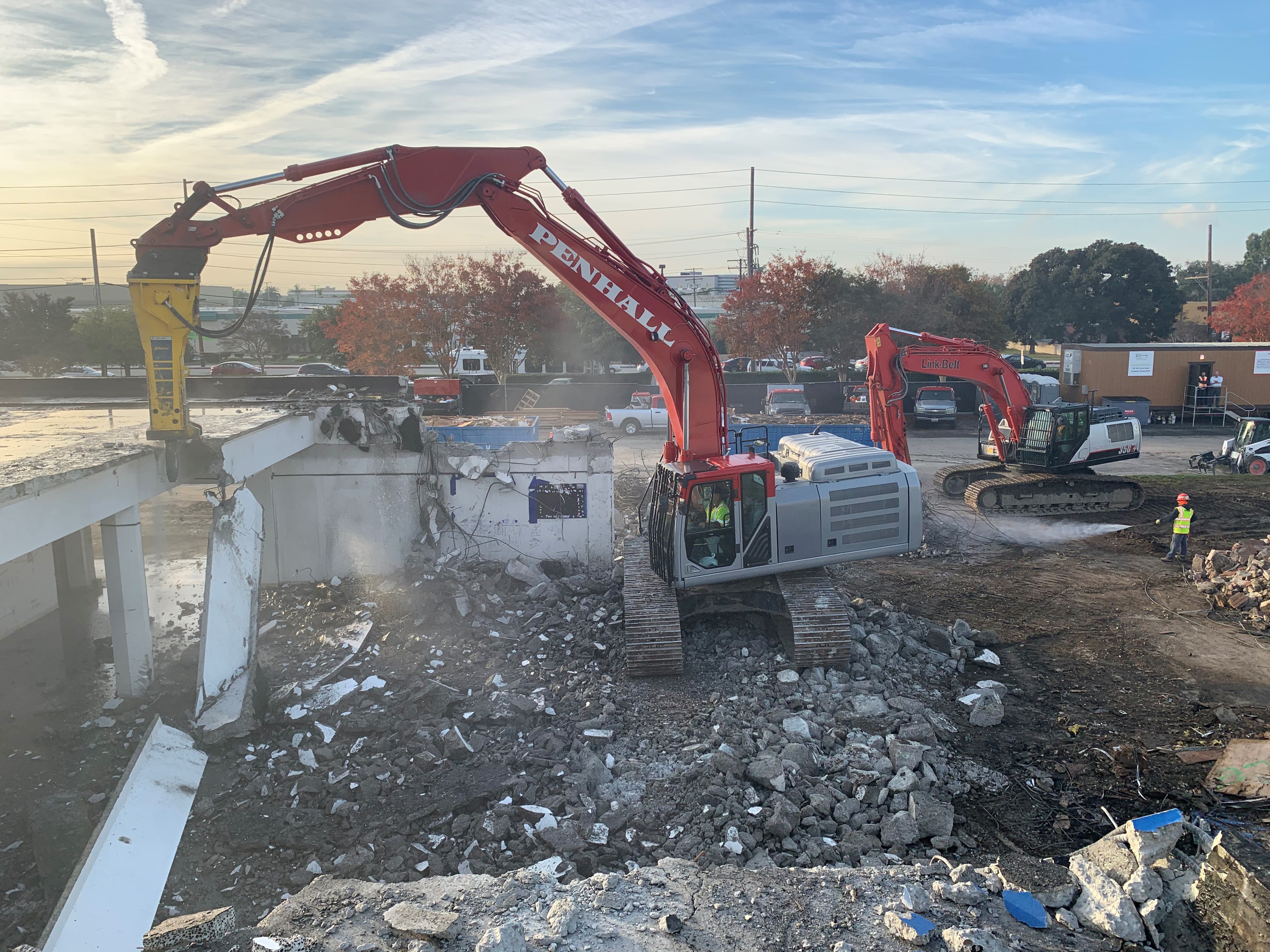
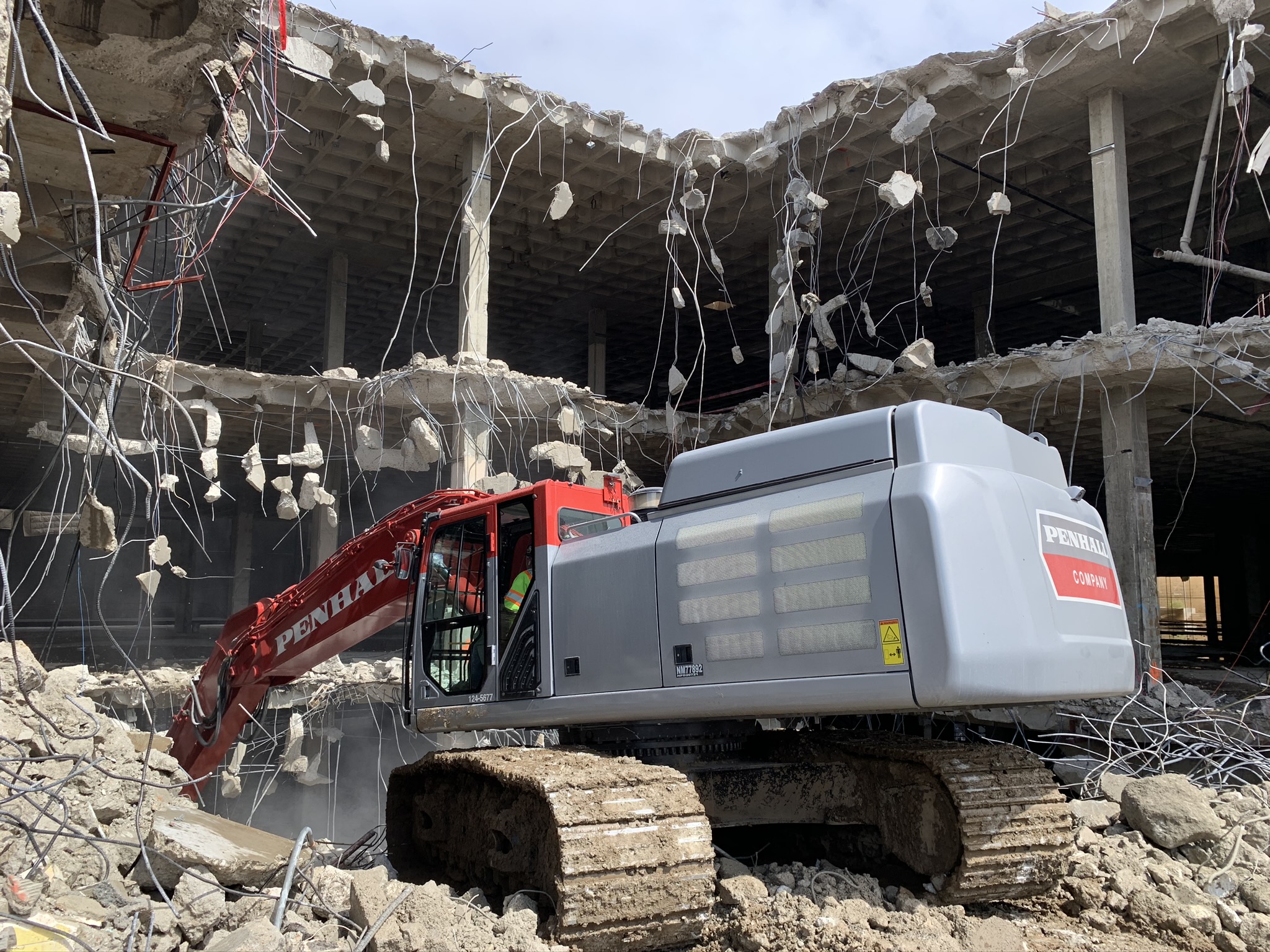
Excavator attachments are the core concrete demolition equipment class on most commercial and infrastructure projects. A modern excavator with a quick-coupler can run multiple attachment types in a single workday, matching the tool to each phase of the demolition sequence without moving the base machine. The main attachment categories used in concrete demolition work are hydraulic breakers, concrete crushers, concrete cutters and shears, and rotary drum cutters.
Hydraulic Breakers
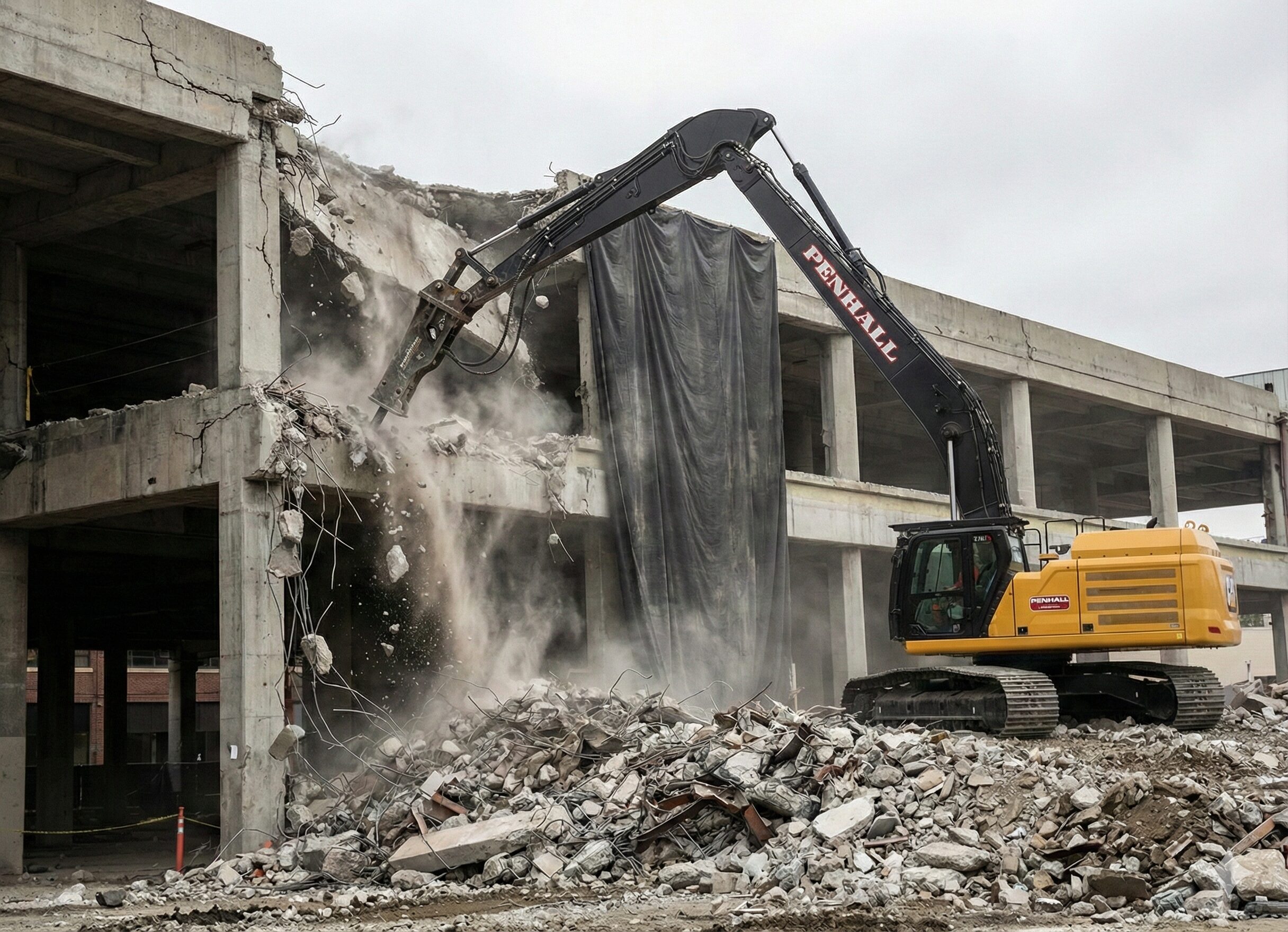
The hydraulic breaker (also called a hydraulic hammer) is the most widely used piece of concrete demolition equipment in commercial and infrastructure work. It operates as an excavator attachment by drawing hydraulic power from the excavator's hydraulic system to drive a steel chisel, moil point, or blunt tool into the concrete at high frequency, fracturing the material through rapid repetitive impact.
Hydraulic breakers are available in a wide range of operating weights, from small units in the 200 to 500 pound range suited to compact excavators working in confined areas, to massive units exceeding 10,000 pounds for use on large excavators demolishing heavy foundations, piers, and mass concrete structures. The impact energy delivered by a hydraulic breaker scales with size: smaller units deliver hundreds of foot-pounds per blow; large units deliver tens of thousands.
Hydraulic breakers are most effectively used for:
- General concrete breaking of slabs, pavements, driveways, and flatwork.
- Foundation and footing demolition where mass removal is the objective.
- Primary breaking of large structural concrete elements before crushing or processing.
- Pavement and roadway demolition on infrastructure and highway projects.
- Demolition of retaining walls, bridge abutments, and other mass concrete structures.
Concrete Crushers
A concrete crusher is an excavator attachment with two opposing jaws, typically tipped with hardened steel or carbide inserts, that crush concrete between them by hydraulic compression. Unlike breakers, which fracture concrete through impact, concrete crushers apply compressive force directly to the material, cracking and crushing it progressively between the jaws.
Concrete crushers are designed for two distinct roles in the demolition sequence. Primary concrete crushers have wide jaws capable of grasping and crushing large sections of structural concrete directly, making them suitable for demolishing reinforced beams, columns, walls, and slabs without pre-breaking. Secondary concrete crushers (sometimes called pulverizers or concrete pulverizer attachments) have narrower jaw profiles optimized for further reducing already-broken concrete to smaller, more uniform fragment sizes.
A key advantage of concrete crushers over hydraulic breakers in many applications is their ability to separate rebar from concrete during the crushing process. As the jaws compress and fragment the concrete, the steel reinforcement is exposed and can be extracted, either by the crusher's integral rebar cutters or by a separate shear attachment. This rebar separation reduces the volume of mixed-waste concrete and steel that must be disposed of together, and allows the clean concrete aggregate to be recycled separately.
Concrete crushers are particularly valuable for:
- Primary demolition of reinforced structural members including beams, columns, and walls.
- Secondary reduction of broken concrete to process-ready fragment sizes.
- Rebar separation and extraction during demolition to facilitate recycling.
- Demolition in areas where the impact energy and noise of a hydraulic breaker must be reduced.
- Processing demolished concrete for on-site recycling as subbase or fill material.
Concrete Cutters and Shears
Concrete cutters, also called hydraulic shears or demolition shears, are excavator attachments with scissor-action cutting jaws designed to cut through reinforced concrete members and structural steel. Unlike breakers and crushers, which work by impact and compression, concrete cutters sever material along a defined cutting plane, making them the precision tool in the excavator attachment toolkit.
Concrete cutters are available in multiple configurations. Concrete and steel shears have wide-jaw, high-force designs for cutting through reinforced concrete beams, columns, and walls as well as structural steel sections. Multi-demolition processors combine crusher and shear capabilities in a single rotating attachment head, allowing the operator to alternate between crushing and cutting functions without changing attachments.
The primary applications for concrete cutter attachments include:
- Cutting reinforced concrete beams, columns, and wall sections to defined lengths for removal.
- Severing structural steel framing, rebar bundles, and embedded steel sections during demolition.
- Selective demolition of specific structural members while preserving adjacent structure.
- Processing demolished structural members into manageable sections for loading and disposal.
- Cutting post-tensioned concrete members under controlled conditions, following structural engineer guidance and GPR-confirmed tendon locations.
Concrete cutters are not general-purpose breaking tools. They are precision cutting attachments best used in combination with breakers and crushers in a complete demolition equipment lineup, rather than as standalone tools for bulk concrete removal.
Rotary Drum Cutters
The rotary drum cutter is a specialized excavator attachment that represents a fundamentally different approach to concrete demolition than impact-based tools. Rather than fracturing concrete through impact or compression, a rotary drum cutter mills and removes concrete by rotating a drum fitted with hardened carbide-tipped cutting picks against the concrete surface. The picks cut and abrade the concrete progressively, removing material in a controlled, measured manner.
The rotary drum cutter's defining characteristic is its low-vibration operation. Because it removes concrete by milling rather than impact, it transmits minimal vibration to the surrounding structure, making it suitable for applications where vibration control is critical:
- Concrete removal in tunnel linings and underground structures where vibration could affect structural stability or the surrounding rock mass.
- Rehabilitation of bridge piers, abutments, and other infrastructure elements where the sound concrete surrounding the removal zone must not be damaged by vibration.
- Concrete removal adjacent to vibration-sensitive equipment, instrumentation, or occupied spaces.
- Selective removal of concrete to precise depths for overlay preparation or repair material placement.
- Concrete removal on historic structures or in proximity to historic masonry or heritage materials.
Demolition Robots
The demolition robot represents one of the most significant capability expansions in concrete demolition in the past two decades. Also called a remote-controlled demolition machine or RC demolition unit, a demolition robot is a compact, rubber-tracked machine fitted with a hydraulic breaker (and in some configurations, crusher or other attachments) that is operated entirely by remote control from a safe distance.
The fundamental advantage of demolition robots over excavator-mounted equipment is their ability to work where excavators cannot go: confined spaces, interior environments, low-clearance areas, and hazardous conditions that would be unsafe or impractical for a standard excavator and operator.
How Demolition Robots Work
A demolition robot is typically powered by a diesel or electric engine driving a hydraulic system that powers both the tracked undercarriage and the attachment tool. The wireless remote control unit gives the operator full directional control, attachment positioning, and tool activation from a distance of up to 300 feet or more depending on the system. Modern demolition robots are equipped with cameras that transmit a live view to the operator, allowing precise tool placement even when line-of-sight to the machine is limited.
Demolition robot platforms are available in several size classes, from compact units weighing approximately 1,500 to 2,000 pounds that can pass through standard doorways, to larger units of 5,000 to 8,000 pounds that deliver breaker performance approaching that of a small excavator. The choice of platform size is determined by the access constraints of the work area and the production rate required.
Applications for Demolition Robots
Demolition robots are not general-purpose equipment substitutes for excavators. They are specialized tools for specific access conditions. The scenarios where demolition robots are the appropriate choice include:
- Interior building demolition on multi-story structures where floor loading capacity or access constraints prevent excavator entry.
- Basement and underground demolition in confined spaces where standard equipment cannot be lowered or maneuvered.
- Low-ceiling parking structure demolition where the height clearance is insufficient for an excavator cab.
- Hazardous environment demolition including asbestos abatement zones, mold remediation, and radiological environments where minimizing human exposure is a priority.
- Bridge and overpass demolition in areas where the structure cannot support the weight of a full-size excavator.
- Demolition adjacent to live infrastructure, such as rail lines or active roadways, where the compact footprint of a robot reduces the exclusion zone required.
On projects where access allows both options, excavator-mounted equipment typically delivers higher production rates than demolition robots of comparable attachment size. Demolition robots are selected for access and safety, not for peak production capacity.
Demolition Robots and Remote Operation Safety
The remote operation capability of demolition robots is not just a feature for accessing confined spaces. It is a fundamental safety advantage in any application where the immediate environment of the demolition work is hazardous to an operator. A worker who would otherwise be standing over a jackhammer or operating a skid steer with a breaker attachment in an unstable structure is instead positioned safely away from the work area, controlling the robot through a camera and remote. The risk of injury from falling debris, structural collapse, or unexpected material behavior is substantially reduced.
Penhall's Behavior-Based Safety (BBS) program recognizes remote demolition operation as a standard risk-reduction tool when project conditions warrant, not an exotic option reserved for unusual projects.
Wire Saws for Large-Scale Structural Demolition
Wire sawing is not a breaking or crushing method. It is a diamond cutting method that uses a continuous loop of diamond-impregnated wire, driven at high speed around a series of guide pulleys, to make precise, clean cuts through virtually any thickness of reinforced concrete or structural steel. Wire saws are the tool of choice when the objective is a defined, clean cut through a large structural element rather than fragmentation and removal of a volume of concrete.
Wire sawing is used in concrete demolition for:
- Cutting through bridge piers, abutments, and columns to defined sections for controlled removal.
- Full-depth cuts through thick walls, mat foundations, and mass concrete structures.
- Cutting post-tensioned structural elements where the cutting plane must be precisely located relative to tendon positions confirmed by GPR scanning.
- Cuts in geometrically complex configurations that blade-based saws cannot reach.
- Precision cuts in vibration-sensitive environments, as wire sawing transmits minimal vibration compared to impact demolition methods.
Wire sawing requires more setup than excavator-mounted tools, including rigging of the wire loop and guide pulleys around the element being cut, and it commands higher per-cut rates than impact breaking. On projects where the required cut geometry, element thickness, or precision requirements rule out other methods, wire sawing is often the only viable approach.
Hydrodemolition for Selective Concrete Removal
Hydrodemolition is a concrete removal method that uses high-pressure water jets, typically 15,000 to 40,000+ PSI, directed against the concrete surface by a robotic machine to selectively remove deteriorated or target concrete while leaving sound material and embedded rebar intact. Unlike mechanical demolition methods that remove all concrete in their path, hydrodemolition exploits the difference in strength between deteriorated and sound concrete: the water pressure preferentially removes weaker material while leaving stronger material in place.
Hydrodemolition is the preferred removal method when:
- The removal zone includes rebar that must be preserved and cleaned in place for re-bonding with new concrete.
- A microfracture-free bonding surface is required for the new overlay or repair material.
- The boundary between deteriorated and sound concrete is variable and cannot be easily pre-defined, requiring a selective removal method that follows material quality rather than a fixed removal depth.
- Silica dust generation must be eliminated, as hydrodemolition produces no airborne dust.
- The scope involves a large surface area where robotic production rates provide a significant efficiency advantage over manual or mechanical methods.
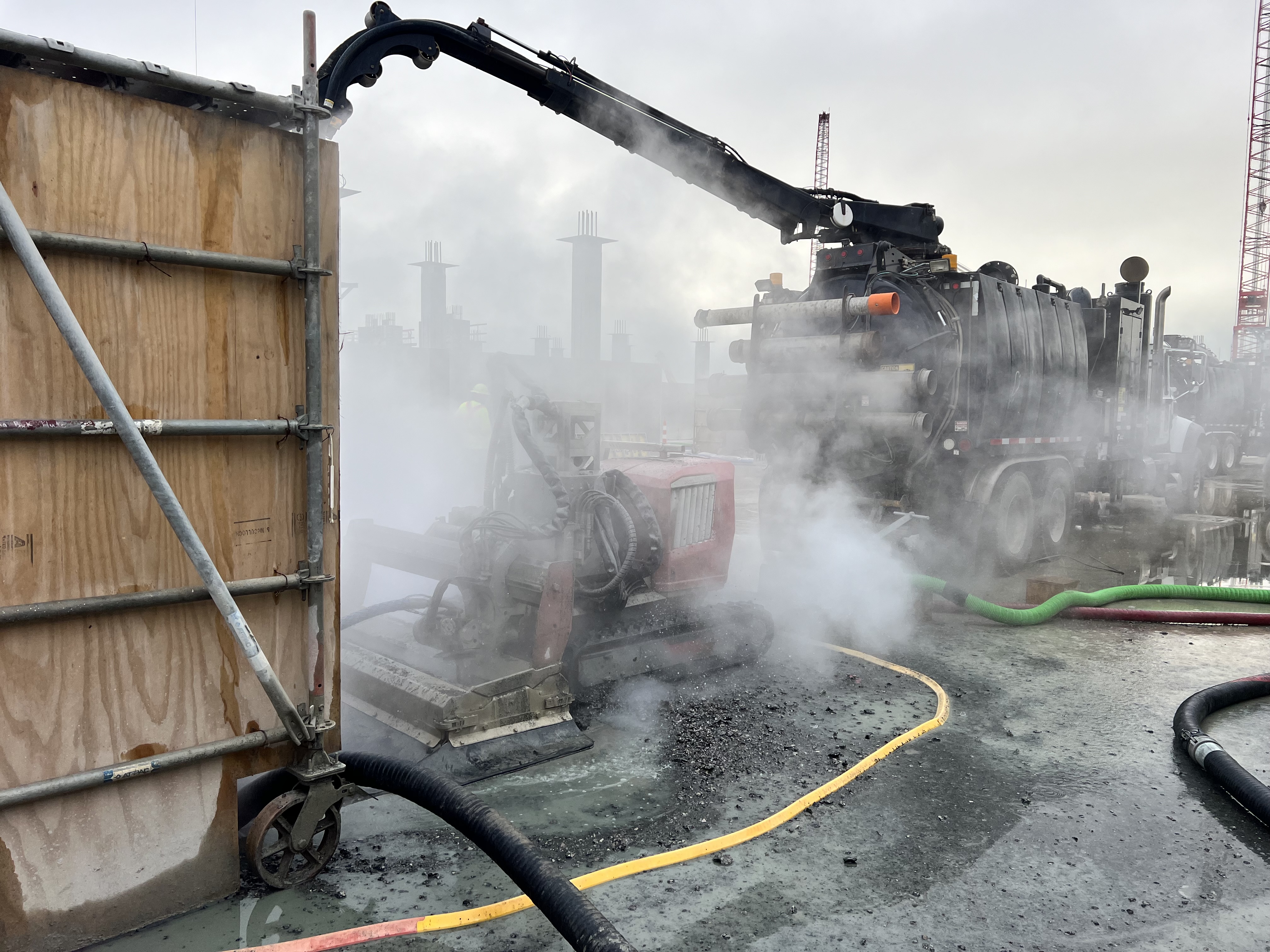
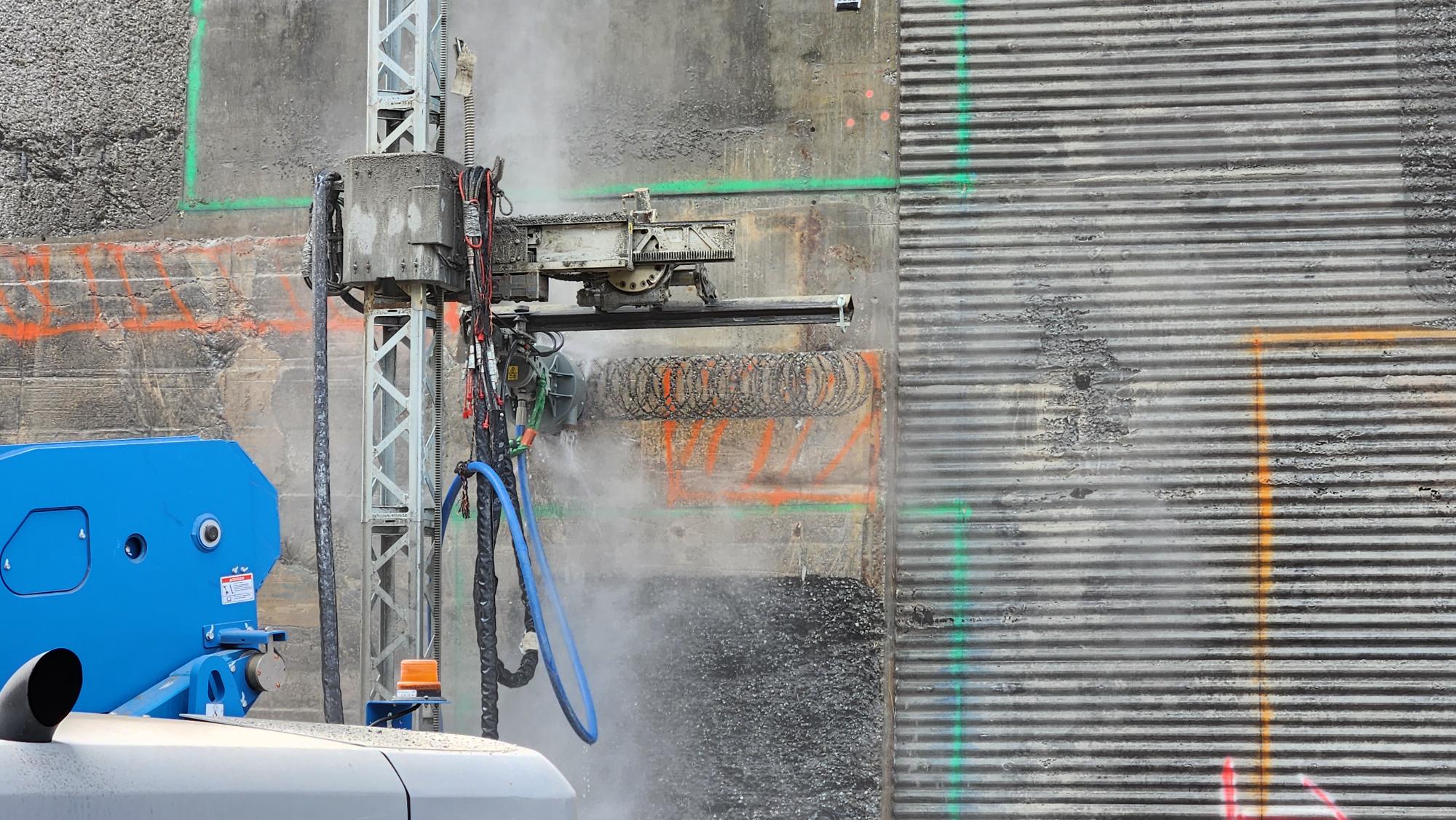
Hydrodemolition generates wastewater that must be collected, treated, and managed in compliance with EPA guidelines. On most projects, this is handled by integral wastewater collection systems on the hydrodemolition robot and supplemental treatment equipment on site.
Handheld and Rig-Mounted Concrete Demolition Tools
Not every concrete demolition task calls for excavator-mounted equipment or specialty robots. A range of handheld and rig-mounted concrete demolition tools are used for detail work, confined-area breaking, and small-scale removal that is impractical or disproportionately costly to perform with larger equipment.
Electric and Pneumatic Breakers
Handheld electric and pneumatic breakers (also called chipping hammers or demolition hammers) deliver impact energy at the scale needed for manual concrete breaking, spalling, and chipping. They are used for removing small areas of deteriorated concrete, opening up cores for inspection, breaking isolated areas in confined spaces, and detail work at the edges and perimeters of larger machine-performed demolition scopes.
Electric breakers in the 15 to 70 pound class are the standard tool for floor-level work. Pneumatic breakers (air hammers) are used where electrical power is not available or where spark hazard concerns apply. Both tool types are subject to OSHA's silica standard and require dust suppression or respiratory protection for the operator.
Core Drilling for Demolition Relief Cuts
Core drilling is not typically classified as a demolition tool, but it plays an important supporting role in many selective demolition scopes. Relief cores drilled at the corners of planned openings allow saw cuts to terminate cleanly without overrunning the cut line. Closely spaced cores along a planned cut line can define the edge of a removal zone in areas where a saw cannot reach the full required depth. And core drilling is used to create inspection access into a slab or wall to verify conditions before committing to a larger removal scope.
How Equipment Is Selected for a Demolition Project
Equipment selection for a concrete demolition project is not a catalog decision. It is an engineering and field judgment process that considers multiple variables simultaneously. The factors that most significantly affect which concrete demolition tools and equipment are appropriate for a given project include:
Structural System and Reinforcement Type
The type of concrete and reinforcement in the structure defines the baseline equipment requirement. Plain concrete responds well to hydraulic breaking. Heavily rebar-reinforced concrete requires a rebar-separation step (crusher or shear) after breaking. Post-tensioned concrete requires GPR scanning before any breaking or cutting to locate tendon positions, and PT cables must be de-stressed in a controlled sequence before cutting through them. Structural review by an engineer of record is required before any demolition of PT structural members proceeds.
Volume and Production Rate Requirements
The volume of concrete to be removed and the project schedule together define the required production rate. High-volume demolition on tight schedules calls for the largest practical excavator-mounted equipment, potentially running multiple shifts or multiple machines in parallel. Smaller volumes in less time-critical scopes may be handled efficiently by compact equipment or demolition robots, eliminating the cost and logistics of mobilizing a large excavator fleet.
Access and Overhead Constraints
Access is often the controlling factor in equipment selection. Interior demolition in an occupied building is limited by doorway dimensions, floor loading, and overhead clearance. Basement demolition requires either equipment that can be lowered in sections or demolished-down, or a demolition robot that fits through existing access points. Bridge and elevated structure work may be constrained by load-bearing capacity of the structure below the work area. Each constraint narrows the practical equipment options and may require specialty equipment where standard tools cannot be used.
Vibration and Noise Constraints
Many commercial and infrastructure demolition projects impose vibration and noise constraints driven by adjacent occupied spaces, sensitive equipment, historic structures, or regulatory requirements. Hydraulic breakers are the most vibration-intensive option. Rotary drum cutters, wire saws, diamond saw cutting, and hydrodemolition all deliver significantly lower vibration transmission. On projects with tight vibration limits, vibration monitoring is set up at the constraint boundary, and equipment selection and operating parameters are calibrated to stay within the permitted limits.
Environmental and Regulatory Requirements
Demolition in environmentally sensitive areas, near waterways, or in facilities with hazardous material concerns imposes requirements that affect equipment selection and operating procedures. Hydrodemolition requires wastewater management. Hydraulic breaking near waterways may require containment of debris and water. Interior demolition in buildings with asbestos or lead paint requires equipment and procedures compatible with hazmat abatement protocols. Silica dust controls under OSHA's silica standard apply to all concrete demolition methods that generate respirable dust.
Pre-Work Scanning Before Concrete Demolition
Regardless of which concrete demolition equipment is selected for a project, the standard first step before any demolition work begins on a commercial or infrastructure structure is a GPR scan of the work area.
GPR scanning before demolition serves three purposes. First, it identifies post-tension cables and their locations, enabling the demolition sequence to be planned around them and triggering the structural engineering review required before PT cables can be cut. Second, it maps embedded utilities (electrical conduit, plumbing, gas lines, data cables) that must be isolated or relocated before demolition exposes them. Third, it provides the rebar layout information needed to select the right combination of breaking and processing equipment for the reinforcement density present.
The cost of a GPR scan before demolition is a small fraction of the cost of hitting an undetected PT cable, severing a live utility, or demolishing a structural element in a sequence that compromises the surrounding structure. On any project where the interior condition of the concrete is not fully confirmed by current, verified structural drawings, scanning before demolition is the professional standard of care.
Penhall's Concrete Demolition Services
Penhall Company provides selective and full concrete demolition services on commercial and infrastructure projects across North America, using a project-matched equipment approach that draws on the full range of concrete demolition tools and systems rather than a single-equipment methodology.
Penhall's demolition capabilities span the full equipment spectrum described in this guide. Penhall brings the breadth of equipment and the field expertise to match the right tool to each phase of a complex scope, combining breaker, crusher, wire saw, core drill, and scanning resources under a single project.
Penhall's integrated service model means that pre-work scanning, concrete cutting, coring, and demolition are coordinated under a single contract, eliminating the coordination overhead of managing multiple specialty subcontractors for related scopes. For post-tensioned structures, Penhall coordinates with structural engineers as a standard protocol before any demolition of PT elements proceeds.
Penhall's full concrete services offering includes:
Selective and full demolition: hydraulic breaking, crushing, wire sawing, demolition robot operations, and controlled PT demolition.
Hydrodemolition: robotic high-pressure water concrete removal for bridge decks, parking structures, and large-scale rehabilitation.
Concrete cutting: flat sawing, wall sawing, wire sawing, and hand sawing for demolition, renovation, and infrastructure work.
Concrete coring: core drilling for relief cuts, investigation access, and utility penetrations supporting demolition scopes.
GPR concrete scanning: pre-demolition scanning for PT cable location, rebar mapping, and embedded utility identification.
Structural repair: concrete restoration and repair following demolition, including FRP strengthening.
As North America’s largest provider of concrete cutting, coring, and demolition services, with locations across the country, Penhall can mobilize quickly for slab scanning and concrete work in any region.