At a Glance
- Concrete floor deterioration in warehouses, manufacturing plants, and distribution centers follows predictable patterns. Early identification of damage type determines the right repair strategy.
- Patching is appropriate for localized, isolated damage covering less than 25% of the floor surface with no underlying structural issues.
- Resurfacing works best when damage is widespread but shallow, and when the existing slab retains structural integrity.
- Full removal and replacement is warranted when the slab has systemic structural failure, extensive subbase problems, or when repeated patching has failed.
- Surface preparation is the single biggest factor in repair durability. A repair that bonds poorly to the existing slab will fail regardless of the material used.
- Scarifying and shaving the concrete before any repair restores proper surface profile and removes contamination that prevents bonding.
- Consulting a qualified contractor early in the evaluation process prevents costly over-engineering or under-engineering of the repair scope.
Why Industrial Concrete Floors Deteriorate
Concrete floors in commercial and industrial settings endure conditions that accelerate deterioration far beyond what residential or light commercial slabs experience. Forklift traffic, heavy point loads from racking systems, chemical spills, thermal cycling, and deicing salt infiltration all work against slab integrity over time.
The result is a spectrum of damage conditions, from minor surface scaling to full-depth cracking and subbase failure. Each condition has a distinct cause, a distinct failure mechanism, and a distinct repair approach. Misidentifying the damage type leads to repairs that fail early, which wastes budget and creates the same safety and operational hazards the repair was meant to eliminate.
Understanding what you are looking at before committing to a scope of work is the foundation of effective concrete floor repair in warehouses, manufacturing plants, and distribution centers.
Evaluating Floor Condition: A Systematic Approach
Before any decision about patching, resurfacing, or replacement, a proper condition assessment is necessary. The assessment should cover four areas.
Surface condition. Look for scaling, spalling, delamination, and surface erosion. These are the most visible signs of deterioration, but surface damage alone does not indicate the depth or severity of the problem.
Crack mapping. Document crack patterns, widths, and locations. Hairline shrinkage cracks are normal and generally non-structural. Cracks wider than 1/4 inch, pattern (map) cracking across large areas, and cracks with vertical displacement (faulting) are more serious indicators of structural movement or subbase failure.
Slab stability. Rocking or deflecting slabs indicate voids beneath the surface. Chain drag testing, where an experienced contractor drags a chain across the floor and listens for hollow sounds, is a simple field method. Ground-penetrating radar provides a more definitive picture of void locations and subbase conditions.
Joint condition. Control joints and expansion joints protect the slab from stress buildup. When joint edges have spalled or the joint filler has failed, wheels and forks impact the unsupported edge repeatedly, causing progressive damage in a pattern called joint edge spalling or joint deterioration.
This assessment produces a damage map of the facility, which forms the basis for the repair decision matrix.
The Decision Framework: Patch, Resurface, or Replace
No single rule covers every situation, but the following criteria provide a starting framework for facility managers and project engineers working through the decision.
When to Patch
Patching is appropriate when:
- Damage is localized to specific areas representing less than 20 to 25 percent of the total floor surface
- The surrounding slab is structurally sound with no evidence of voids, subbase failure, or systemic cracking
- Damage is full-depth in isolated areas, such as around drain openings, column bases, or areas with documented point load history
- Joint edge spalling is limited in scope and confined to identifiable high-traffic lanes
Resurfacing is not a structural repair. If applied over a slab with movement, voids, or ongoing cracking, the overlay will reflect the same cracks and fail. A resurfacing decision must be preceded by a subbase assessment and any necessary void filling.
When to Replace
Full removal and replacement is the appropriate scope when:
- Structural cracking is systemic, with crack widths exceeding 1/4 inch, vertical displacement, or pattern cracking across more than 30 to 40 percent of the slab area.
- Subbase investigation reveals extensive voids, saturated soils, or compromised base course material.
- Previous repair attempts have failed repeatedly in the same locations, indicating an underlying condition that surface repairs cannot address.
- The floor has settled unevenly and cannot be corrected to acceptable flatness tolerances without full-depth work.
- Chemical contamination has penetrated the full slab depth, preventing adequate bond for any overlay or patch system.
Replacement is the highest-cost option in the short term but is often the most cost-effective decision over the facility's operational life when the underlying conditions make lower-intervention approaches unreliable.
Surface Preparation: The Factor That Determines Repair Success
Surface preparation receives less attention than material selection in most discussions of concrete floor repair, but it has greater influence over long-term repair performance. A premium repair material applied to a poorly prepared substrate will fail. A standard repair material applied to a properly prepared substrate will outperform it significantly.
The goal of surface preparation is twofold: remove all contamination that would inhibit bond, and create a surface profile that gives the repair material mechanical interlock with the existing concrete.
Common Contamination Sources in Industrial Facilities
- Hydraulic fluid and lubricant infiltration from equipment maintenance
- Forklift battery acid
- Curing compounds and surface sealers from previous treatments
- Laitance (the weak surface layer that forms during concrete placement)
- Carbonation of the concrete surface from atmospheric exposure
Any of these contaminants, left in place, creates a bond-breaking layer between the old concrete and the repair material. Mechanical preparation removes them.
Mechanical Preparation Methods
Shot blasting is the standard preparation method for large floor areas. It removes the surface layer, exposes aggregate, and creates a consistent surface profile (measured in CSP, or Concrete Surface Profile). Shot blasting is fast, contained, and produces minimal dust with proper equipment.
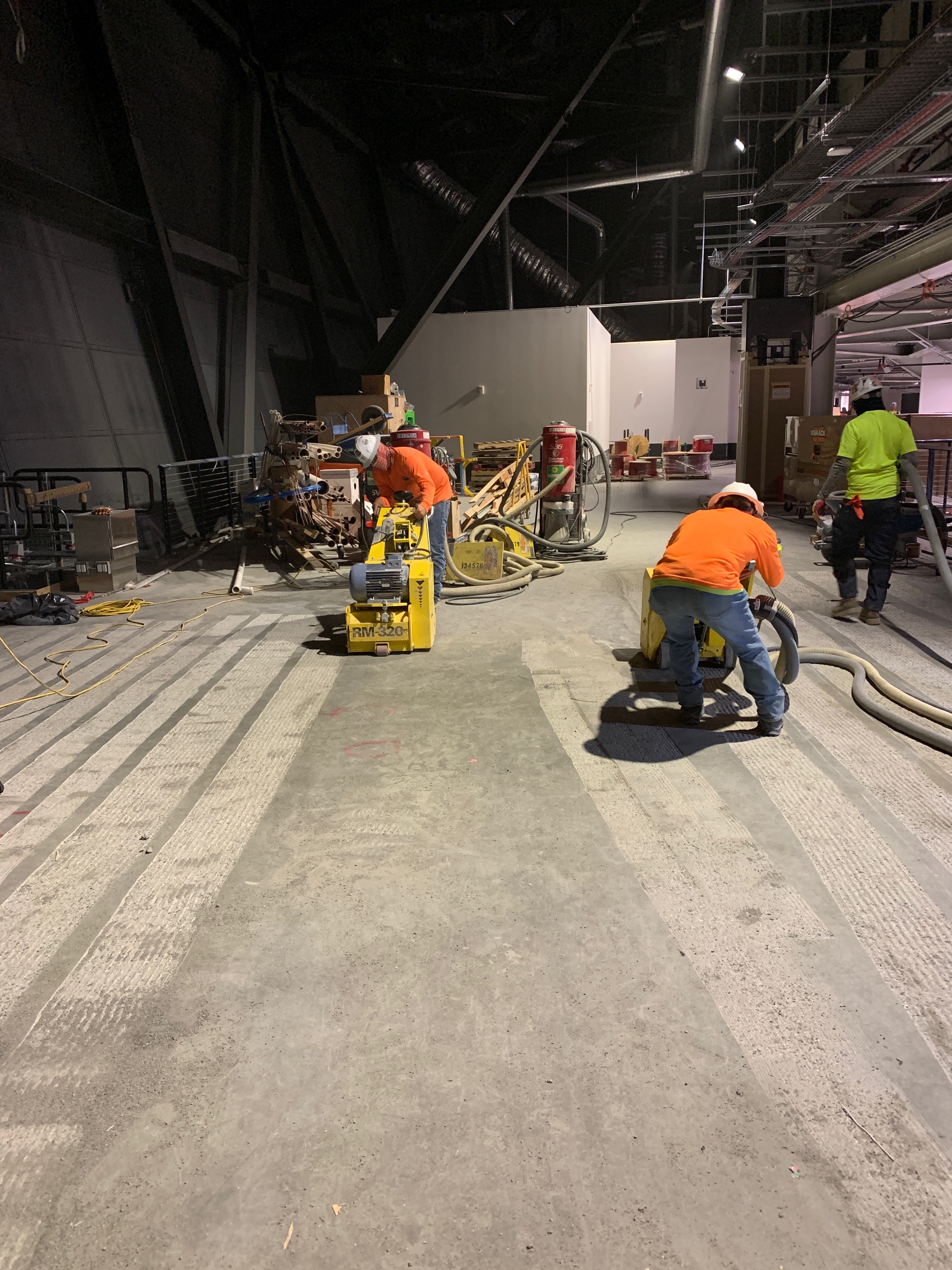
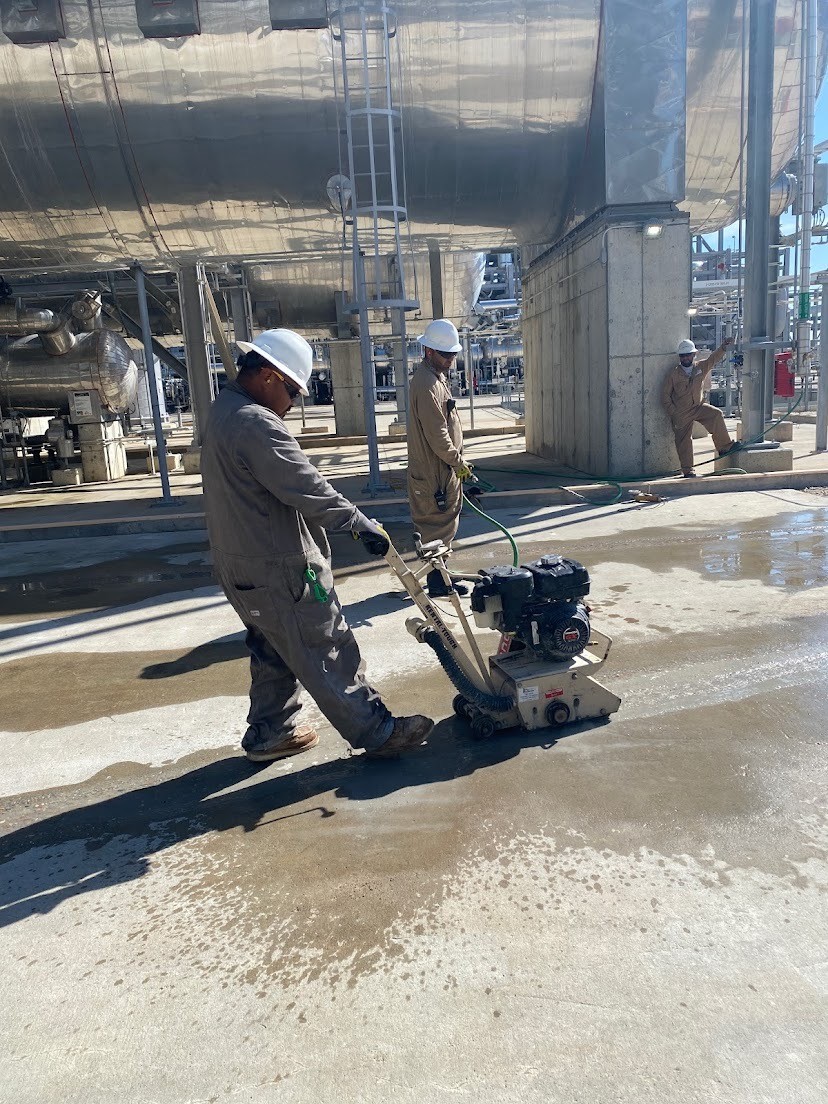
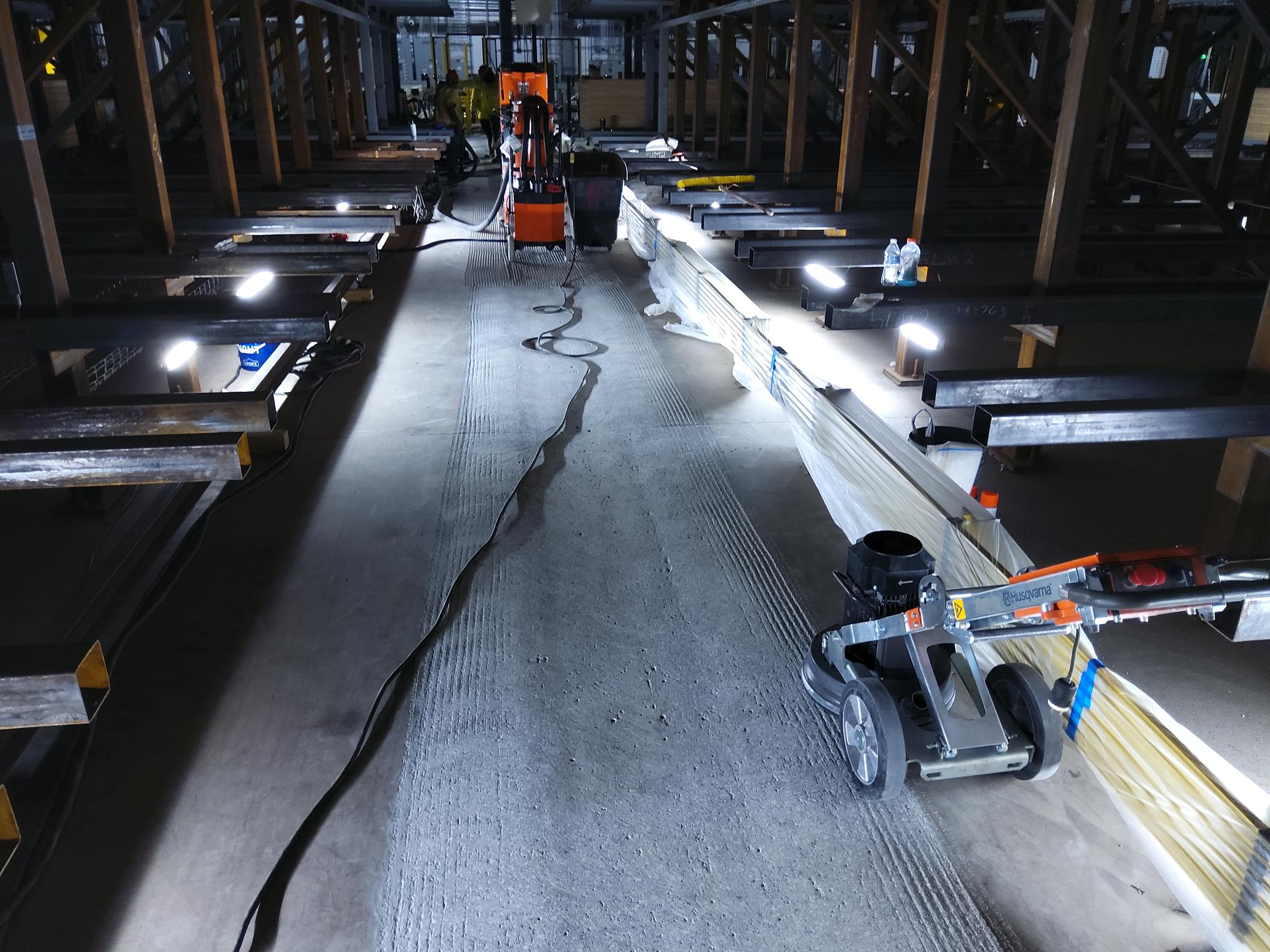
Scarifying and shaving is used when more aggressive material removal is needed, when existing coatings must be removed, or when high spots must be brought down to restore floor flatness. Scarifying cuts into the concrete surface with rotating carbide cutters, producing a more open, aggressive profile suitable for thick overlays or where the surface layer is significantly contaminated or deteriorated.
Grinding is appropriate for lighter profiling work, seam preparation, or when the objective is a smoother finish profile.
Saw cutting defines the perimeter of patch areas with clean, vertical edges. Feathered edges on patches fail; saw-cut boundaries with a minimum depth of 1/4 inch prevent edge delamination.
Profile Requirements by Repair Type
- Thin overlays (less than 1/4 inch): CSP 3 to 4 (shot blast or light scarify)
- Thick overlays (1/4 inch or greater): CSP 5 to 7 (medium to heavy scarify)
- Full-depth patching: saw cut perimeter, removal to sound concrete, aggregate exposure
Getting surface preparation right requires equipment matched to the scale of the project and operators experienced with industrial floor conditions. Over-preparation (too aggressive a profile for the overlay thickness) and under-preparation (insufficient profile for bond strength) are both common errors.
Special Considerations for Warehouses and Distribution Centers
Warehouse floor repair introduces operational constraints that manufacturing environments may not share. The floor is a production asset. Downtime for repairs has a direct cost in throughput, and repairs that fail within months of installation create recurring disruptions.
Several factors specific to warehouse and distribution center floor repair warrant attention.
Floor flatness tolerance. Modern racking systems and high-reach forklifts operate within strict floor flatness tolerances (F-number systems define these limits). A repair that restores the floor structurally but leaves a high spot or low spot within a racking aisle creates an equipment clearance problem. Grinding and shaving after patching or resurfacing may be required to restore tolerance.
Joint protection. Armored joint systems, where a steel or polymer insert is installed at the joint edge, substantially extend joint life in high-traffic aisles. If joints are being opened for repair, incorporating armored joints is worth evaluating for the aisles with the highest forklift frequency.
Rapid-return materials. Standard repair mortars cure over 24 to 72 hours. Rapid-setting repair materials return to service in as little as one to four hours, which significantly reduces the operational impact of floor repair in active facilities. These materials carry a cost premium, but the tradeoff is often favorable when dock throughput is the constraint.
Staging repair in sections. Large-scale floor repair in operating warehouses is almost always staged in sections, working around active racking and operations. Proper sequencing and coordination with facility operations is as important to project success as the technical execution.
Working With a Qualified Contractor
Industrial concrete floor repair is not a commodity service. The range of damage conditions, substrate variables, repair materials, and preparation requirements means that contractor experience and equipment capability have a direct effect on repair longevity.
When evaluating contractors for warehouse floor repair or industrial concrete floor repair, look for:
- Direct experience with your facility type (warehouse, manufacturing, food processing, etc.)
- Access to appropriate surface preparation equipment for the project scale
- Familiarity with rapid-return material systems if operational constraints are tight
- A clear assessment process before the scope is defined, not after
Scope definition before assessment is a risk signal. A contractor who quotes square footage without a floor condition assessment is pricing based on assumptions. Those assumptions may be wrong in either direction.
The Bottom Line: Matching the Repair to the Condition
Concrete floor repair in commercial and industrial facilities works best when the decision follows the condition rather than leading it. Patching, resurfacing, and replacement are each the right answer for a specific set of conditions. The cost difference between them is significant, and so is the operational disruption. Getting the assessment right at the front end avoids the more expensive outcome of a repair approach that does not match the actual damage.
Surface preparation is what makes any of these approaches work. The repair material is only as durable as the bond to the substrate beneath it.
For facilities with active deterioration or upcoming floor repair work, early involvement of an experienced contractor produces better scope definition and better outcomes than waiting until conditions become critical.
Learn more about Penhall's capabilities in structural repair and scarifying and shaving.