
At a Glance
- Plain concrete is strong in compression but weak in tension. Concrete reinforcement, most commonly steel rebar, post-tension cables, or welded wire, compensates for this weakness by carrying the tensile forces that concrete alone cannot resist.
- The four primary types of concrete reinforcement are: mild steel rebar, post-tensioned (PT) cables and tendons, welded wire reinforcement (WWR), and fiber reinforcement. Fiberglass (GFRP) rebar is a growing alternative in corrosion-sensitive applications.
- Post-tensioned concrete is fundamentally different from conventionally reinforced concrete. PT cables are under extreme tension and cannot be cut without triggering a potentially catastrophic structural event. GPR scanning before any cutting or coring in PT structures is non-negotiable.
- Embedded utilities, electrical conduit, plumbing, gas lines, data cables, hydronic tubing, are routinely cast into concrete during construction and create serious hazards if encountered unexpectedly during cutting, coring, or demolition.
- Reinforcement type and density are the two most significant variables driving the cost and complexity of concrete cutting, coring, and demolition work.
- Penhall Company offers GPR concrete scanning to identify reinforcement and utilities before any cutting or coring begins, as well as full concrete cutting, coring, and demolition services nationwide.
Why Concrete Needs Reinforcement
Concrete is one of the most widely used construction materials in the world, and for good reason. It’s extraordinarily strong in compression, able to resist the crushing forces of heavy loads, tall structures, and the weight of the built environment. A standard 4,000 PSI concrete mix can withstand roughly 4,000 pounds of compressive force per square inch before failing.
But concrete has a significant structural limitation: it is weak in tension. Tensile strength, resistance to being pulled apart or bent, is typically only about 10 percent of its compressive strength. A 4,000 PSI concrete mix may have a tensile strength of just 300 to 400 PSI. That’s enough for a simple footing on stable, uniform soil, but it’s nowhere near adequate for a beam that spans an opening, a slab that must carry vehicle loads, a bridge deck subjected to dynamic stress, or any structural element that experiences bending.
When a concrete beam bends under load, the top surface is in compression and the bottom surface is in tension. Without reinforcement, the tension side cracks and the beam fails. Concrete reinforcement solves this problem by embedding materials with high tensile strength inside the concrete, creating a composite structural system in which each material contributes what it does best: concrete carries compression, reinforcement carries tension.
This is the foundational principle behind all reinforced concrete materials, and understanding it is the first step toward understanding why different reinforcement types are used in different applications, and why what’s inside a concrete structure matters so much to anyone working on it.
Types of Concrete Reinforcement
Mild Steel Rebar (Deformed Reinforcing Bar)
Mild steel rebar is the most common form of concrete reinforcement in the world. Rebar, short for reinforcing bar, consists of steel bars with a deformed (ribbed or lug) surface profile that provides mechanical bond with the surrounding concrete. The deformations prevent the bar from simply sliding through the hardened concrete matrix when tension is applied.
Rebar is categorized by grade, diameter, and yield strength. In North America, the most common grades are:
Grade 40 (40,000 PSI yield strength): used in lighter residential applications, now largely replaced by Grade 60 in most markets.
Grade 60 (60,000 PSI yield strength): the standard for most commercial and industrial construction in the United States.
Grade 75 and Grade 80: higher-strength bars used in applications requiring greater tensile capacity with smaller bar diameters, such as precast elements or seismic-resistant structures.
Bar size is designated by number in the U.S. system, #3 through #18, where the number roughly corresponds to the bar’s diameter in eighths of an inch. A #4 bar is approximately 1/2 inch in diameter; a #8 bar is approximately 1 inch in diameter. The larger the bar, the more tensile force it can carry, and the more resistance it presents to a diamond blade or drill bit.
Rebar is a passive reinforcement system. It does not carry any load until the concrete around it cracks and the tensile force is transferred to the steel. At that point, the rebar resists the tension and prevents the crack from widening into a structural failure. This is fundamentally different from post-tensioned reinforcement, which actively prestresses the concrete before any load is applied.
How Rebar Affects Cutting and Coring
Rebar is the reinforcement type most commonly encountered during concrete cutting and coring operations, and it has a significant impact on both cost and production rates. Diamond blades and drill bits are designed to cut through concrete, they can cut through rebar as well, but at a much higher rate of wear.
When a diamond blade or core bit encounters steel, the abrasive particles that do the cutting are consumed far faster than when cutting plain concrete. A blade that might yield 500 linear feet on an unreinforced slab may yield only 150 to 200 feet on a heavily reinforced one. That is a 2.5x to 3x increase in blade cost alone, before accounting for the slower cutting speed.
The density and orientation of rebar also matters. A single layer of #4 bars at 12 inches on center is manageable. Multiple layers of #8 bars at 6 inches on center in both directions represents a much more challenging and costly cutting environment. Experienced contractors account for this variability when pricing work, which is why rebar information is essential input for any accurate cutting or coring estimate.
Post-Tensioned Cables and Tendons
Post-tensioned (PT) concrete is a form of prestressed concrete in which high-strength steel tendons or cables are threaded through the slab or beam, typically enclosed in plastic sheaths, and then tensioned using hydraulic jacks after the concrete has reached sufficient strength. The tension is locked in place using steel anchors cast into the edge or soffit of the structural member. Once the jacks are removed, the cables remain under permanent high tension, placing the entire concrete section in compression.
This prestress dramatically changes the structural behavior of the concrete. A post-tensioned slab or beam can span greater distances, carry heavier loads, and be constructed with less material than an equivalently performing conventionally reinforced section. This is why PT concrete is widely used in:
Parking structures and podium decks
High-rise building floors and transfer plates
Bridge decks and box girders
Large-span commercial and industrial slabs
Swimming pools and water-retaining structures
The Life-Safety Risk of Cutting Post-Tensioned Concrete
Post-tensioned cables are under enormous tension, typically 150,000 to 270,000 PSI of stress in the steel itself. A single 0.5-inch diameter PT strand carries a jacking force of approximately 30,000 to 33,000 pounds. When a PT cable is cut, the stored energy in the strand is released instantaneously and violently. The cable can retract at high speed, destroying the concrete around it, projecting fragments, and potentially causing structural collapse if multiple tendons are cut.
This is not a theoretical risk. It is a documented cause of fatalities on construction sites. Cutting through a PT cable with a concrete saw or core drill without knowing it is there is one of the most dangerous situations in concrete work.
The protocol for working in post-tensioned concrete is non-negotiable:
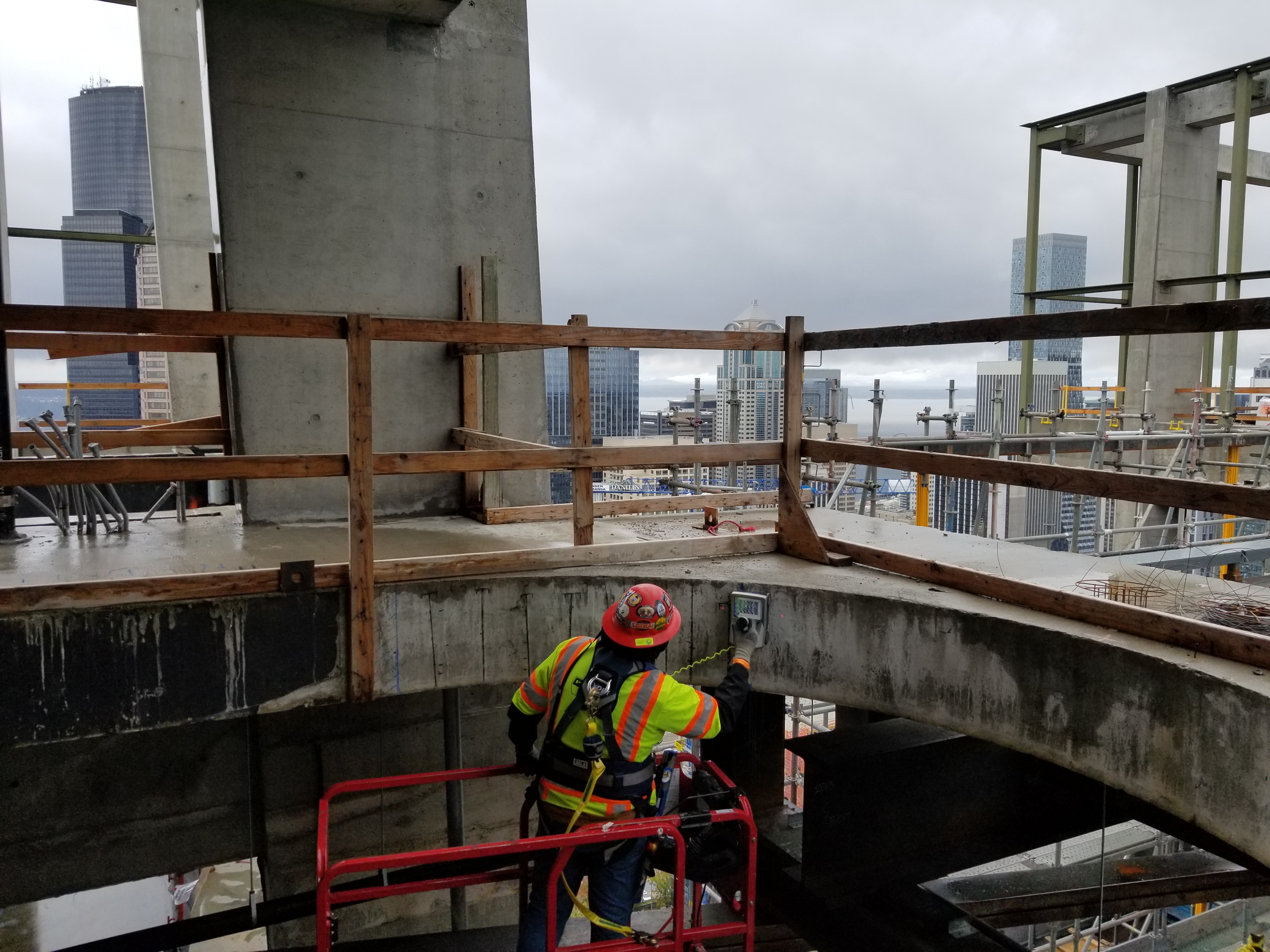
A GPR (Ground Penetrating Radar) scan must be performed before any cutting or coring to locate PT tendons.
Structural drawings must be reviewed to confirm PT layout, tendon spacing, and anchor locations.
Cut and core locations must be planned to avoid PT cables, ideally with structural engineer review.
If a PT cable must be cut as part of a planned renovation or demolition, the structure must first be assessed by a structural engineer, and the cables must be de-stressed in a controlled sequence before cutting begins.
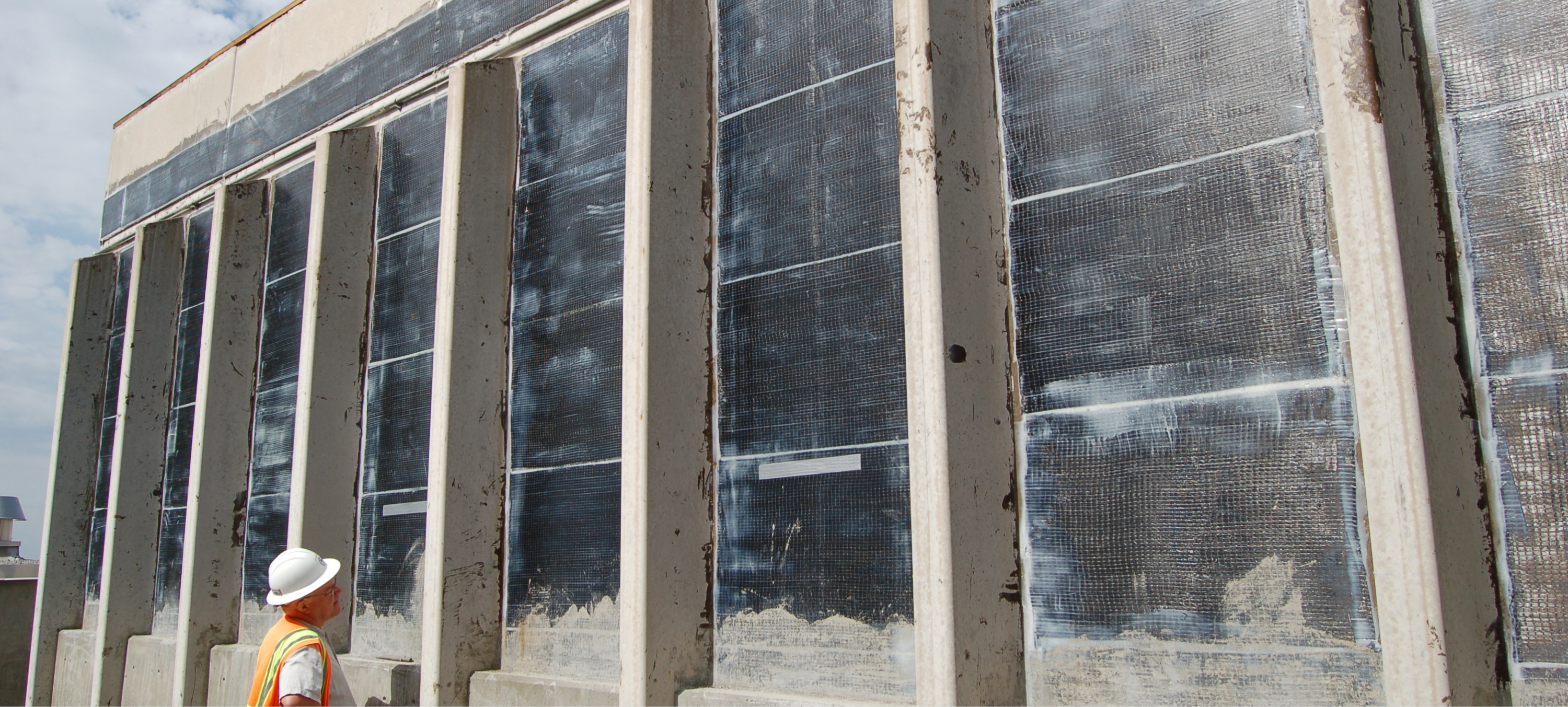
Penhall’s crews are trained to identify indicators of post-tensioned construction, anchor pockets, PT end caps, tendon blisters on slab edges and soffits, and to require GPR scanning before proceeding with any cutting or coring in PT structures.
How to Identify a Post-Tensioned Slab
Visual and documentary indicators of post-tensioned construction include:
Anchor pockets or stressing pockets: rectangular or rounded recesses on the slab edge or soffit where the PT jacking equipment was applied.
PT end caps: plastic caps covering exposed tendon ends, usually visible at slab edges or in parking structure fascias.
Tendon blisters: raised profiles on the slab soffit indicating the path of draped tendons in two-way PT slabs.
Construction drawings: structural drawings that specify “post-tensioned” design, tendon layout, and anchor schedules.
Thinner-than-expected slabs: PT construction allows slabs to be thinner than conventional rebar designs for the same span. An unexpectedly thin slab for its span length should raise suspicion.
When in doubt, the only reliable answer is a GPR scan. Visual indicators can be obscured by finishes, coatings, or previous repairs. Structural drawings may not be available for older buildings. GPR scanning provides direct subsurface evidence of what is inside the slab before any work begins.
Welded Wire Reinforcement (WWR)
Welded wire reinforcement (also called welded wire fabric or WWF) consists of a grid of steel wires, smooth or deformed, welded at each intersection to form a flat mat or roll. It is used primarily in slabs-on-ground, precast panels, and light structural applications where a distributed, uniform reinforcement pattern is more efficient than individually placed rebar.
WWR is specified by wire spacing and wire diameter. Common designations follow the W-number system (smooth wire) or D-number system (deformed wire), where the number indicates the cross-sectional area of the wire in hundredths of a square inch. A W4 wire has a cross-sectional area of 0.04 square inches; a W8 has 0.08 square inches.
In terms of impact on cutting and coring operations, WWR is generally less aggressive than rebar, the individual wires are smaller in diameter and the steel volume is lower, but it still accelerates blade and bit wear relative to plain concrete. Its presence should be noted when scoping cutting and coring work.
Fiber Reinforcement
Fiber reinforcement involves adding discrete fibers directly to the concrete mix during batching, distributing reinforcement uniformly throughout the concrete matrix rather than placing it in specific locations. Fibers are used primarily to control plastic shrinkage cracking, improve impact and abrasion resistance, and in some applications, partially or fully replace traditional reinforcement in non-structural elements.
The main types of fiber reinforcement used in concrete are:
Steel fibers: hooked, crimped, or straight steel filaments that improve post-crack flexural toughness and impact resistance. Used in industrial floors, precast tunnel segments, and shotcrete.
Synthetic fibers (polypropylene, nylon, polyethylene): primarily used in low dosages to control plastic shrinkage cracking during curing. At higher dosages, structural synthetic fibers can contribute meaningfully to flexural performance.
Glass fibers (GFRC): used in glass fiber reinforced concrete panels and architectural precast. Alkali-resistant glass formulations are required for long-term durability in concrete.
Basalt fibers: an emerging option offering high tensile strength and corrosion resistance, derived from volcanic rock.
From a cutting and coring standpoint, fiber-reinforced concrete presents relatively minor additional resistance compared to plain concrete in most applications. Steel fiber concrete at higher dosages can increase blade and bit wear to a degree, but far less dramatically than rebar or PT cables.
Fiberglass (GFRP) Rebar
Glass fiber reinforced polymer (GFRP) rebar is a non-metallic alternative to steel rebar that is gaining adoption in applications where corrosion resistance is critical: marine structures, bridge decks in aggressive deicing environments, wastewater treatment facilities, and MRI rooms where magnetic interference must be eliminated.
GFRP rebar has a tensile strength comparable to or higher than Grade 60 steel rebar, but it does not corrode, does not conduct electricity, and is transparent to radar and radio frequency signals. It is also significantly lighter than steel.
For cutting and coring purposes, GFRP rebar is less damaging to diamond blades and bits than steel rebar, it cuts more like a hard plastic than steel. However, it still creates resistance and must be accounted for in production estimates. Importantly, GPR scanning cannot reliably detect GFRP rebar because it is not reflective to radar signals in the same way steel is. This is an important limitation to understand when working in structures where GFRP may have been used.
Embedded Utilities in Concrete: The Hidden Hazard
In addition to structural reinforcement, concrete structures routinely contain embedded utilities that were cast in place during original construction, or added later through core-drilled penetrations and patched-over conduit runs. These are not structural elements, but they are every bit as important to identify before any cutting or coring work begins.
Common Types of Embedded Utilities
The range of utilities that can be found inside concrete is wide:
- Electrical conduit and wiring: the most commonly encountered embedded utility in commercial and industrial slabs, walls, and elevated decks. Can carry low-voltage data wiring or high-voltage power. Cutting through a live electrical circuit is an electrocution and fire hazard.
- Plumbing pipes: supply and drain lines are frequently cast into concrete slabs and walls, especially in multi-story construction where the concrete structure serves as both floor and ceiling. Hitting a pressurized supply line causes immediate flooding; hitting a drain line causes a different but still disruptive mess.
- Gas lines: less common but present in some structures, particularly in industrial and older commercial buildings. A core drill or saw through a gas line is a fire and explosion hazard.
- Hydronic heating tubing: radiant floor heating systems embed plastic or metal tubing in slabs at regular intervals. These are pressurized with heated water and easy to damage with a core drill. In older systems, the tubing may be degraded and difficult to detect by visual inspection alone.
- Data and communications conduit: fiber optic, coaxial, and structured cabling systems are routinely run through conduit cast into or beneath concrete slabs and walls. Severing a data line may not pose a physical safety hazard, but the operational and financial impact in a hospital, data center, or trading floor can be severe.
- Fire suppression piping: sprinkler system supply mains are frequently routed through concrete walls and slabs. Hitting a pressurized fire line produces immediate large-volume water discharge.
- Drain and sanitary lines: cast-in floor drains and their associated piping, including large-diameter drain pipes cast through structural slabs, are common in industrial and parking structures.
Why Embedded Utilities Create Cutting and Coring Risk
Unlike rebar, which creates a predictable cost and wear impact, embedded utilities create unpredictable and potentially severe safety consequences. Rebar that wasn’t accounted for in the estimate means a higher blade cost and a longer job. An electrical line that wasn’t accounted for can mean a hospitalization.
The key challenge with embedded utilities is that they are often not documented. Original as-built drawings may not reflect field changes made during construction. Renovation work may have added conduit runs that aren’t on any drawing. Previous repairs may have embedded utilities in locations where none were expected. In buildings that have been through multiple renovation cycles, the subsurface landscape inside the concrete can be extraordinarily complex.
This is precisely why GPR scanning before cutting or coring is not merely a best practice, it is a professional and safety obligation in any project where unknown utilities may be present.
GPR Scanning: The Only Reliable Way to Know What’s Inside
Ground Penetrating Radar (GPR) works by transmitting radar pulses into the concrete and recording the reflections from embedded objects, rebar, PT cables, conduit, pipes, voids, and other anomalies. The resulting data can be interpreted in real time by a trained technician to identify what is present, where it is located, and at what depth.
GPR scanning is fast, non-destructive, and can be performed on slabs, walls, columns, and beams. A typical scan of a proposed cut or core location takes minutes and can immediately confirm whether the planned location is clear or whether repositioning is needed.
Penhall’s concrete scanning services use GPR equipment to identify reinforcement, PT cables, and embedded utilities before cutting or coring begins. Penhall recommends scanning as a standard pre-work step on virtually every cutting and coring project, not as an optional add-on, but as a fundamental component of safe and accurate project execution.
Important limitations to understand about GPR:
- GPR detects metallic and high-contrast objects reliably. GFRP rebar, plastic conduit without a metallic tracer wire, and certain low-contrast materials may not be clearly visible.
- In very heavily congested slabs with dense rebar layers at multiple depths, objects below the uppermost reinforcement layer may be difficult to image.
- GPR scanning identifies the presence and location of embedded objects; it does not necessarily identify what those objects are. Conduit and rebar at the same depth can look similar on a scan. Experienced interpretation is essential.
Even with these limitations, GPR scanning provides dramatically more information than proceeding without it, and on any project involving post-tensioned concrete or unknown utility locations, it is indispensable.
How Reinforced Concrete Materials Affect Cutting, Coring, and Demolition
Every type of concrete reinforcement and every embedded utility category creates a different set of challenges for the crews and equipment performing cutting, coring, and demolition work. Understanding these interactions is what separates an accurate project estimate from a costly surprise.
Impact on Blade and Bit Wear
Diamond blades and core bits are consumable tooling. Their service life, and therefore their cost contribution per linear foot or per core, varies enormously based on what they encounter inside the concrete.
In ascending order of impact on tooling wear: plain concrete, fiber-reinforced concrete, welded wire reinforcement, mild steel rebar, and post-tensioned steel. A heavily reinforced slab with multiple layers of large-diameter rebar can reduce blade life to a fraction of what it would be in plain concrete, dramatically increasing tooling cost per unit of production.
Impact on Production Rates
Reinforcement doesn’t just consume blades faster, it also slows cutting and coring speed. When a blade or bit hits steel, the operator typically reduces feed rate to protect the tooling and the equipment. The combination of slower advance and more frequent blade changes means that a reinforced concrete project takes significantly longer per unit than an unreinforced one of the same dimensions.
This is why “how much does this weigh” isn’t the right question when scoping concrete cutting or coring. The right questions are: what is the concrete’s PSI, what reinforcement is present, what is its size and spacing, and has a GPR scan been performed to confirm what’s inside?
Structural Implications of Cutting Reinforced Concrete
Cutting or coring through a reinforced concrete member removes reinforcement from the structural system. In many cases this is acceptable, a small core through a slab at a location engineered to avoid critical reinforcement has negligible structural impact. But larger cuts, cuts through beams, walls, or columns, or cuts that remove significant rebar have structural consequences that must be assessed and managed.
For any cutting or coring that removes meaningful reinforcement from a structural element, a structural engineer should review the proposed work before it begins. In post-tensioned structures, this is essentially mandatory. Penhall routinely works with structural engineers of record and project owners’ engineering consultants to confirm that proposed cut and core locations are structurally acceptable.
Selective Demolition in Reinforced Concrete
Selective demolition, the controlled removal of specific concrete elements while preserving the surrounding structure, is one of the most technically demanding applications in the concrete industry. In reinforced structures, selective demolition requires a precise understanding of the reinforcement layout, the load path of the structure, and the sequence in which material can be safely removed. Penhall’s selective demolition services combine pre-work GPR scanning, structural review, and experienced field execution to ensure that reinforced concrete can be removed safely, efficiently, and without compromising the integrity of the structure that remains.
Penhall’s Services for Reinforced Concrete
Working safely and effectively in reinforced concrete requires the right combination of pre-work intelligence, experienced crews, and appropriate equipment. Penhall Company provides the full spectrum of services needed to execute cutting, coring, and demolition in the most complex reinforced concrete environments:
GPR concrete scanning: pre-work scanning to locate rebar, PT cables, embedded utilities, and voids before any cutting or coring begins. Non-destructive, fast, and interpretable in real time on the job site.
Concrete cutting: flat sawing, wall sawing, wire sawing, and hand sawing for slabs, walls, and structural members in all reinforcement conditions, including post-tensioned structures.
Concrete coring: precision core drilling from 1 inch to 60+ inches in diameter, in all reinforcement conditions.
Selective demolition: controlled removal of reinforced concrete elements with full attention to structural implications and surrounding structure protection.
Hydrodemolition: high-pressure water concrete removal that preserves embedded rebar, removes deteriorated concrete without microfracturing the sound material, and provides a superior bonding surface for repair work.
Structural repair: concrete restoration and repair services following cutting, coring, or demolition, including FRP strengthening for reinforced concrete elements.
As North America’s largest provider of concrete cutting, coring, and demolition services, Penhall brings the scale, equipment depth, and field experience to handle reinforced concrete work of any complexity. With locations across the country, Penhall can mobilize quickly for projects in any region.