At a Glance
- Commercial concrete removal requires selecting the right method based on site conditions, proximity to active operations, structural sensitivity, and debris management requirements.
- The four primary methods used on commercial and industrial projects are hydraulic breaking, robotic demolition, sawing and removal, and selective hand demolition.
- Utility scanning and coordination must precede any concrete breaking work to protect embedded systems and avoid costly damage or safety incidents.
- Robotic demolition equipment is the preferred approach in low-headroom, confined, or high-vibration-sensitive environments where full-size equipment cannot safely operate.
- Sawing and removal produces clean, controlled cuts that protect adjacent structures and allow for precise removal boundaries, making it well suited for phased work in occupied facilities.
- Project sequencing matters: concrete removal that happens without proper planning for debris handling, utility protection, and replacement phasing leads to schedule overruns and rework.
Why Method Selection Matters on Commercial and Industrial Sites
Concrete removal on a commercial construction or industrial maintenance project is not a uniform task. A warehouse floor replacement, a bridge deck rehabilitation, a parking structure repair, and a manufacturing facility expansion each present different constraints: vibration sensitivity, access limitations, dust and noise restrictions, structural adjacency concerns, and the need to maintain operations in surrounding areas.
Choosing the wrong removal method creates problems that go beyond the breaking work itself. Excessive vibration can damage adjacent structures or sensitive equipment. Uncontrolled demolition near active utilities creates serious risk. Poor sequencing between removal, scanning, and replacement can stall downstream trades and push a project off schedule.
The methods covered here -- hydraulic breaking, robotic demolition, sawing and removal, and selective hand demolition -- each have conditions where they perform well and conditions where they should be avoided. Understanding those distinctions allows general contractors, project owners, and facility managers to plan work that is efficient, safe, and appropriate for the site.
Hydraulic Breaking
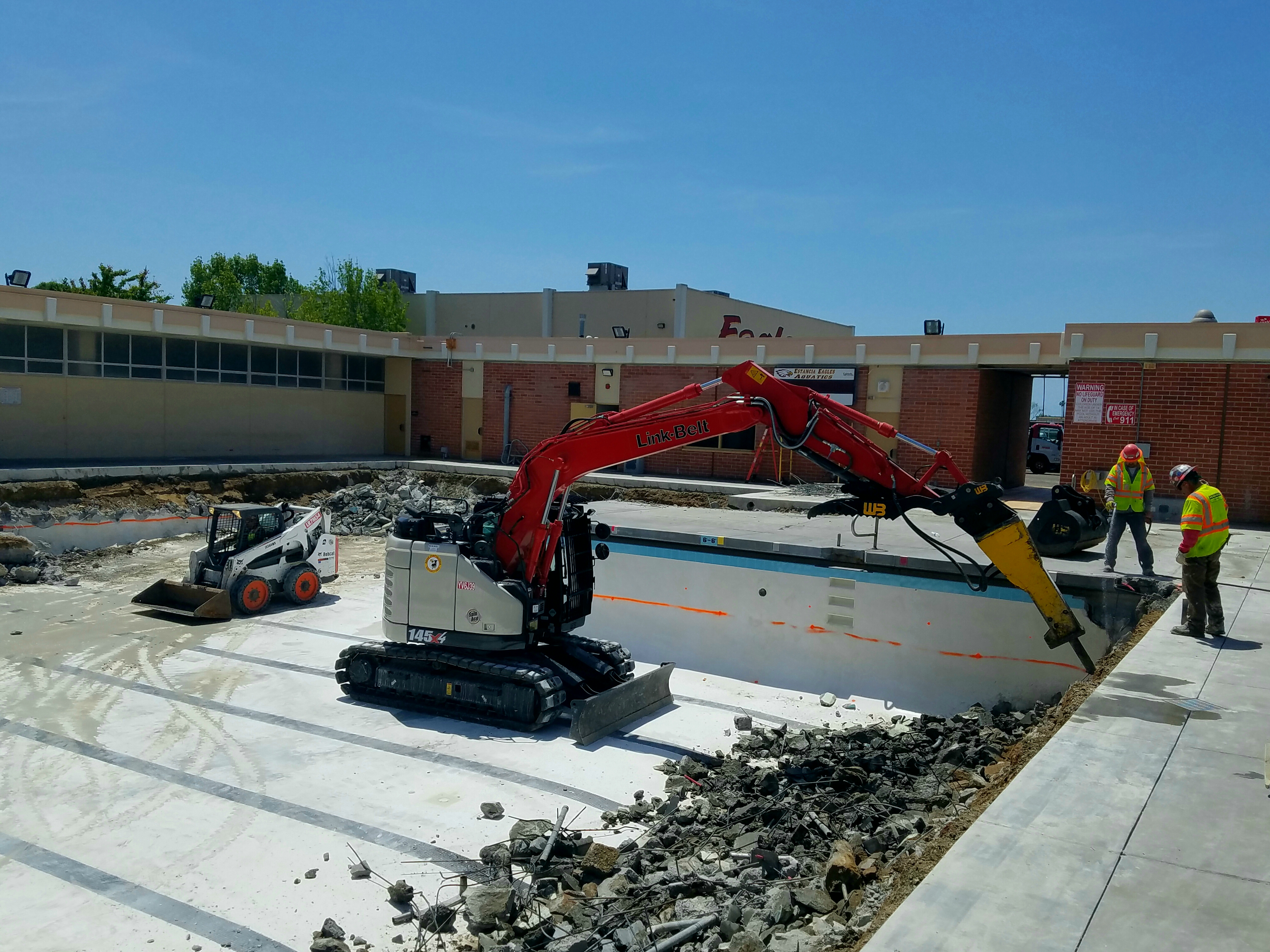
Hydraulic breaking is the standard approach for large-scale concrete removal on open commercial and infrastructure projects. Hydraulic breakers, typically mounted on excavators or skid steers, deliver high-impact force through a steel tool driven into the concrete surface. This breaks the slab or structure into manageable sections that can be loaded and removed.
When hydraulic breaking is appropriate:
- Open sites with sufficient equipment access and overhead clearance
- Large volume removal where production rate is a priority
- Exterior work or interior spaces where vibration and noise are not primary constraints
- Projects where demolition debris will be stockpiled and processed on site
Limitations to account for:
Hydraulic breaking is not precise. It generates significant vibration, noise, and airborne dust. On projects adjacent to occupied spaces, sensitive equipment, or existing structures with limited tolerance for vibration, the method requires careful evaluation or may need to be replaced with an alternative. Debris management also requires planning: broken concrete must be removed from the work zone efficiently to maintain production rates and site safety.
For large commercial demolition projects -- parking lots, industrial slabs, bridge approach slabs -- hydraulic breaking remains one of the most cost-effective and time-efficient options available when site conditions allow.
Robotic Demolition
Robotic demolition equipment has expanded the range of projects where controlled, mechanical concrete breaking is feasible. Remote-controlled demolition robots are compact, low-profile machines that can work in environments inaccessible to standard excavators -- low-headroom parking structures, occupied buildings, confined utility vaults, and spaces where operator safety in close proximity to unstable structure is a concern.
When robotic demolition is appropriate:
- Interior demolition in occupied or partially occupied facilities
- Low-headroom environments such as parking garages or basement levels
- Spaces with ventilation restrictions where full-size diesel equipment is not permitted
- Projects where precision and reduced vibration are required alongside mechanical breaking force
- Hazardous environments where remote operation protects workers
Equipment capabilities:
Modern demolition robots can be fitted with hydraulic breakers, crushers, and shear attachments, allowing them to perform a range of tasks beyond simple breaking. Their electric or hydraulic drive systems reduce emissions concerns in enclosed spaces. Operators work at a safe distance from the demolition face, which is a significant advantage in structurally compromised or hazardous environments.
Robotic demolition does not replace high-volume breaking for large open sites, but it fills a critical role in the commercial and industrial project mix where access, safety, or environmental constraints make conventional equipment unsuitable. Learn more about Penhall's demolition services.
Sawing and Removal
Concrete sawing is a controlled cutting process that uses diamond-tipped saw blades or wire to produce precise, straight cuts through concrete slabs, walls, and structural members. On commercial projects, sawing is frequently used to define removal boundaries before breaking begins, or as the primary removal method when the work requires clean edges, minimal vibration, and controlled depth.
Common sawing applications on commercial projects:
- Defining saw-cut joints at the perimeter of a repair area before slab removal
- Full-depth slab cutting for section removal and replacement
- Wall sawing to create openings in concrete walls or barriers
- Wire sawing for large-section cuts on bridge piers, foundations, or thick structural elements
- Removing concrete in occupied facilities where vibration and noise must be minimized
Why sawing and removal fits phased commercial work:
Many commercial and industrial facilities cannot shut down completely for concrete replacement. A distribution center, hospital, data center, or manufacturing plant may need concrete work completed in sections, around active operations, without disturbing adjacent areas. Sawing defines clean removal boundaries that protect in-service sections of floor or structure, allows for precise coordination with replacement phasing, and reduces vibration transmission to surrounding areas.
Sawing also produces a cleaner substrate at the repair boundary. In overlay and repair applications, a saw-cut edge performs better than a broken edge because it provides a uniform interface for bonding.
Explore Penhall's concrete breaking and removal capabilities to understand how sawing integrates with broader project scopes.
Selective Hand Demolition
Not every concrete removal task calls for mechanical equipment. In areas with extremely tight access, near sensitive embedded utilities or structural elements, or where the removal must be executed with fine control to protect adjacent work, selective hand demolition with jackhammers, chipping guns, and hand tools is the right approach.
When selective hand demolition is appropriate:
- Removing concrete immediately around embedded utilities, conduit, or rebar that must be preserved
- Partial-depth removal such as scarifying a deteriorated surface layer while leaving the substrate intact
- Areas too confined for even compact robotic equipment
- Final cleanup and detailing after mechanical breaking
- Situations where removal boundaries are irregular or defined by structural conditions that require real-time judgment
Integration with other methods:
Selective hand demolition rarely stands alone as the primary method on a commercial project. It typically follows mechanical breaking to clean out corners, remove material adjacent to sensitive elements, or achieve final elevations and edges that equipment cannot reach. On projects where sawing defines the removal boundary, hand demolition may be used to break and remove the cut section in areas where lifting equipment cannot work effectively.
Scanning and Utility Coordination Before Breaking Begins
One of the most consequential steps in any concrete removal project is what happens before the first break. Concrete slabs, walls, and structures on commercial and industrial sites routinely contain embedded post-tension cables, conduit, rebar, water lines, and other utilities that are not visible from the surface and may not be fully documented in as-built drawings.
Ground-penetrating radar (GPR) scanning identifies subsurface conditions before breaking begins. This is not optional on commercial projects -- hitting a post-tension cable during demolition creates an immediate safety hazard and can cause structural distress to adjacent sections. Severing an active conduit delays the project and creates liability. Damaging a waterline in an occupied facility creates far larger problems than the cost of the scan.
Utility coordination with facility managers and applicable utility owners should accompany the scanning process. On projects where as-built documentation is incomplete or where the facility has been modified over time, field scanning is the baseline for safe removal planning.
Proper sequencing looks like this:
- Review available as-built drawings and identify known embedded systems
- Complete GPR scanning across the removal area
- Mark subsurface findings on the slab surface for field reference
- Coordinate with facility management and utility owners to confirm findings and establish protection requirements
- Define removal boundaries and method selection based on scanning results
- Execute breaking work with markings maintained and visible to equipment operators
Skipping or abbreviating this process is one of the most common reasons commercial concrete removal projects encounter unplanned delays and cost overruns.
Sequencing Concrete Removal with the Broader Project Scope
On commercial construction and infrastructure projects, concrete removal is rarely an isolated scope item. It connects to the trades and activities that follow: base preparation, utility rough-in or replacement, formwork, and concrete placement. How removal is sequenced affects everything downstream.
Common sequencing considerations:
Phased removal in occupied facilities. When the facility must remain in operation, removal must be sequenced in sections that maintain safe access and operations. This typically means establishing clear separation between work zones and in-service areas, often using concrete saw cuts as the defining boundary between active and inactive sections.
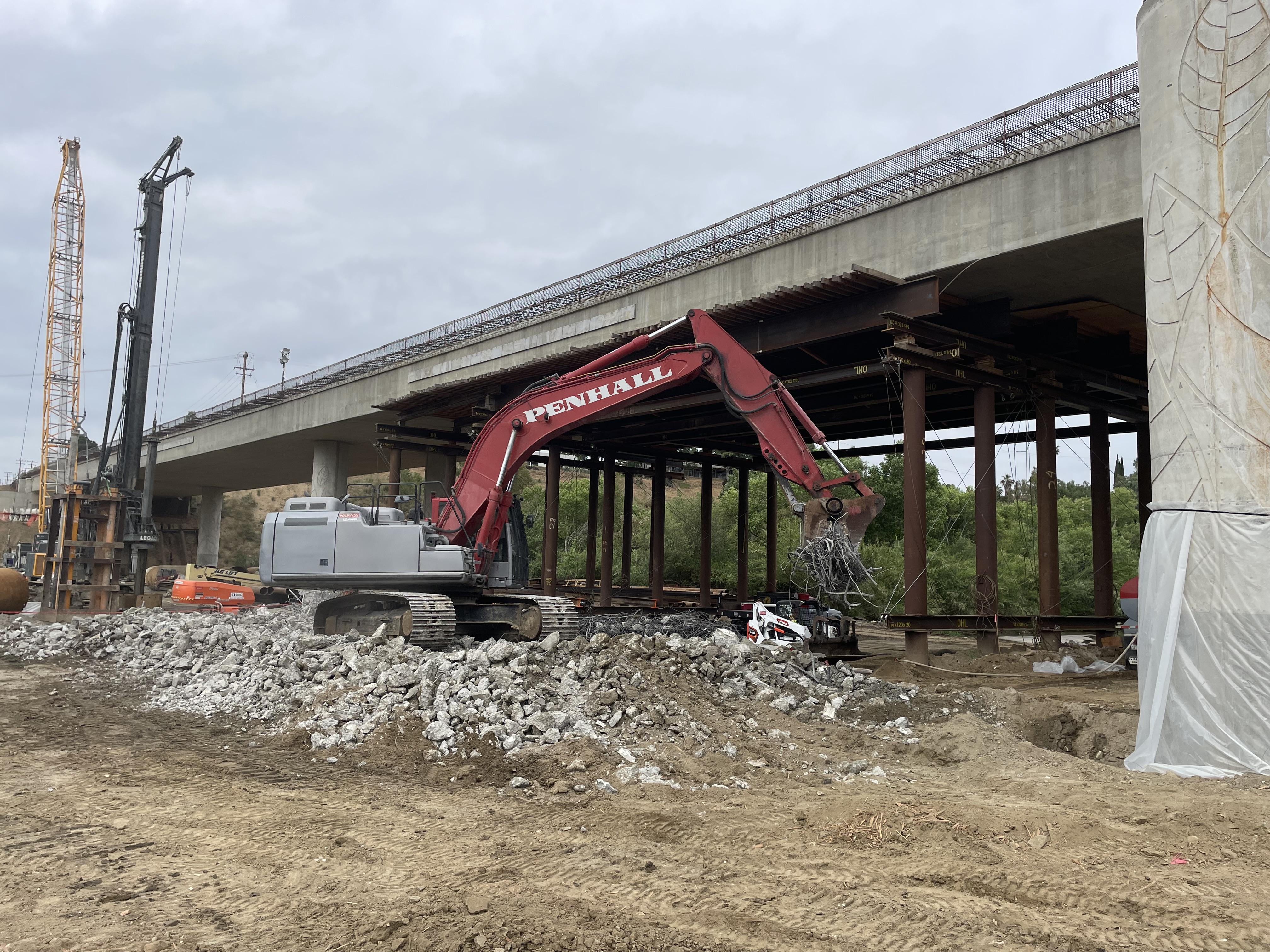
Debris handling and haul routes. Broken concrete must leave the site. On projects with limited site access or tight schedules, debris staging and haul-out timing must be planned alongside the breaking work itself. Equipment congestion that delays haul-out slows breaking production.
Substrate preparation. Replacement concrete or overlays require a prepared substrate. The removal method affects what preparation is needed. Hydraulic breaking typically leaves a rough, fractured surface that may require additional grinding or scarification. Saw cuts leave clean edges that are ready for repair material. Planning for substrate preparation as part of the removal scope prevents surprises during replacement.
Utility replacement integration. If existing utilities within the slab are being replaced as part of the project, utility rough-in typically follows removal and precedes replacement concrete. Coordinating the removal scope with utility contractors avoids conflicts and rework.
Choosing a Contractor for Commercial Concrete Removal
The scale and complexity of commercial and industrial concrete removal requires a contractor with the equipment, experience, and project management capability to execute the work safely and on schedule. Key factors to evaluate:
- Experience on projects of similar scale and type (industrial, infrastructure, occupied facilities)
- In-house scanning capabilities or established scanning coordination processes
- Equipment fleet that covers the range of methods likely to be required: hydraulic breaking, robotic demolition, sawing, and hand demolition
- Familiarity with utility coordination requirements and post-tension slab protocols
- Demonstrated ability to work within facility operating schedules on phased projects
Concrete removal scopes that appear straightforward at the outset frequently encounter conditions -- hidden utilities, post-tension systems, structural constraints -- that require the contractor to adapt. A contractor with limited method capability or experience will have fewer options when conditions change.
Penhall has performed concrete breaking and removal on commercial, industrial, and infrastructure projects across the country. Our crews are equipped for hydraulic breaking, robotic demolition, sawing and removal, and hand demolition, and our scanning capabilities support proper pre-work planning on every project.
Scope definition before assessment is a risk signal. A contractor who quotes square footage without a floor condition assessment is pricing based on assumptions. Those assumptions may be wrong in either direction.
The Bottom Line: Matching the Repair to the Condition
Concrete floor repair in commercial and industrial facilities works best when the decision follows the condition rather than leading it. Patching, resurfacing, and replacement are each the right answer for a specific set of conditions. The cost difference between them is significant, and so is the operational disruption. Getting the assessment right at the front end avoids the more expensive outcome of a repair approach that does not match the actual damage.
Surface preparation is what makes any of these approaches work. The repair material is only as durable as the bond to the substrate beneath it.
For facilities with active deterioration or upcoming floor repair work, early involvement of an experienced contractor produces better scope definition and better outcomes than waiting until conditions become critical.
Learn more about Penhall's capabilities in structural repair and scarifying and shaving.