
At a Glance
Rebar is passive: it carries tensile forces only after the concrete cracks. Post-tension cables are active: stressed to 150,000 to 270,000 PSI after the concrete cures, placing the slab in permanent compression.
The core difference in post-tension vs. rebar is stress. Rebar carries no pre-applied load. A single 0.5-inch PT strand carries approximately 30,000 pounds at all times. Cutting through one releases that energy instantaneously.
Post-tension slabs are not dangerous to occupy. They are dangerous to cut or drill without knowing where the cables are. With a GPR scan before work begins, PT cables can be located, avoided, and worked around safely.
PT construction is common in any commercial building with flat-plate floors, parking structures, high-rise towers, and large-span slabs built in the past 40 to 50 years. Assuming a commercial slab is probably conventional rebar is not a safe assumption.
Visual indicators of PT construction include anchor pockets on the slab edge, PT end caps, and tendon blisters on the soffit. Useful, but not reliable: they can be patched over, removed, or absent in certain configurations.
GPR scanning is the only reliable method for confirming PT cable location before cutting or coring. It distinguishes PT cables from rebar by reflection pattern, spacing, and depth, and results are marked directly on the concrete surface.
Post-Tension vs. Rebar: The Fundamental Difference
Both rebar and post-tension cables are steel. Both are embedded in concrete. Both contribute to the structural performance of the slab. Beyond those surface similarities, they are fundamentally different systems with different structural behaviors, different installation methods, and radically different risk profiles when encountered during cutting or drilling work.
How Conventional Rebar Works
Conventional rebar (reinforcing bar) is a passive reinforcement system. Deformed steel bars are placed in the concrete formwork before the pour, positioned at the depth and spacing specified by the structural design, and cast in place as the concrete is poured around them. The rebar carries no load and experiences no stress until the concrete around it cracks under tensile or bending forces.
When the slab bends under load, the tension side of the slab cracks. At that point, the tensile force transfers to the rebar, which resists the crack from widening into a structural failure. The rebar is essential to the slab's performance, but it is not under stress in its resting state. A drill bit or diamond blade that hits an undetected rebar bar will be damaged and may be destroyed, and the anchor or core location may need to be moved. The rebar will not move. There is no stored energy release. The consequences are disruptive and costly, but they are not violent.
How Post-Tension Cables Work
Post-tension cables are an active reinforcement system. High-strength steel strands (typically 270 ksi ultimate tensile strength, compared to 60 ksi for Grade 60 rebar) are threaded through the slab or beam in plastic sheaths before the pour. After the concrete reaches sufficient strength, hydraulic jacks are used to stress the strands to their specified load, typically 70 to 80 percent of their ultimate tensile strength. The stressed ends are then locked against cast-in anchors at the slab edge or soffit, and the jacks are removed.
The result is a slab that is permanently, continuously in compression. The PT cables are not waiting to carry load after cracking occurs. They are actively precompressing the concrete at all times, preventing the tensile cracking that would otherwise occur and allowing the slab to span farther, carry more load, and be built thinner than an equivalent rebar-only design. This is why PT construction is so widely used in long-span commercial and institutional floors and parking structures.
The cables remain under full tensile stress for the life of the structure. A 0.5-inch diameter PT strand stressed to 70 percent of its 270 ksi ultimate carries approximately 30,000 pounds of tensile load, permanently. That load does not relax, fluctuate with live loads, or diminish over time in normal service conditions. It is always there.
Why the Stress Difference Changes Everything for Drilling and Cutting
The stress difference between post-tension cables vs. rebar is the entire reason why the conversation about identifying slab type before drilling or cutting matters at all.
When a diamond blade or drill bit cuts through a rebar bar, the bar is severed. It was not under stress, so there is no energy release. The structural consequence is real and needs to be assessed, but the event itself is not violent. The hazard is to the tooling, to the anchor or core placement, and potentially to the long-term structural performance of the element, not to the worker in the immediate area.
When a diamond blade or drill bit cuts through a PT cable, the result is categorically different. The strand, under 30,000 pounds of tensile load, severs. The stored elastic energy in that strand releases instantly. The cable retracts at high speed in both directions from the cut point. The concrete around the anchor zone may be destroyed as the cable releases its load. Adjacent tendons in the same tendon band may also be affected. The worker standing over the saw or holding the drill is in the immediate area of this energy release.
This is not an abstract risk. PT cable strikes during concrete cutting and coring have caused fatalities. The incidents are documented. The mechanism is well understood. And the prevention is straightforward: scan the slab before cutting or coring, locate the PT cables, and plan the work to avoid them.
Post-Tension Cables vs. Rebar: Quick Reference
| Feature | Conventional Rebar | Post-Tension Cables |
|---|---|---|
| How it works | Passive: carries tension only after concrete cracks and load transfers to steel | Active: cables are stressed after concrete cures, placing slab in permanent compression |
| Typical steel | Deformed steel bars, Grade 40 to Grade 80 | High-strength strand (270 ksi) or bar, inside plastic sheath with grease |
| Stress level | No pre-applied stress; steel is unstressed until slab cracks under load | 150,000 to 270,000 PSI of tensile stress permanently applied |
| Visible indicators | None visible from surface or slab edge in most cases | Anchor pockets, PT end caps, tendon blisters on slab edge or soffit |
| Slab thickness | Typically thicker for equivalent span length | Often thinner than rebar-only design for same span and load |
| Common structures | Residential slabs, footings, industrial floors, walls, beams | Parking structures, high-rise floors, podium decks, bridges, large-span commercial slabs |
| If cut accidentally | Blade damage, potential rework; no sudden energy release | Violent cable retraction, concrete damage, potential structural failure, injury or fatality |
| Pre-work scanning | Recommended to manage tooling cost and avoid utilities | Non-negotiable; GPR scanning required before any cutting or coring |
How Common Are Post-Tension Slabs?
One of the most significant errors a drilling or cutting crew can make is assuming that post-tensioned construction is rare, exotic, or confined to large-scale infrastructure. It is none of those things.
Post-tensioned concrete construction has been the standard structural system for a large proportion of commercial, institutional, and multi-family residential buildings since the 1970s. Any flat-plate or flat-slab floor system in a commercial building with spans exceeding roughly 20 to 25 feet is a strong candidate for PT design. Parking structures built in the past several decades are almost universally post-tensioned. High-rise residential and office towers use PT floors as a matter of course. Large-span industrial slabs, podium decks over parking, and transfer structures in mixed-use buildings are routinely post-tensioned.
In a commercial construction environment, particularly in urban markets, a crew that proceeds without scanning in any concrete slab is not making a conservative assumption that the slab is probably conventional rebar. They are making an unknowing assumption about a probability they cannot actually assess from visual inspection of the surface.
Structures Where PT Is the Strong Probability
- Parking structures of any vintage built after roughly 1970, particularly in urban and suburban markets.
- High-rise office, residential, hotel, and mixed-use building floors, essentially any flat-plate floor system over 4 to 5 stories.
- Podium deck construction, where a concrete platform spans over a parking structure and supports a building above.
- Transfer structures and transfer slabs in buildings where columns or walls do not run continuously to the foundation.
- Large-span commercial and industrial floors in retail, distribution, and manufacturing facilities.
- Bridges, elevated highway structures, and other infrastructure elements built with segmental or cast-in-place PT design.
- Swimming pools and water-retaining structures, where PT is used to control cracking under hydrostatic pressure.
Structures Where Conventional Rebar Is More Likely
- Residential slabs-on-ground, including single-family driveways, patios, and basement floors.
- Low-rise industrial and warehouse slabs-on-ground with spans supported by the subgrade rather than spanning between columns.
- Footings, grade beams, and other below-grade structural elements.
- Tilt-up wall panels and precast wall elements.
- Lightly loaded commercial floors in buildings with short spans and column-supported designs.
Even in structures where conventional rebar is the most likely reinforcement type, embedded utilities (conduit, pipes, hydronic tubing) are present in many slabs and create their own hazards. GPR scanning is recommended before any penetrating work regardless of PT probability.
How to Tell If a Slab Is Post-Tensioned
Identifying a post-tensioned slab before drilling or cutting work begins involves three sources of information: visual inspection of the structure, review of construction documents, and GPR scanning. Each has different reliability, and only one, GPR scanning, provides confirmed cable locations rather than inferential evidence.
Visual Indicators
Several visual features indicate post-tensioned construction. Knowing what to look for and where to look is the first step in any pre-work assessment:
| Indicator | What It Looks Like | Reliability |
|---|---|---|
| Anchor pockets / stressing pockets | Rectangular or rounded recesses on slab edge or soffit, approx. 3" x 5" to 4" x 6", spaced 24"–48" apart along the slab edge | High when visible; may be patched over or hidden by finishes |
| PT end caps | Plastic caps (often gray or orange) covering exposed strand ends at slab edge or in parking structure fascia | High when visible; may be removed or covered |
| Tendon blisters | Raised profile on slab soffit following the path of draped PT tendons in two-way PT slabs | Moderate; only visible on exposed soffits |
| Thinner-than-expected slab | Slab is noticeably thin for its span relative to what a rebar-only design would require | Low by itself; useful corroborating indicator |
| Construction drawings | Structural drawings specify PT design, tendon layout, anchor schedules, and stressing records | Highest; but drawings may be unavailable or outdated for older structures |
| GPR scan | PT cables produce strong, regular hyperbolic reflections at consistent spacing and depth, distinct from rebar pattern | Highest available non-destructive method when drawings are unavailable |
The most important thing to understand about visual indicators is what they can and cannot tell you. Anchor pockets and PT end caps confirm that PT construction is present. But their absence does not confirm that PT cables are absent. In older buildings, anchor pockets are often patched flush and painted over after stressing. In some PT system configurations, the stressing hardware is recessed or protected in ways that are not visible from a standard walk-through. Visual inspection should be used to raise PT probability, not to dismiss it.
Construction Drawings
The structural drawings for a building are the authoritative source for reinforcement type and layout. Structural drawings that specify post-tensioned design will show tendon layout, spacing, depth, anchor locations, and stressing records. For buildings where structural drawings are available and have been verified against as-built conditions, they are the most reliable source of information about reinforcement type.
The limitation is availability. Structural drawings are frequently unavailable for older buildings, particularly those that have changed ownership multiple times, have been through significant renovations, or were built before drawing digitization was standard. When drawings are not available or cannot be verified as current, they cannot be relied on to confirm the absence of PT cables in a slab.
GPR Scanning: The Only Method That Confirms Cable Location
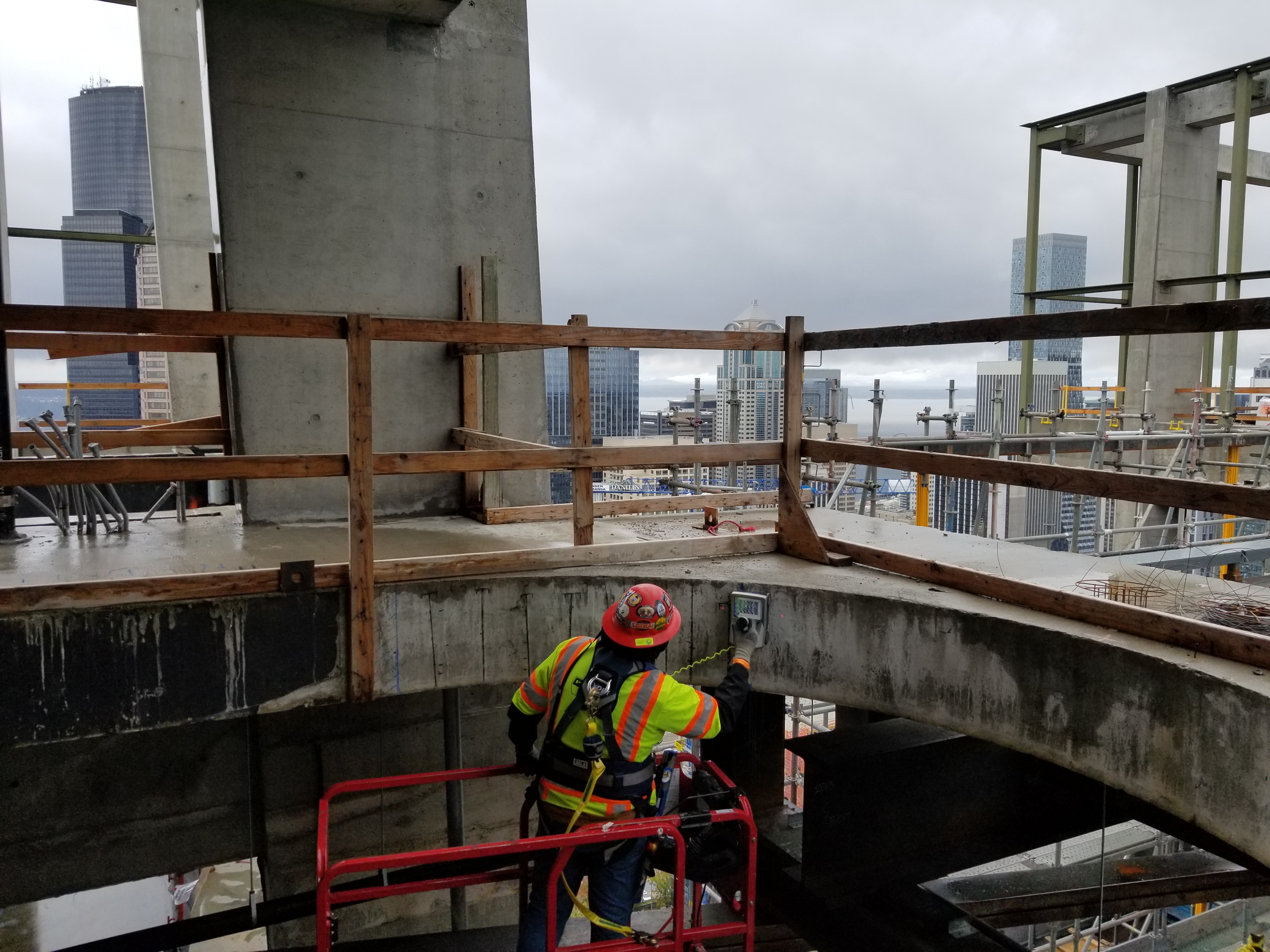
GPR scanning is the only non-destructive method that can confirm the presence and specific location of PT cables before cutting or coring work begins. A trained GPR technician scanning a PT slab will observe the characteristic reflection pattern produced by PT tendons: strong, regular hyperbolic reflections at consistent spacing (typically 24 to 48 inches on center in one or both directions), at a consistent depth that differs from the top and bottom conventional rebar mats.
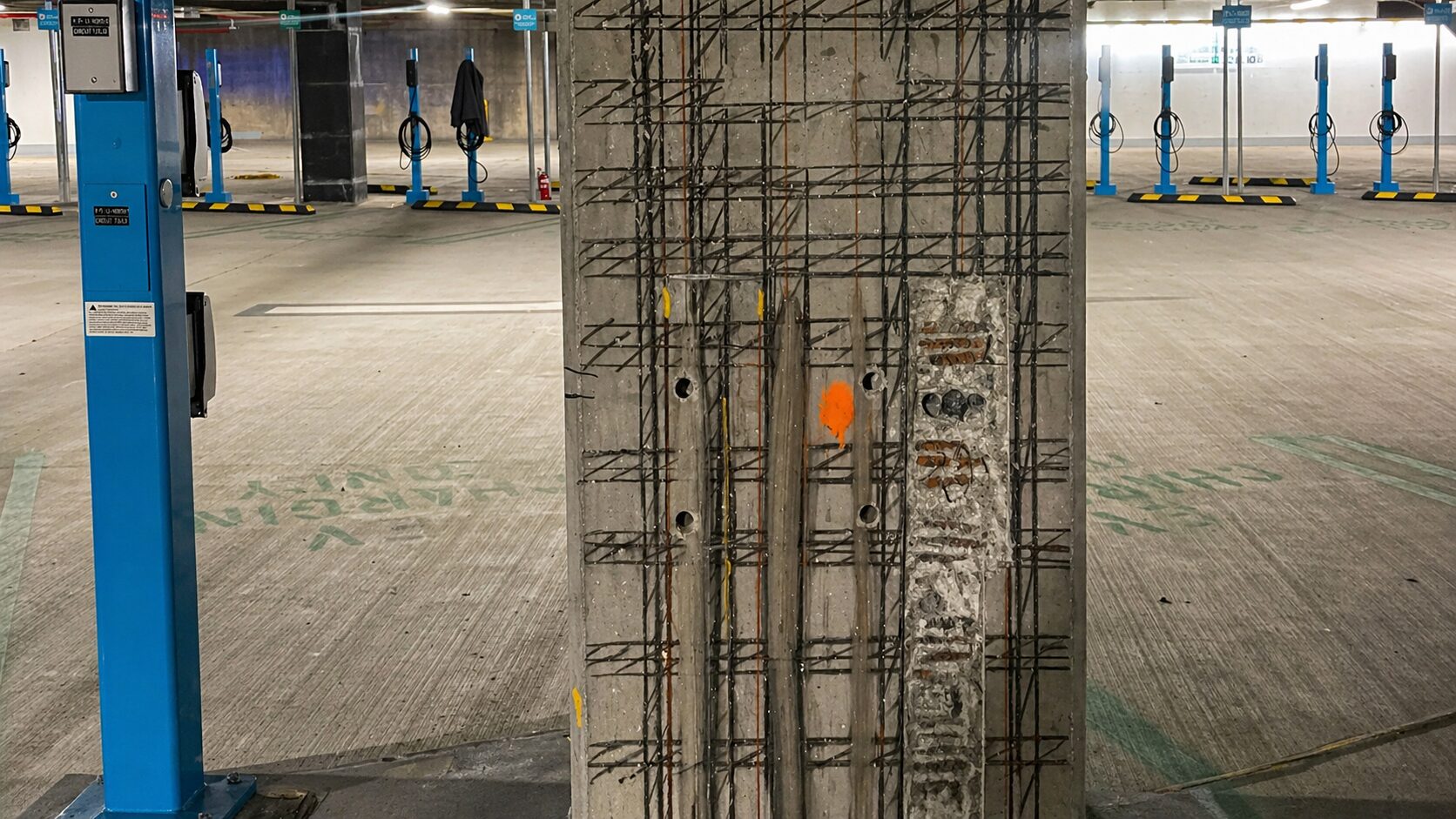
The technician marks the PT cable locations directly on the concrete surface using a distinct marking convention (typically red spray paint with a PT notation) to differentiate them from passive rebar. This gives the drilling or cutting crew a surface map of where the cables run before the work begins.
GPR scanning also identifies conventional rebar, embedded conduit, pipes, and other utilities in the same scan pass. The full picture of what is inside the slab, PT cables and passive reinforcement and utilities combined, is the most complete possible pre-work intelligence. Penhall’s concrete scanning services provide this information as a standard step before any cutting or coring work in structures where the slab interior is unknown.
Are Post-Tension Slabs Dangerous?
This question comes up regularly from workers, supervisors, and facility managers who are about to have drilling or cutting work done in a building they suspect is post-tensioned. The honest answer has two parts.
Post-tension slabs are not dangerous to occupy. They are among the most structurally sound, well-engineered floor systems in common use. The compression applied by PT cables actually improves the concrete's resistance to cracking, moisture infiltration, and long-term deterioration. Buildings with PT floors perform well over decades of service under heavy occupancy loads, and the presence of PT cables does not create any hazard to people using the building normally.
Post-tension slabs are dangerous to cut or drill into without knowing where the cables are. This is the critical distinction. The danger is not inherent to the structure. The danger arises when a worker introduces a cutting or drilling tool into the slab without the information needed to avoid the cables.
What Happens When a PT Cable Is Cut
The sequence of events following a PT cable strike is well documented and consistent across incidents. The diamond blade or drill bit severs the steel strand. The stored elastic energy in the strand, the energy that was maintaining 30,000 pounds of tensile load, releases in an instant. The cable retracts rapidly in both directions from the cut point. The momentum of the retracting cable destroys the concrete surrounding the anchor at each end. The anchor pocket may blow out. Concrete fragments are ejected from the area of the anchor.
In a two-way PT slab with cables running in both directions, cutting a cable in one direction can alter the load distribution in the surrounding slab area, potentially stressing adjacent tendons. In severe cases, particularly in post-tensioned beams or heavily PT-loaded transfer structures, cutting a single tendon can initiate a progressive failure.
The worker in the area of the strike is at risk from three sources: the cable itself as it retracts, fragments of concrete ejected from the anchor zone, and potential structural instability in the immediate area of the cut. These are not theoretical risks. They are the documented mechanism of actual fatalities.
The Prevention Is Simple
The entire risk profile associated with post-tension rebar confusion, which is really the risk of mistaking an active PT cable for passive rebar, is preventable with a GPR scan before work begins. The scan locates the PT cables. The cables are marked on the surface. The work is planned to avoid them. If a cable must be cut as part of the planned scope, a structural engineer assesses the impact, controlled de-stressing is performed, and the work proceeds in a planned sequence rather than through an accidental strike.
The cost of a GPR scan before drilling or cutting in a commercial concrete environment is small. The cost of a PT cable strike is not. This is the most straightforward cost-benefit calculation in the concrete industry.
The "Post-Tension Rebar" Confusion and Why It Matters
The search term post-tension rebar is commonly used to describe the steel inside a post-tensioned slab, and while the intent is clear, the terminology reflects a conflation that has practical consequences on job sites.
PT cables are not rebar. They are made from different steel (high-strength prestressing strand, typically 270 ksi, vs. 60 ksi Grade 60 deformed bar). They have a different physical form (multi-wire strand in a greased plastic sheath vs. a solid deformed bar). They behave differently under load (active vs. passive). And they respond differently when cut (violent energy release vs. passive severance).
When a crew refers to the reinforcement in a slab generically as rebar without distinguishing between passive bars and PT cables, the risk is that the differentiation that matters most for safety gets lost. A foreman who says "we scanned for rebar and it came back clear" in a PT slab may mean that the scan confirmed no conventional rebar in the drill path. That is not the same as confirming no PT cables in the drill path.
Professional GPR scanning services for concrete work scan for all embedded objects simultaneously. The technician identifies and marks both conventional rebar and PT cables, using distinct marking conventions for each. The written briefing to the crew explicitly distinguishes between the two. This distinction, between passive rebar and actively stressed PT cables, is the single most important piece of information the crew needs before drilling or cutting in a commercial concrete environment.
Working Safely in Post-Tension Slabs
Post-tensioned construction does not need to be avoided. It simply needs to be respected and worked in with the right information. The following protocols represent industry best practice for cutting and coring work in PT concrete:
Step 1: Establish PT Probability Before Mobilizing
Before any drilling, coring, or cutting crew mobilizes to a commercial concrete project, the project coordinator should establish the PT probability for the structure. For buildings where structural drawings are available, review them. For buildings where drawings are unavailable or where the slab has been modified since original construction, assume PT is possible until a GPR scan confirms otherwise. In parking structures, high-rise floors, and podium decks built in the past 50 years, assume PT is present until proven otherwise.
Step 2: Order a GPR Scan Before Any Penetrating Work
For any project in a structure with confirmed or probable PT design, order a GPR scan before the drilling or cutting crew arrives. The scan should cover all proposed work locations and use a scanning protocol and antenna frequency appropriate for the slab thickness and expected reinforcement. The scan technician should provide marked results and a verbal briefing that explicitly identifies PT cable locations and distinguishes them from conventional rebar.
Step 3: Review Scan Results Before Beginning Work
Before the first drill goes into the concrete, the lead crew member should review the scan markings and briefing with the scanning technician. All proposed work locations should be confirmed as clear of PT cables, or relocated to clear positions, before drilling begins. Any location that falls within the established clear-zone buffer of a detected PT cable should be reviewed with the structural engineer of record before proceeding.
Step 4: If a PT Cable Must Be Cut, Involve an Engineer
In renovation and demolition scopes where PT cables must be cut as part of the planned work, cutting is not simply a field decision. A structural engineer must assess the impact of PT cable removal on the slab's structural integrity, specify a controlled de-stressing sequence, and confirm that the structure can be safely shored and stabilized before and after cable cutting. Penhall's selective demolition teams coordinate with structural engineers on PT work as a standard protocol.
Step 5: Train Crews to Recognize PT Indicators
Field crews that regularly work in commercial concrete environments should be trained to recognize the visual indicators of PT construction: anchor pockets, PT end caps, tendon blisters. This recognition should trigger an automatic protocol: stop, confirm PT status with a scan, and proceed only after confirmed cable locations are in hand. This is not a judgment call for the field crew to make on their own. It is a defined workflow.
Penhall's Scanning and Concrete Services for Post-Tension Structures
Penhall Company has extensive experience working in post-tensioned concrete structures, with field crews trained to recognize PT indicators, require pre-work scanning, and execute cutting and coring work safely after PT cable locations are confirmed by GPR. Penhall provides the full workflow:
GPR concrete scanning:PT cable detection, rebar mapping, utility location, and void detection before any cutting or coring begins. Scan results are marked directly on the concrete with distinct PT cable markings, and crews receive a full verbal briefing before work starts.
Concrete cutting: flat sawing, wall sawing, wire sawing, and hand sawing in PT and conventionally reinforced concrete, with blade selection and cut planning informed by GPR scan results.
Concrete coring: precision core drilling in PT slabs with core locations confirmed clear by GPR before drilling begins
Selective demolition: controlled removal of post-tensioned concrete with structural engineering coordination, controlled de-stressing protocols, and full pre-work scanning.
Selective demolition: controlled removal of reinforced and post-tensioned concrete.
Structural repair: concrete restoration following PT concrete work, including FRP strengthening for elements where PT reinforcement has been removed.
With locations across the country, Penhall can mobilize quickly for slab scanning and concrete work in any region.