At a Glance
- What this covers: Safe concrete coring in post-tension and structural slabs requires GPR subsurface scanning to +/- 0.5 in. accuracy before a drill touches the surface. Skipping this step risks severing tendons under 30,000+ psi of stored stress.
- Who performs this work: ACI- or ASCC-certified core drilling contractors with documented ground-penetrating radar capability and structural engineer coordination, in compliance with ACI 318-19 and OSHA 29 CFR 1926 Subpart Q.
- How cables are found: A 1.6 GHz or 2.0 GHz GPR antenna maps post-tension tendon position, depth, and drape profile before layout is marked; electromagnetic induction provides secondary confirmation for unbonded mono-strand systems.
- How deep cables sit: Draped post-tension cables in a typical 8-to-10-inch commercial slab range from 1 inch above the bottom at midspan to near mid-depth at supports; depth varies continuously along the span and must be mapped, not assumed.
- Why precision matters: Diamond wet-core drilling maintains a bore diameter tolerance of +/- 1/16 in., and every penetration larger than 6 inches in a post-tension slab requires structural engineer review to assess load-path and tendon stress-field impact.
- What sets specialists apart: Experienced core drilling contractors deliver GPR scan images, core logs, and as-drilled records that satisfy building department documentation requirements and protect GCs from structural liability on commercial projects.
What Is Concrete Coring and Why Does It Matter on Structural Slabs?
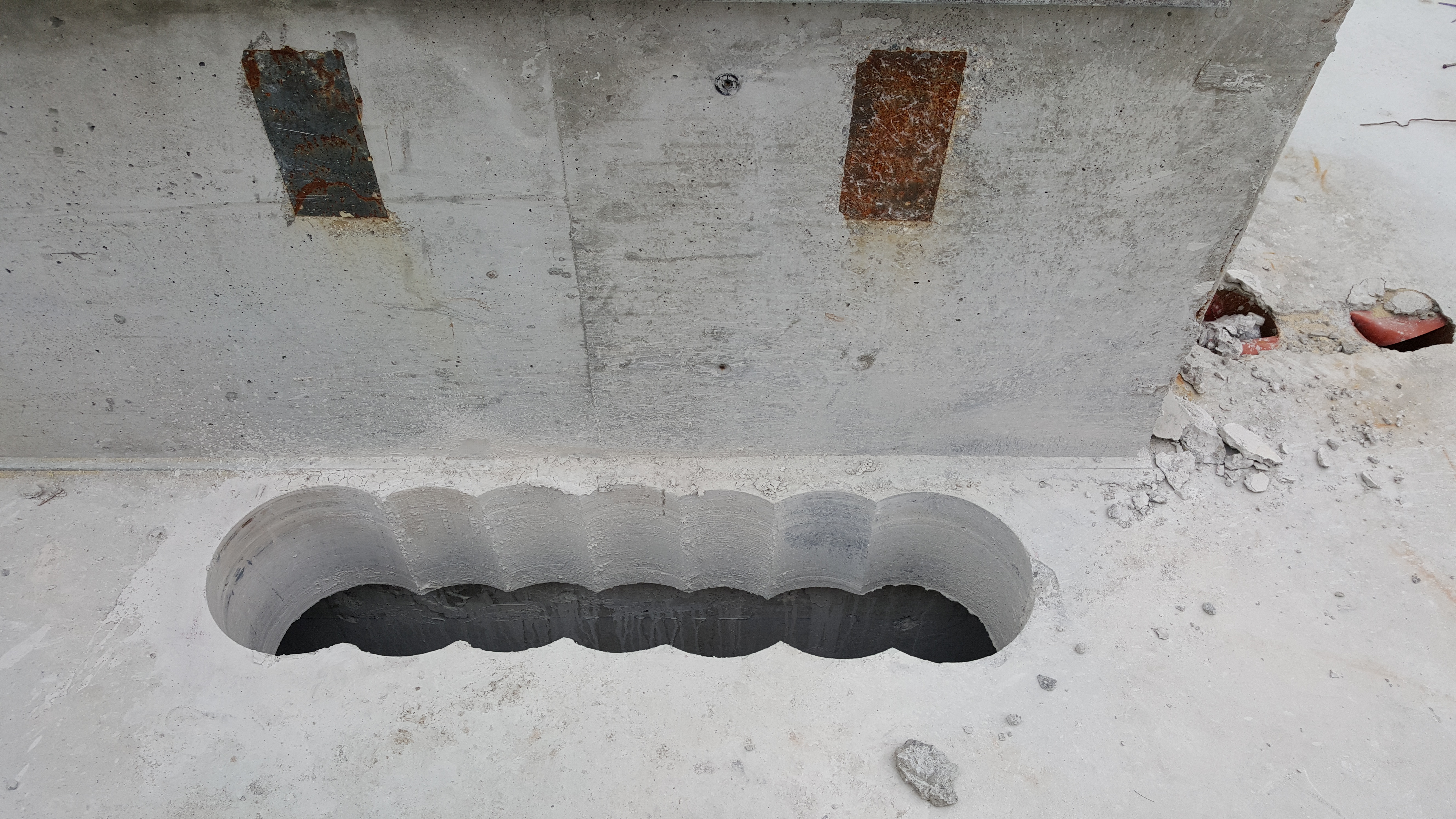
Concrete coring is the process of cutting a precise cylindrical hole through a concrete slab, wall, or foundation using a rotating diamond-tipped drill barrel. On post-tension or structural slabs, the method used before and during drilling determines whether the structure remains safe or suffers irreversible damage.
Standard coring on unreinforced or lightly reinforced slabs is a relatively forgiving operation. Structural slab coring is not. Commercial buildings constructed after the 1970s, including office towers, parking structures, hospitals, and mixed-use podiums, overwhelmingly rely on post-tensioned concrete for their floor systems. These slabs contain high-strength steel tendons stressed to between 150,000 and 200,000 psi and anchored at the slab perimeter. A single severed tendon releases stored elastic energy that can initiate progressive cracking, permanent deflection, or partial collapse of the bay.
Mechanical, electrical, plumbing, fire suppression, and data infrastructure all require penetrations through these slabs. Placing those penetrations accurately without compromising structural integrity is the defining competency of a qualified core drilling contractor.
Understanding Post-Tension Slabs Before Any Core Drill Touches the Surface
A post-tension slab is a reinforced concrete floor system in which high-strength steel tendons, either unbonded monostrand (wrapped in grease and plastic sheathing) or grouted multi-strand, are threaded through the slab formwork, cast in place, and then tensioned against anchorage hardware after the concrete reaches design strength, typically at 75% or greater of the 28-day compressive strength per ACI 318-19 Section 26.10.
How Post-Tension Cables Are Positioned in a Slab
Post-tension tendons in a flat-plate or flat-slab system are arranged in two perpendicular banded and distributed patterns, with banded tendons concentrated near column lines and distributed tendons spread across the bay at regular intervals. Spacing between individual strands typically ranges from 4 to 6 feet in the banded direction and 4 to 5 feet in the distributed direction, though field conditions, pour sequence, and contractor installation variability mean actual positions frequently deviate from structural drawings.
This deviation is precisely why structural drawing review alone is insufficient before coring. On renovation and tenant improvement projects, the original structural engineer of record (EOR) may no longer be accessible, and as-built post-tension layout drawings may not exist. GPR scanning resolves the actual installed condition, not the design intent.
How Deep Are Post-Tension Cables in a Slab?
Post-tension cables in a standard 8-to-10-inch commercial slab are profiled at a variable depth along their span. This variable positioning is the drape profile, and it is deliberate. At midspan, where bending tension is highest at the bottom of the slab, tendons are positioned approximately 1 to 1.5 inches above the bottom surface (inside the minimum cover requirement of 3/4 inch for interior conditions per ACI 318-19 Table 20.6.1.3). At column supports, where bending reverses, tendons rise toward the mid-depth or upper third of the slab section.
The practical implication: a tendon that a GPR scan shows at 3 inches of depth at one location may be at 1.5 inches of depth just 4 feet away. Depth changes continuously. Assuming a safe drilling depth based on a single scan point is a structural risk. A qualified core drilling contractor maps the full drape profile across the intended core location and establishes a minimum safe clearance before committing core barrel position.
Key figure: Typical post-tension tendon drape in an 8-inch slab spans from 1.0 in. above the soffit at midspan to approximately 3.5 to 4.0 in. from the bottom (mid-depth) at column supports. GPR resolution at 1.6-2.0 GHz provides depth accuracy to +/-0.5 in. in concrete with 28-day compressive strength of 4,000-5,000 psi.
Locating Post-Tension Canyons Before Coring
Locating post-tension cables before coring is a non-negotiable first step on any structural slab, and ground-penetrating radar (GPR) is the industry-standard technology for doing it accurately, non-destructively, and without cutting power or coordinating with the building's electrical systems.
Ground-Penetrating Radar (GPR) Scanning
GPR emits short pulses of electromagnetic energy into the concrete substrate and measures the reflected signals that return when the wave encounters a material with different dielectric properties. Steel tendons, rebar, conduit, and voids all produce distinct hyperbolic reflection signatures. A 1.6 GHz or 2.0 GHz ground-coupled antenna provides the frequency-depth trade-off required for standard slab thickness: sufficient resolution to differentiate a 0.5-inch tendon from adjacent reinforcing steel, at penetration depths reaching 12 to 18 inches.
The output is a B-scan radargram, a cross-sectional subsurface image, that a trained GPR operator interprets to identify tendon location, depth, and spacing. Safe core locations are marked directly on the slab surface, typically with paint or chalk grid lines, at a standoff distance of not less than 2 inches from any identified tendon. On dense layouts, the operator works with the project structural engineer to evaluate whether a safe core path exists or whether the core location must be relocated.
GPR scanning also detects secondary hazards that traditional coring misses: embedded conduit runs, post-installed anchor locations, sleeves, waterproofing membrane layers, and subsurface voids from incomplete consolidation or prior water intrusion. Detecting these entities before drilling prevents costly rework and reduces schedule impact on occupied facilities.
Electromagnetic Induction and X-Ray Subsurface Imaging
Electromagnetic induction (EMI) scanning provides a complementary confirmation method for unbonded mono-strand post-tension systems. Monostrand tendons are ferromagnetic, and an EMI scanner detects the disruption in a generated magnetic field caused by each tendon, producing a plan-view heat map of steel density across the scan area. EMI is particularly effective at distinguishing the closely spaced, parallel tendons of a banded post-tension layout in areas where GPR radargrams are difficult to interpret due to signal interference from wire mesh or tight rebar spacing.
Concrete x-ray imaging remains the highest-resolution subsurface imaging method available for concrete, capable of resolving tendon position to within 1/8 inch, but its application on commercial coring projects is limited by radiation safety exclusion zone requirements and the logistics of positioning both the X-ray source and detector plate on opposite sides of the slab. X-ray is typically reserved for forensic structural investigation or highly congested areas where GPR interpretation is inconclusive and the structural consequence of error is severe.
The Step-by-Step Process for Safe Coring in Post-Tension Slabs
Safe post-tension slab coring follows a defined sequence that integrates structural coordination, subsurface scanning, and precision drilling. Each phase builds on the last and cannot be safely skipped or reversed.
1. Pre-Mobilization Document Review: Obtain available structural drawings, post-tension shop drawings, and as-built records from the EOR or building owner. Identify banded vs. distributed tendon zones, column bay dimensions, and any documented prior penetrations or repairs.
2. Structural Engineer Coordination: Submit proposed core locations to the EOR or a licensed structural engineer for review before scanning begins. For cores larger than 6 inches in diameter or within 18 inches of a column, written engineer approval is standard practice and required by many jurisdictions.
3. GPR Scan Grid Execution: Establish a minimum 24 x 24 inch scan grid centered on each proposed core location. Scan in both perpendicular directions to generate crossing B-scans that confirm tendon position in plan and depth in profile.
4. Safe-Zone Marking: Mark the exact tendon centerlines and depth annotations on the slab surface. Confirm a minimum 2-inch horizontal clearance from any tendon before approving the final drill point.
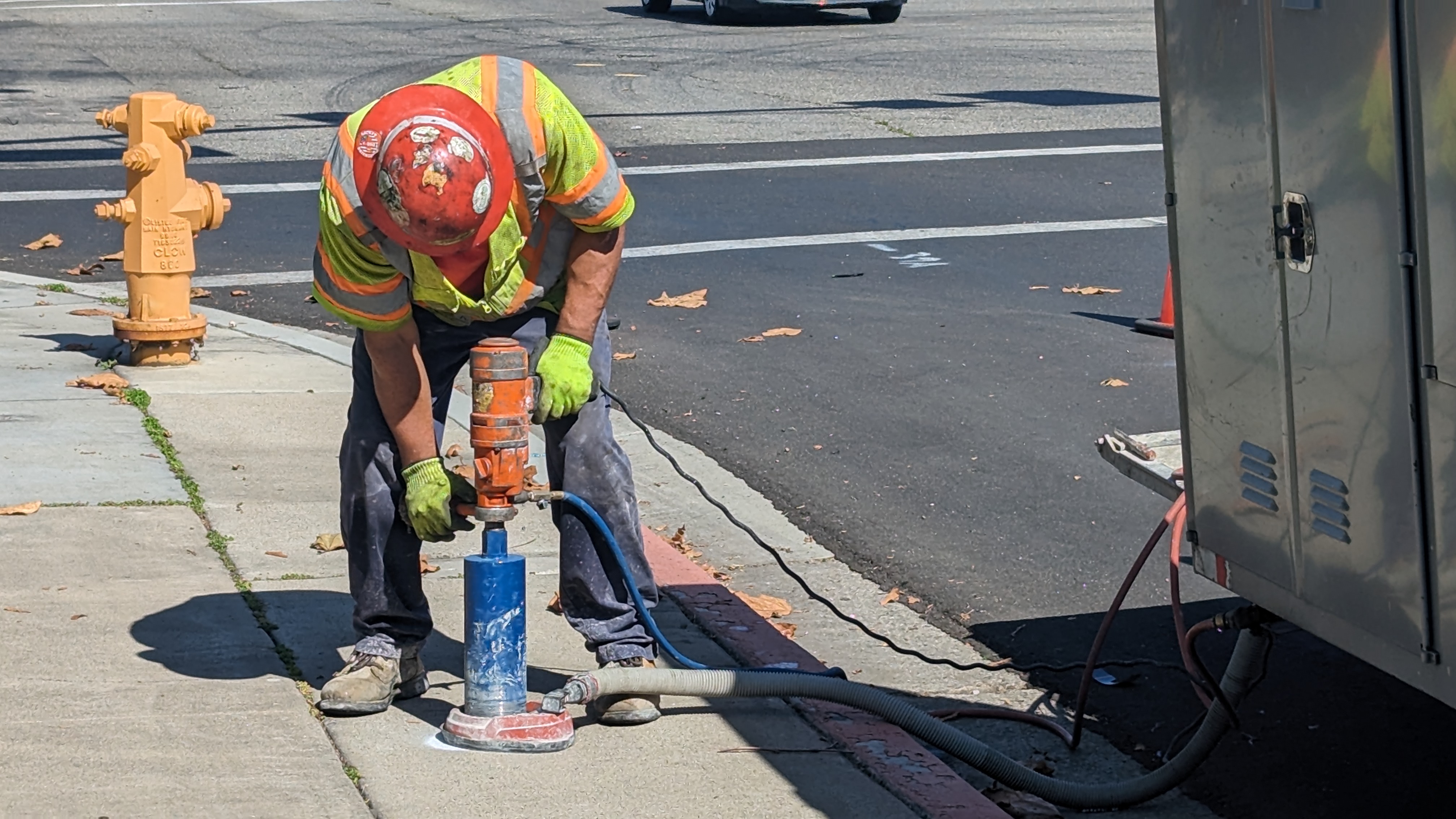
5. Core Drill Setup and Wet Drilling: Mount the core drill stand on a vacuum pad or mechanical anchor. Begin wet-method diamond coring using continuous water flow to control heat, reduce dust, and extend barrel life. Maintain a controlled penetration rate of 1 to 3 inches per minute in 4,000-5,000 psi concrete to prevent barrel deflection.
6. Real-Time Depth Monitoring: Track core barrel penetration depth against the mapped tendon profile throughout the cut. If the drill operator encounters unexpected resistance or a change in cutting behavior consistent with steel contact, drilling stops immediately.
7. Core Removal and Void Documentation: Remove the core plug intact where possible to allow visual inspection of the cut concrete matrix. Document core length, diameter, any reinforcement or tendon contact, and final penetration depth.
8. As-Drilled Record and Closeout: Deliver a complete as-drilled package including the GPR scan image, annotated slab plan, core log, operator certification, and equipment calibration records. This documentation satisfies building department requirements and provides the GC with structural liability protection.
Precision Coring vs. Traditional Coring: A Technical Comparison
The table below compares GPR-guided precision coring against traditional unguided coring across the dimensions that matter most on commercial structural slab projects.
| Factor | Precision Coring (GPR + Wet Core Drill) | Traditional Unguided Coring |
|---|---|---|
| Cable detection before drilling | GPR scan to +/-0.5 in. accuracy prior to setup | None; relies on operator judgment |
| Tendon strike risk | Minimal; cores placed in verified safe zones | High; undocumented tendon layouts common |
| Structural engineer sign-off | Standard on all post-tension work | Rarely required |
| Dust & slurry control | Wet-method diamond core with vacuum slurry recovery | Dry or wet; slurry often uncontrolled |
| Core diameter tolerance | +/-1/16 in. with carbide-tipped diamond barrel | Variable; operator skill-dependent |
| Documentation | GPR scan image, core log, as-drilled record | Typically none |
| Typical mobilization notice | 24-48 hours with site coordination | Same-day common |
| Regulatory compliance | ACI 318-19 structural concrete, OSHA 29 CFR 1926 | Inconsistent |
The cost difference between precision coring and unguided coring is real but modest relative to the liability exposure of a tendon strike. Tendon repair on a typical commercial slab involves structural engineer assessment, specialized coupler hardware, post-tension re-stressing equipment, and potential structural shoring. That repair scope routinely exceeds $25,000 to $75,000 per incident, exclusive of schedule impact, tenant disruption, and litigation risk.
Structural Risk Mitigation and Subsurface Coordination on Large Commercial Sites
Large commercial sites, including multi-building campuses, hospital systems, airport facilities, and institutional structures, present coring risk at a different scale than a single-tenant renovation. Volume of penetrations, coordination across multiple trades, occupied-facility constraints, and distributed structural documentation all compound the challenge.
Effective structural risk mitigation on these projects starts with a pre-construction subsurface coordination meeting that aligns the GC, structural engineer, core drilling contractor, MEP engineers, and the commissioning building owner. The agenda should cover:
- A centralized core penetration log that tracks requested, scanned, approved, and completed cores by location and date across the entire project
- A defined submittal process for GPR scan results, with a minimum 48-hour review window before drilling begins at any new location
- Clear rules for core relocation authority, covering who can approve a field adjustment to a core point if scanning reveals a conflict and what documentation is required
- Occupied-floor protocols for noise, vibration, and slurry containment, including after-hours drilling windows where structural slab penetrations are directly above operating clinical, data center, or manufacturing environments
- A stop-work trigger definition: any GPR anomaly that cannot be conclusively interpreted as rebar, tendon, or conduit halts drilling at that location pending engineer review
On projects with BIM coordination workflows, post-tension tendon models at LOD 300 or higher can be imported into the clash detection environment to pre-screen proposed MEP penetration locations before any field scanning occurs. This digital pre-coordination layer reduces the volume of conflict discoveries in the field and shortens the GPR scan scope to confirming as-installed conditions rather than discovering them from scratch.
When to Call Specialized Core Drilling Contractors
The selection question is not whether a contractor can operate a core drill. It is whether they have the scanning capability, the structural literacy, and the documentation discipline to protect the building, the schedule, and the GC's liability position when they work in a post-tension slab.
Penhall's concrete coring teams operate across commercial, industrial, and infrastructure markets with in-house GPR scanning capability, structural engineer coordination protocols, and full documentation workflows on every post-tension slab project. Contact your regional Penhall office to discuss project scope and mobilization requirements.