At a Glance
- Commercial concrete resurfacing extends service life 15-25 years by bonding a new wear layer to a structurally sound slab. ICRI CSP 3-5 surface profiles are required for polymer-modified overlays; inadequate prep is the leading cause of delamination failure.
- Concrete surface preparation is not a single method but a decision tree: the appropriate technique (scarifying, shot blasting, diamond grinding, or hydrodemolition) depends on contamination depth, existing profile, overlay system, and project specification per ICRI Guideline No. 310.2R.
- Scarifying concrete removes up to 1/2" of surface per pass using rotating cutting wheels, making it the correct tool for coating removal, deep laitance elimination, and CSP 4-9 profile creation on heavily scaled or contaminated slabs.
- Coring concrete per ASTM C42 extracts 2"- to 4"-diameter cylinders to measure compressive strength, carbonation depth, chloride ion penetration, and delamination thickness before any overlay or resurfacing decision is made.
- Cross slope correction on commercial parking lots, roadways, and accessible routes must target 1%-2% per AASHTO and ADA standards. Deviations beyond 2% on pedestrian surfaces trigger ADA non-compliance; deviations below 1% cause standing water and freeze-thaw deterioration.
What Is Commercial Concrete Resurfacing?
Commercial concrete resurfacing is the application of a bonded overlay system, typically 1/4" to 2" thick, to a structurally sound but deteriorated slab to restore load-bearing capacity, surface texture, cross slope, and service life without full-depth replacement.
Resurfacing is appropriate when the existing slab retains structural integrity (compressive strength of at least 3,000 psi verified by core testing per ASTM C42), but the surface exhibits scaling, spalling, delamination, freeze-thaw damage, or loss of skid resistance. It is not appropriate over slabs with active cracking from differential settlement, insufficient subbase compaction, or expansive soils without addressing the root cause first.
Overlay System Selection by Application
| Overlay Type | Thickness Range | Compressive Strength | Best Application | Bond Mechanism |
|---|---|---|---|---|
| Thin-Bonded Polymer-Modified | 1/4" - 3/4" | 4,000-6,000 psi | Parking decks, walkways, industrial floors | Epoxy or latex bonding agent; CSP 3-5 required |
| Unbonded Concrete Overlay | 4" - 6" | 4,500+ psi | Heavy-traffic roadways, truck courts | Separation layer (bond breaker); no profile required |
| Ultrathin Bonded Wearing Course | 3/4" - 1.5" | 5,000-8,000 psi | Bridge decks, airport aprons, DOT roads | Epoxy binder; ICRI CSP 5-7 required |
| Polyurea/Polyurethane Coating | 40-80 mils | N/A (flexible) | Waterproofing, chemical resistance | Mechanical adhesion; CSP 3-4 required |
| Cementitious Microtoping | 1/8" - 1/4" | 3,000-4,500 psi | Aesthetic restoration, light pedestrian | Moisture-tolerant primer; CSP 2-3 required |
Resurfacing becomes cost-ineffective when full-depth delamination affects more than 25% of the slab area (identified via chain-drag sounding per ASTM D4580 or ground-penetrating radar), when rebar is corroding and section loss exceeds 20%, or when subgrade conditions have produced slab deflection under load. In these cases, partial or full-depth replacement is the more durable and economical solution.
What Is Concrete Surface Preparation?
Concrete surface preparation is the systematic mechanical, chemical, or thermal treatment of a slab surface to achieve a defined International Concrete Repair Institute (ICRI) Concrete Surface Profile (CSP), remove contaminants, eliminate laitance, and establish the tensile bond strength necessary for an overlay or coating system to perform to specification.
ICRI Guideline No. 310.2R-2013 defines 9 CSP levels (CSP 1-9) measured in surface amplitude. Selecting the wrong profile level is the most common cause of premature delamination. A thin epoxy coating requires CSP 2-3 (0.001"-0.006" amplitude). A bonded cementitious overlay requires CSP 4-6. An ultrathin structural wearing course requires CSP 5-7. Mismatch between specified and achieved profile voids most manufacturer warranties.
Surface Preparation Methods Compared
| Method | CSP Range Achieved | Removal Depth | Best For | Limitations |
|---|---|---|---|---|
| Diamond Grinding | CSP 1-3 | < 1/16" | Profile leveling, joint grinding, cross slope correction | Cannot remove coatings > 20 mils or heavy contamination |
| Scarifying | CSP 4-9 | 1/16" - 1/2" per pass | Coating removal, laitance, scaling, surface profiling | Produces aggressive texture; requires follow-up grind for some coatings |
| Shot Blasting | CSP 3-7 | < 1/8" | Large flat areas, parking structures, warehouse floors | Ineffective near edges/walls; requires containment system |
| Milling / Cold Planing | CSP 6-9 | 1/4" - 2" per pass | Full overlay removal, cross slope restoration, pavement rehab | High vibration; not suitable for bridge decks or thin slabs |
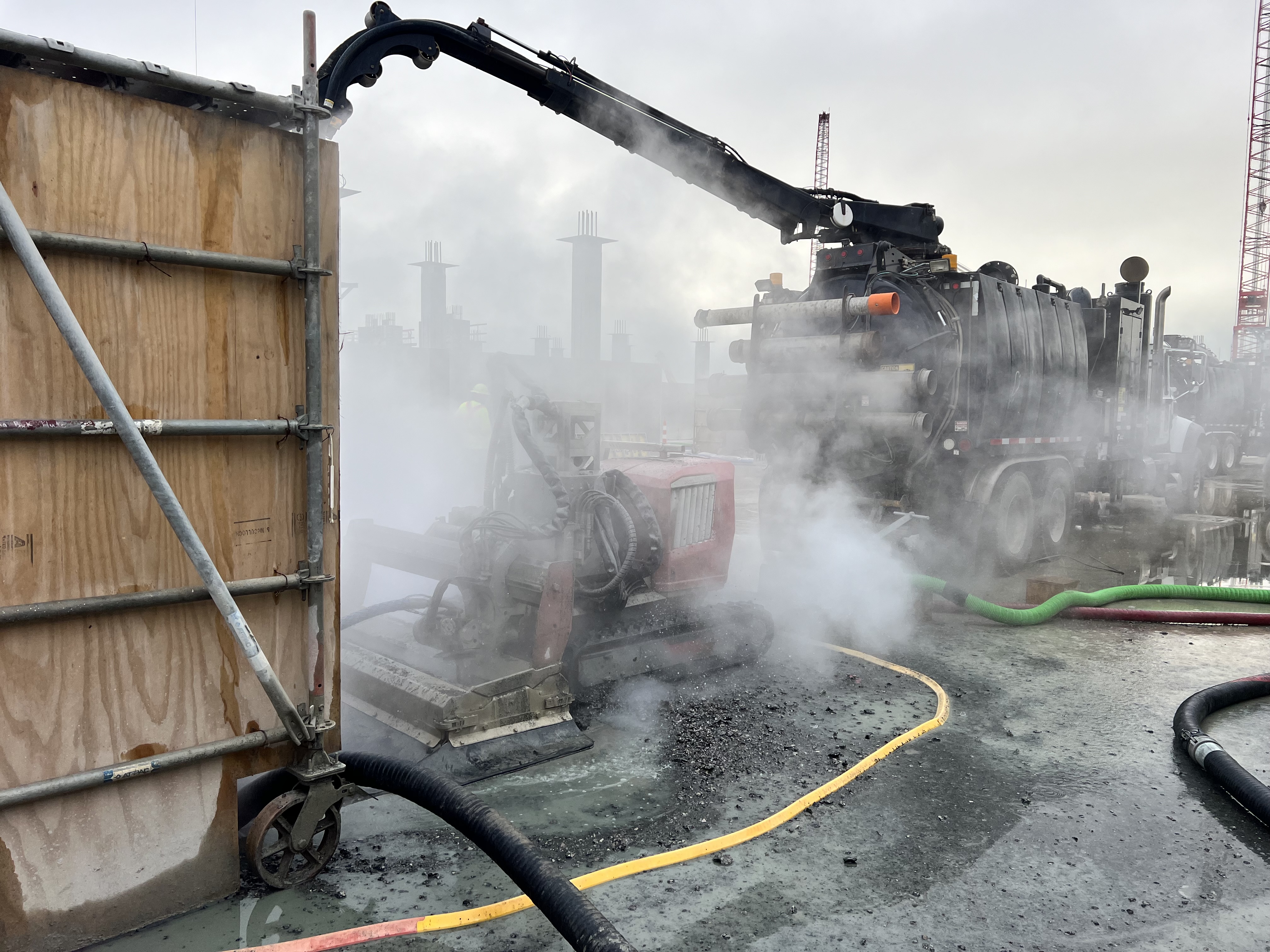
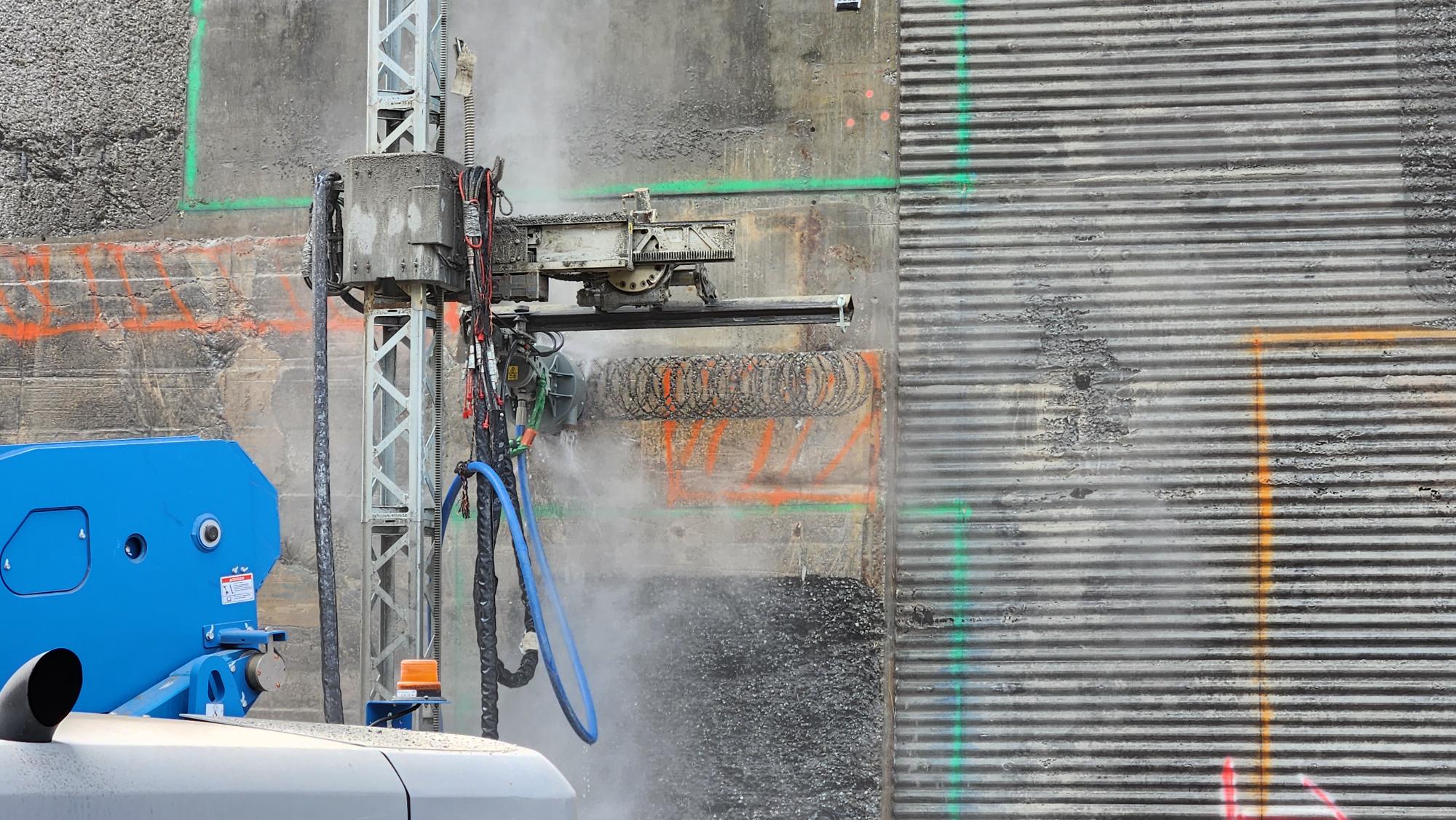
| Hydrodemolition | CSP 5-9 | Variable, selective | Selective removal, rebar-tight areas, bridge decks | Water management required; higher mobilization cost |
| Abrasive Blasting | CSP 3-5 | < 1/16" | Spot treatment, vertical surfaces, small areas | Slow; not suitable for large horizontal areas |
Pre-Preparation Diagnostics: Advanced Entity Testing
Before selecting a preparation method, a competent contractor performs subsurface diagnostic testing to characterize the slab condition. Skipping this step produces incorrect method selection and scope errors.
- Chain drag / hammer sounding (ASTM D4580): Identifies hollow, delaminated areas acoustically. Cost-effective first screen; covers 100% of surface area.
- Ground-penetrating radar (GPR): Maps rebar depth, spacing, and condition; detects subsurface voids; locates post-tension cables without contact. Penetrates 18"-24" in concrete.
- Electromagnetic induction (cover meter): Measures precise rebar depth (accurate to +/- 1/4") and estimates bar diameter. Required before any coring or milling operation.
- Phenolphthalein carbonation testing: Determines carbonation front depth (typically 0.25" to 1.5" in aged slabs). Carbonated concrete has reduced pH, compromising passive rebar protection.
- Chloride ion profiling (ASTM C1152): Quantifies chloride concentration at 1" depth increments. Chloride levels above 0.6 lb/yd3 at rebar depth indicate active corrosion risk.
- Tensile pull-off testing (ASTM C1583): Measures in-place tensile bond strength of existing overlay or substrate. Minimum 200 psi required for most bonded overlay systems.
What Is Scarifying Concrete?
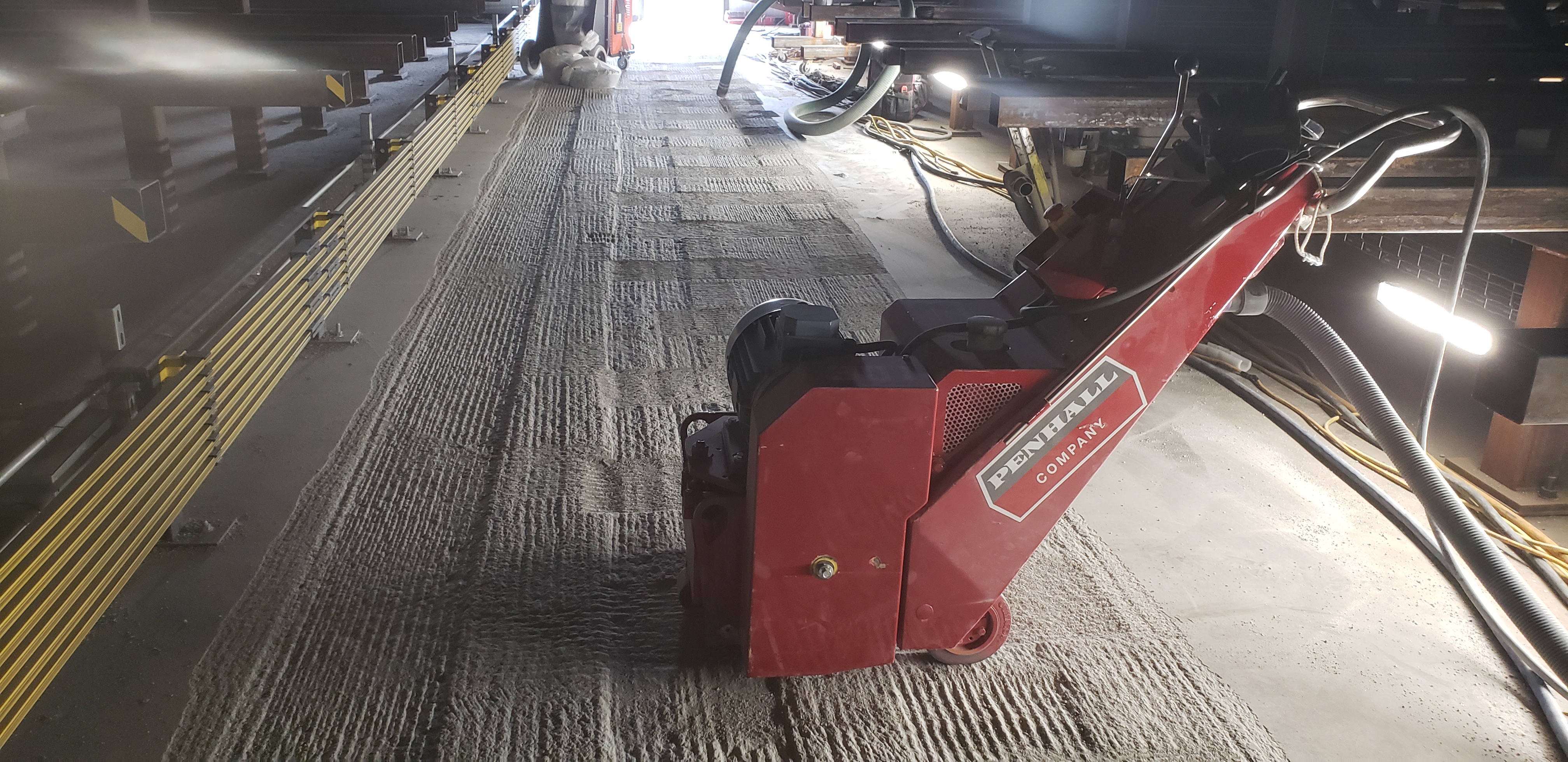
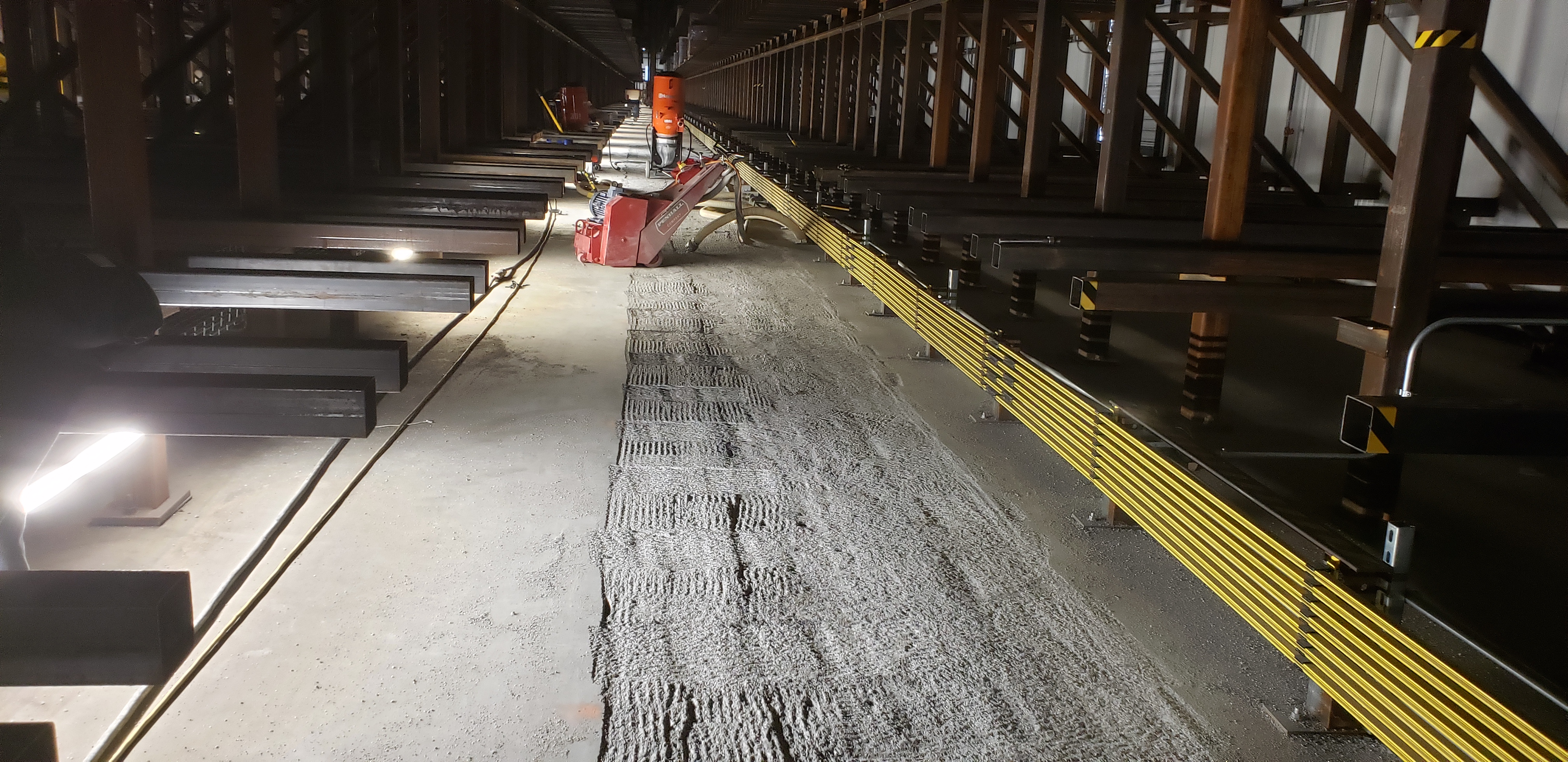
Scarifying concrete is a high-production mechanical surface preparation method that uses a rotating drum equipped with multiple tungsten carbide or hardened steel cutting wheels to fracture and remove surface concrete at a controlled depth, creating ICRI CSP 4-9 profiles appropriate for bonded overlays, coating systems, and coating removal.
A single-pass concrete scarifier removes between 1/16" and 1/2" of material depending on drum configuration, cutter spacing, machine speed, and concrete hardness. Multiple passes increase removal depth. Walk-behind units process 1,500-3,000 SF/hour; ride-on scarifiers achieve 8,000-15,000 SF/hour on open floor areas.
Scarifying vs. Shot Blasting vs. Diamond Grinding
| Factor | Scarifying | Shot Blasting | Diamond Grinding |
|---|---|---|---|
| ICRI CSP Output | CSP 4-9 (aggressive) | CSP 3-7 (moderate) | CSP 1-3 (fine) |
| Removal Depth | 1/16" - 1/2" per pass | < 1/8" | < 1/16" |
| Coating Removal | Yes, up to 1/4" thick coatings | Yes, up to 50 mils | No; for profile only |
| Production Rate | 1,500-15,000 SF/hr | 3,000-10,000 SF/hr | 500-3,000 SF/hr |
| Edge Access | Within 1/2" of walls | Limited (4"-6" from edges) | Within 1/4" of walls |
| Dust Generation | High; HEPA vacuum required | Contained in blast cycle | Moderate; wet or dry |
| Substrate Vibration | Moderate | Low | Low |
| Ideal Follow-on | Shot blast or grind to refine | Ready for most overlays | Apply coating directly |
When scarifying is the correct preparation method, the existing surface has contamination deeper than 1/8" (oils, deicers, chlorides); failed coatings or membranes bonded to the slab; scaling damage from freeze-thaw exceeding CSP 3; or a specified bonded overlay requiring CSP 5+. It is also used to roughen slabs that have been over-ground or trowel-burnished to a CSP below the overlay manufacturer's requirement.
What Is Coring Concrete?
Coring concrete is the extraction of cylindrical samples from in-place concrete using a diamond-tipped rotary drill per ASTM C42, producing 2" to 4" diameter cores used to evaluate compressive strength, carbonation depth, chloride ion penetration, delamination presence, overlay bond integrity, and existing slab thickness prior to any resurfacing or structural modification.
Compressive strength from field cores is evaluated at a diameter-to-length ratio of 2:1 after correction factors are applied per ASTM C42 Section 7.4. A core with a length-to-diameter ratio below 1.75 requires a strength correction factor of 0.87-0.96. Results below 3,000 psi typically indicate the slab cannot support a bonded overlay without full-depth repair or replacement in that zone.
Coring Protocol for Pre-Resurfacing Assessment
- Core frequency: Minimum 1 core per 1,000 SF for condition assessment; 1 per 500 SF in areas with visible distress or suspected delamination.
- Core diameter: 3" standard for compressive strength testing; 4" when extracting cores through existing overlays to preserve bond interface for examination.
- Rebar clearance: Use electromagnetic cover meter before drilling. Maintain minimum 3" clear from rebar to avoid cutting reinforcement and generating ASTM C42 exclusion conditions.
- Chloride sampling: Extract concrete powder at 0"-1", 1"-2", and 2"-3" increments during coring using a vacuum drill system. Submit to lab per ASTM C1152 within 24 hours of extraction.
- Documentation: Photograph core extraction location, core top and bottom surfaces, and any delamination or voids encountered. Map core locations on site plan with GPS coordinates or dimensioned reference points.
Advanced Diagnostic Integration: Beyond the Core
Coring alone provides point data. For large infrastructure projects, core results are most valuable when integrated with GPR scan data to correlate anomalies with physical samples. A GPR anomaly at 1.5" depth confirmed by a core showing delaminated overlay and zero bond strength at the same depth produces a defensible condition map for scope and pricing.
What Is Cross Slope and Why Does It Matter for Commercial Concrete?
Cross slope is the transverse grade of a paved surface measured perpendicular to the direction of travel, expressed as a percentage, and it governs surface drainage performance, vehicle stability, pavement structural durability, and ADA pedestrian accessibility compliance on commercial facilities and public infrastructure.
On roadways and parking lots, AASHTO Green Book standards specify a cross slope of 1.5%–2% on tangent sections to ensure positive drainage without exceeding vehicle stability thresholds. Under ADA Standards for Accessible Design (Section 402.2), pedestrian accessible routes may not exceed a 2% (1:50) cross slope in any direction; running slope is separately governed. FHWA Technical Advisory T 5040.36 cross-references these standards for federal-aid highway projects.
Cross Slope Failure Modes and Their Consequences
| Cross Slope Condition | Primary Failure Mode | Secondary Effect | Applicable Standard |
|---|---|---|---|
| < 1% (insufficient drainage) | Standing water, freeze-thaw D-cracking | Black ice formation; slip liability | AASHTO Green Book 3-22 |
| 1% - 2% (target range) | No failure mode; optimal performance | Positive drainage; ADA-compliant if pedestrian | ADA Sec. 402.2; AASHTO |
| 2% - 4% (marginal; roadway acceptable) | ADA non-compliance on ped. routes | Tire wear asymmetry on tangent roads | ADA Sec. 402.2 |
| > 4% (excessive) | Vehicle stability risk; hydro pooling at transitions | Accelerated overlay delamination at transitions | AASHTO; local traffic eng. |
| Reverse cross slope (negative) | Ponding at curb or gutter; structural undercutting | Frost heave amplification | All drainage standards |
Cross Slope Correction Methods for Commercial Infrastructure
Correcting out-of-tolerance cross slope on existing commercial concrete requires one of three approaches, selected based on deviation magnitude, slab condition, and overlay compatibility:
- Diamond grinding (deviation < 3/8"): Removes high spots to restore correct slope geometry. Achieves tolerance of +/- 1/8" over 10-foot straightedge per ACPA grinding specifications. Best suited for joints, localized high crowns, and ADA ramp corrections.
- Bonded overlay with variable thickness (deviation 3/8" to 1.5"): Places a polymer-modified or cementitious overlay in feathered variable depth to build up low areas and restore positive drainage slope. Requires substrate preparation to CSP 4-5.
- Full-depth milling and resurfacing (deviation > 1.5" or slab approaching end of service life): Cold milling removes the existing surface to a grade-controlled depth, restoring designed cross slope geometry before overlay application. Most precise method for large-area slope restoration.
Measurement and Verification
Cross slope on commercial facilities is measured using a digital level or slope measurement device calibrated to +/- 0.01%, with readings taken at 5-foot intervals across the cross section and 10-foot intervals in the direction of travel. Pre-construction and post-construction cross slope surveys are documented on as-built drawings and retained for ADA compliance records. On federally funded projects, FHWA requires pavement smoothness testing per ASTM E1274 (Profilograph Index) alongside cross slope verification.
How Proper Surface Preparation Impacts Long-Term Durability
The service life of any bonded concrete overlay system is more sensitive to surface preparation quality than to overlay material selection. A premium polyurea coating applied over a CSP 1 substrate on a contaminated slab will delaminate faster than a commodity latex-modified overlay applied over a properly scarified CSP 4-5 surface free of laitance and chloride contamination.
Three failure mechanisms account for the majority of premature overlay failures in commercial and infrastructure applications:
- Insufficient profile amplitude: The overlay cannot achieve mechanical interlock. Tensile pull-off strength falls below 200 psi (ASTM C1583 threshold), leading to delamination under thermal cycling or traffic load.
- Subsurface moisture vapor transmission (MVT): Vapor pressure from the substrate migrates through the overlay bond line. On slabs-on-grade, MVT should be below 3 lbs per 1,000 SF per 24 hours (ASTM F1869 calcium chloride test) or RH below 75% at 40% slab depth (ASTM F2170) before coating application.
- Residual contaminants: Chloride ions, petroleum products, or curing compounds below the mechanical preparation depth suppress bonding chemistry. Chloride levels above 0.2 lb/yd3 at the surface are incompatible with most cement-based overlays without inhibitor treatment.