At a Glance
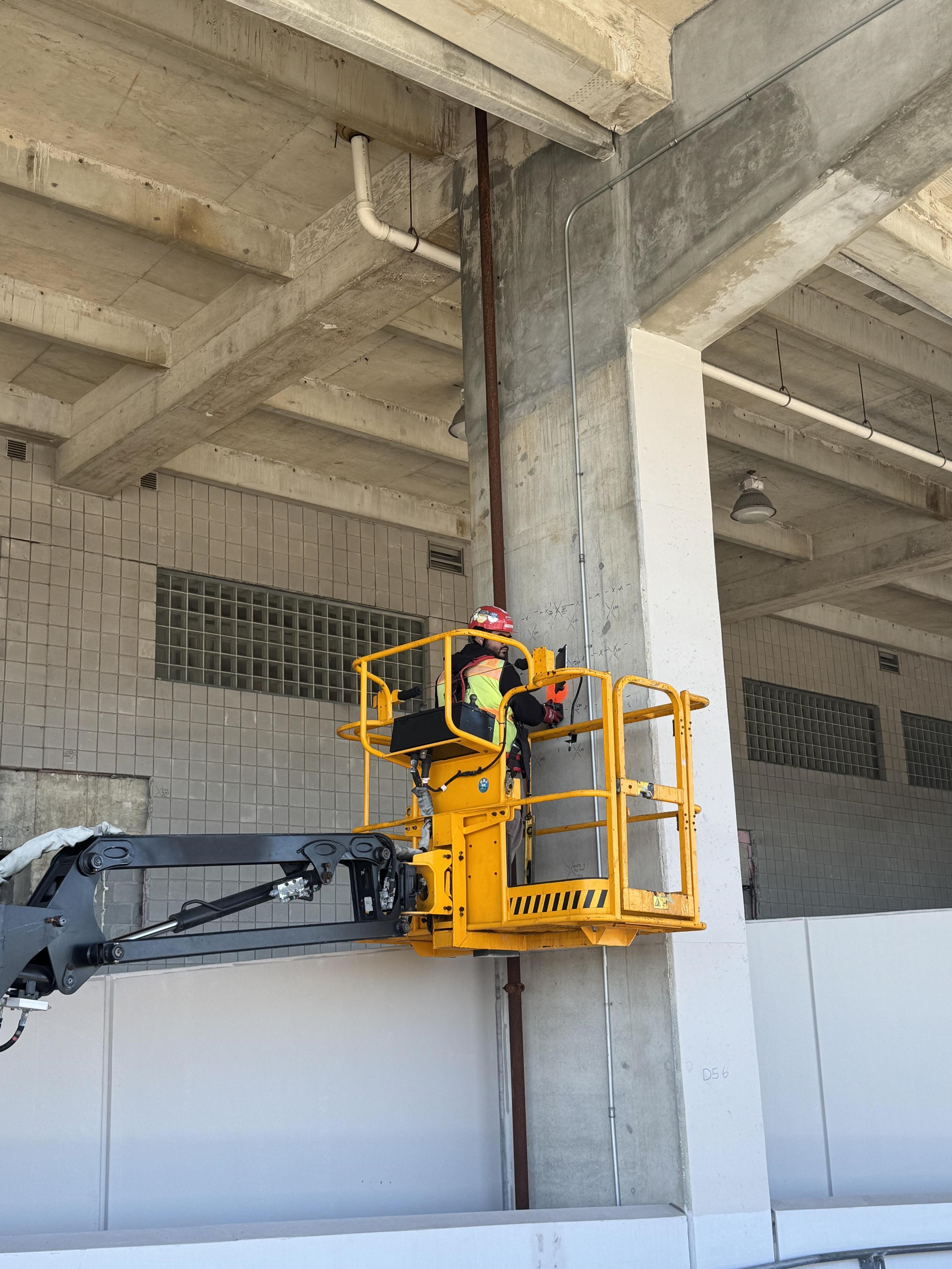
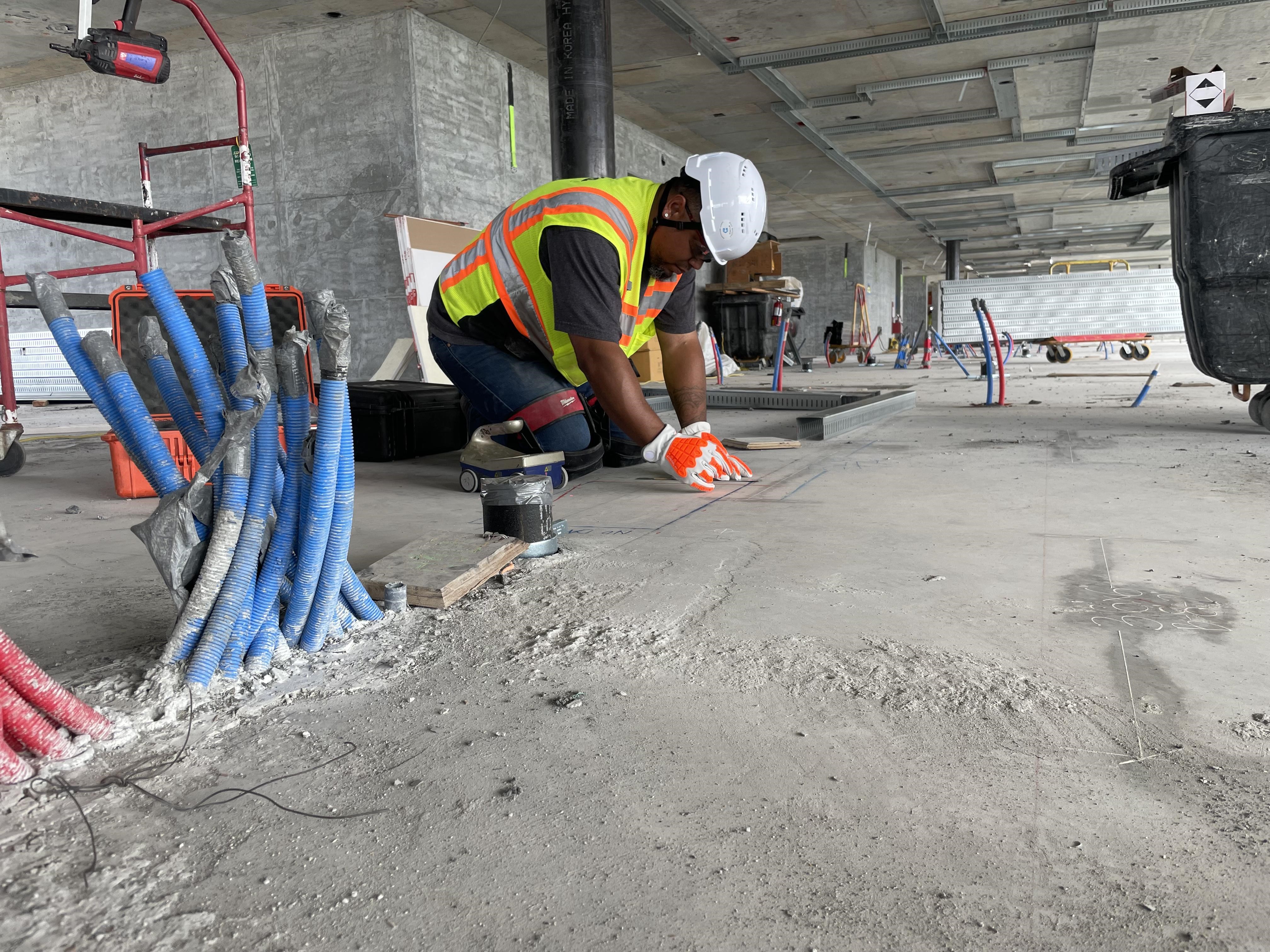
Rebar scanning services use GPR to locate rebar, post-tension cables, conduit, and utilities inside concrete before any drilling, coring, cutting, or trenching begins.
Finding rebar in concrete before penetrating it prevents blade and bit damage, allows anchors and cores to be positioned accurately the first time, and in post-tensioned concrete, avoids a life-safety event: PT cables are not passive rebar.
A rebar detector in concrete can mean several things. Simple electromagnetic cover meters detect a single shallow bar. Professional GPR-based rebar locating services detect rebar at depth, across multiple layers, and identify PT cables, conduit, pipes, and voids in the same pass.
The deliverable is a marked surface: detected rebar, PT cables, and utilities are marked directly on the concrete with spray paint or chalk, giving the crew an immediate, visible guide before work begins.
Rebar scanning services are a standard pre-work step before anchor drilling, core drilling, saw cutting, slab trenching, and renovation scopes involving any concrete penetration.
The cost of a rebar scan is negligible compared to a destroyed blade, a failed anchor, a missed penetration, or a PT cable strike.
Why Finding Rebar in Concrete Before You Cut or Drill Matters
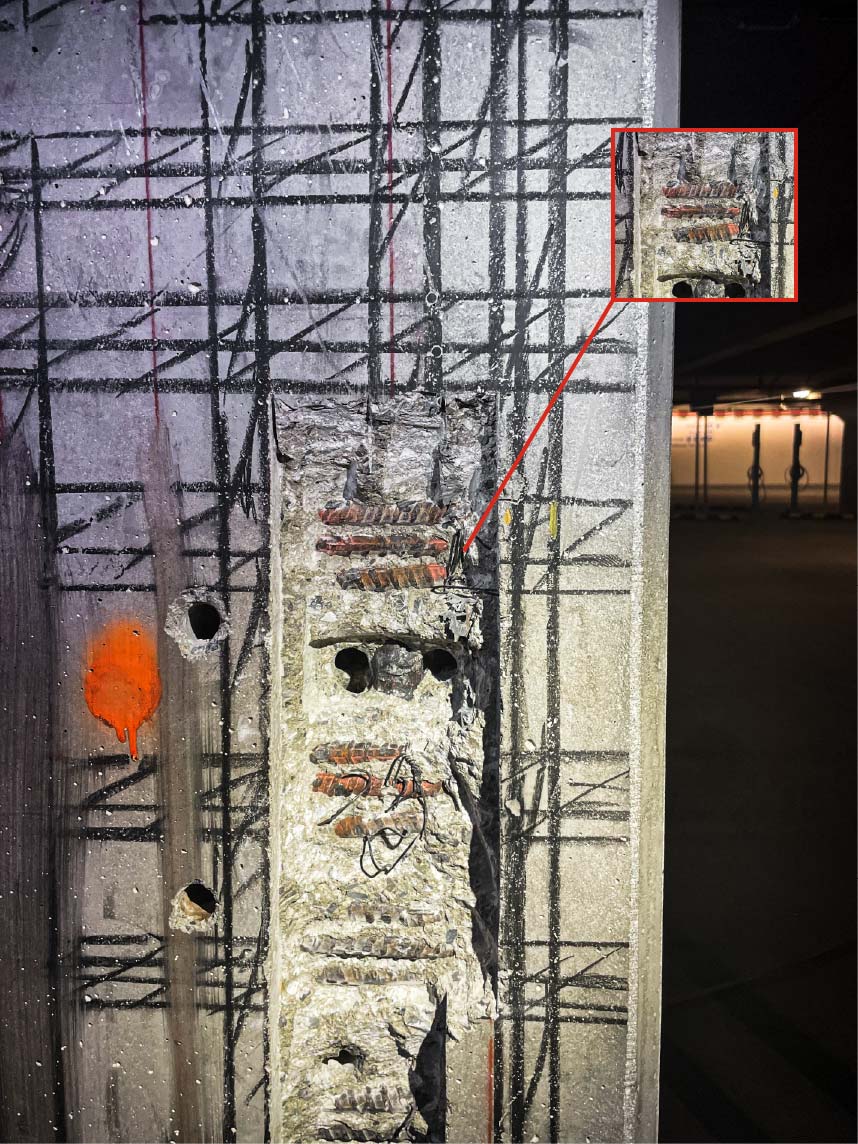
Every concrete slab, wall, beam, and column in commercial and infrastructure construction contains steel reinforcement. That reinforcement is invisible from the surface. It does not show up in a visual inspection. It cannot be detected by tapping or probing. Without a tool specifically designed for finding rebar in concrete, there is no way to know where the bars are, how deep they are, how closely they are spaced, or whether some of the objects inside the concrete are passive rebar or actively tensioned PT cables.
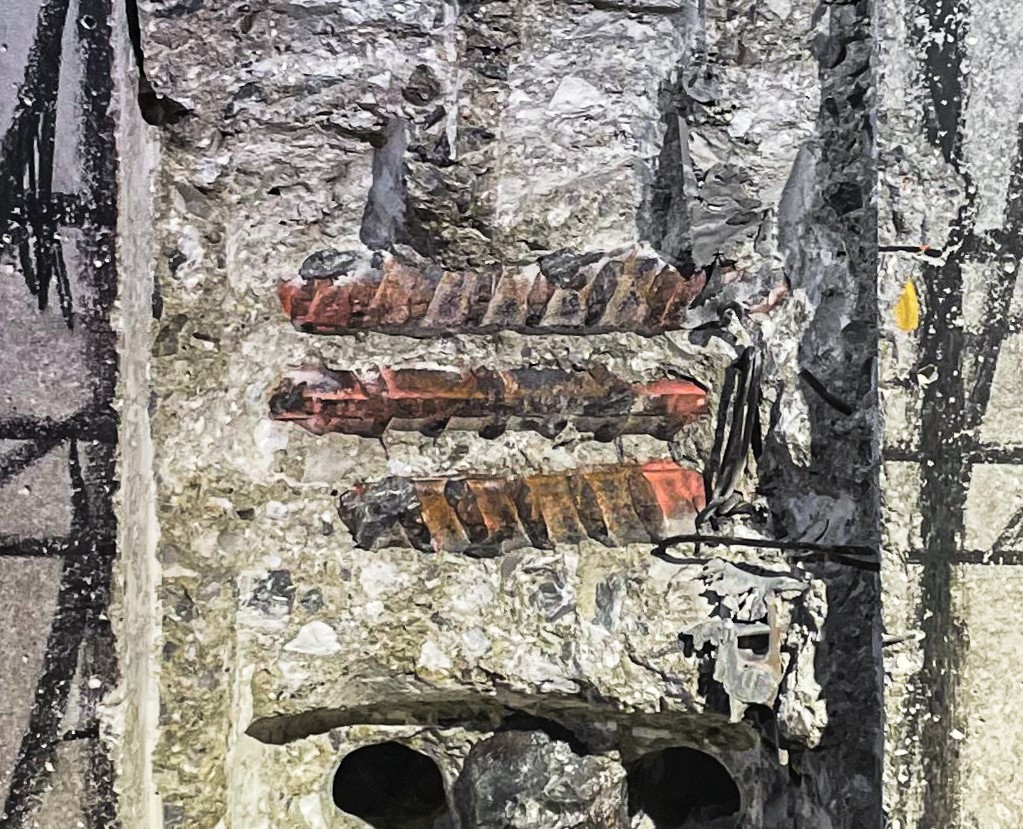
For a drilling or cutting crew working without that information, every penetration is a guess. Most of the time, the guess produces an acceptable outcome: the drill misses the rebar, the anchor goes in cleanly, the core comes out intact. But a meaningful percentage of the time, it does not. The drill hits a bar and stalls. The core bit destroys itself on unexpected reinforcement. The saw blade burns through its diamond segments two passes into a cut that was supposed to take ten. The anchor ends up exactly over a rebar bar and has to be relocated.
Each of these outcomes has a cost. A destroyed diamond blade on a wall saw runs hundreds of dollars to replace. A core bit that hits rebar mid-bore can require pulling the rig, replacing the bit, and re-setting at a new location. Relocated anchors mean additional drilling time, patched holes, and potential re-engineering of the connection. Across a project with dozens of penetrations, the accumulated cost of unplanned rebar hits can far exceed the cost of a comprehensive rebar scan before the work began.
And that calculation assumes the undetected object was passive rebar. In a post-tensioned slab, it might not be. PT cables are under 150,000 to 270,000 PSI of tensile stress. A single 0.5-inch strand carries approximately 30,000 pounds of load. Cutting through one releases that energy instantaneously. The cable retracts at high speed, destroying the concrete around it and creating an immediate danger to anyone in the area. There are documented fatalities associated with undetected PT cable strikes during concrete cutting and coring work.
Rebar scanning services exist to eliminate this uncertainty before the work begins. A scan that takes 30 minutes and costs a fraction of the project budget removes the guesswork entirely.
How Rebar Scanning Services Work
Professional rebar scanning services use Ground Penetrating Radar, not the hand-held electromagnetic rebar detectors available at equipment rental counters. Understanding the difference between these two approaches is important for anyone specifying or purchasing rebar locating services.
GPR vs. Electromagnetic Cover Meters
Electromagnetic cover meters (also called profometers or rebar locators) work by detecting the magnetic field disruption caused by a steel rebar bar near the sensor. They are simple, inexpensive, and effective for a single purpose: measuring the concrete cover depth over a known rebar bar when you are positioning the sensor directly above it.
What cover meters cannot do is equally important to understand:
- They cannot detect rebar at depths greater than roughly 3 to 4 inches in most models.
- They cannot detect multiple overlapping rebar layers because the signal saturates in dense reinforcement environments.
- They cannot detect PT cables, conduit, pipes, or any other embedded utility.
- They do not produce a cross-sectional image of the slab interior, only a point-by-point signal reading that requires the operator to interpret proximity.
GPR overcomes all of these limitations. A professional GPR rebar scanning service uses a high-frequency antenna (typically 1.5 GHz to 2.6 GHz for standard concrete applications) that transmits pulses of radar energy into the slab and records reflections from all embedded objects, at all depths within the scan range, simultaneously. The result is a continuous cross-sectional image of the slab interior that shows every rebar bar, PT cable, conduit run, and utility in the scan path.
For any concrete work where the stakes are higher than measuring cover depth on a known bar, GPR-based rebar scanning services are the appropriate tool. This includes virtually all commercial and infrastructure drilling, coring, and cutting work.
The GPR Rebar Scanning Workflow
Understanding how a rebar scanning service operates in the field helps project teams integrate it smoothly into the work schedule and get the most value from the scan deliverable.
Step 1: Site and project review. Before scanning begins, the technician reviews available information about the structure: construction drawings if available, the type of construction (conventionally reinforced vs. post-tensioned), the planned work scope, and the proposed locations for anchors, cores, or cuts. This context helps the technician calibrate expectations, identify likely reinforcement patterns, and focus the scan on the highest-priority areas.
Step 2: Equipment setup and calibration. The GPR antenna is connected to the control unit and the system is powered up. For accurate depth estimates, the technician calibrates the signal velocity for the concrete being scanned, either using a known depth reference or a standard dielectric value for the concrete type. Antenna selection is confirmed based on the slab thickness and the required resolution.
Step 3: Scanning. The technician moves the GPR antenna across the concrete surface in systematic passes covering the proposed work areas. For a targeted pre-drill scan, passes are made in two perpendicular directions across each proposed location, capturing the rebar reflections from both orientations. For a full-area grid scan, passes are made at regular intervals across the entire area in both directions.
Step 4: Real-time interpretation. As the antenna moves, the control unit displays the radargram in real time. The technician reads the data as it is collected, identifying the hyperbolic reflections produced by individual rebar bars, the pattern of PT cable reflections, and any anomalies that indicate conduit, pipes, or voids. In most scanning concrete for rebar applications, interpretation is performed live, allowing the technician to immediately respond to unexpected findings.
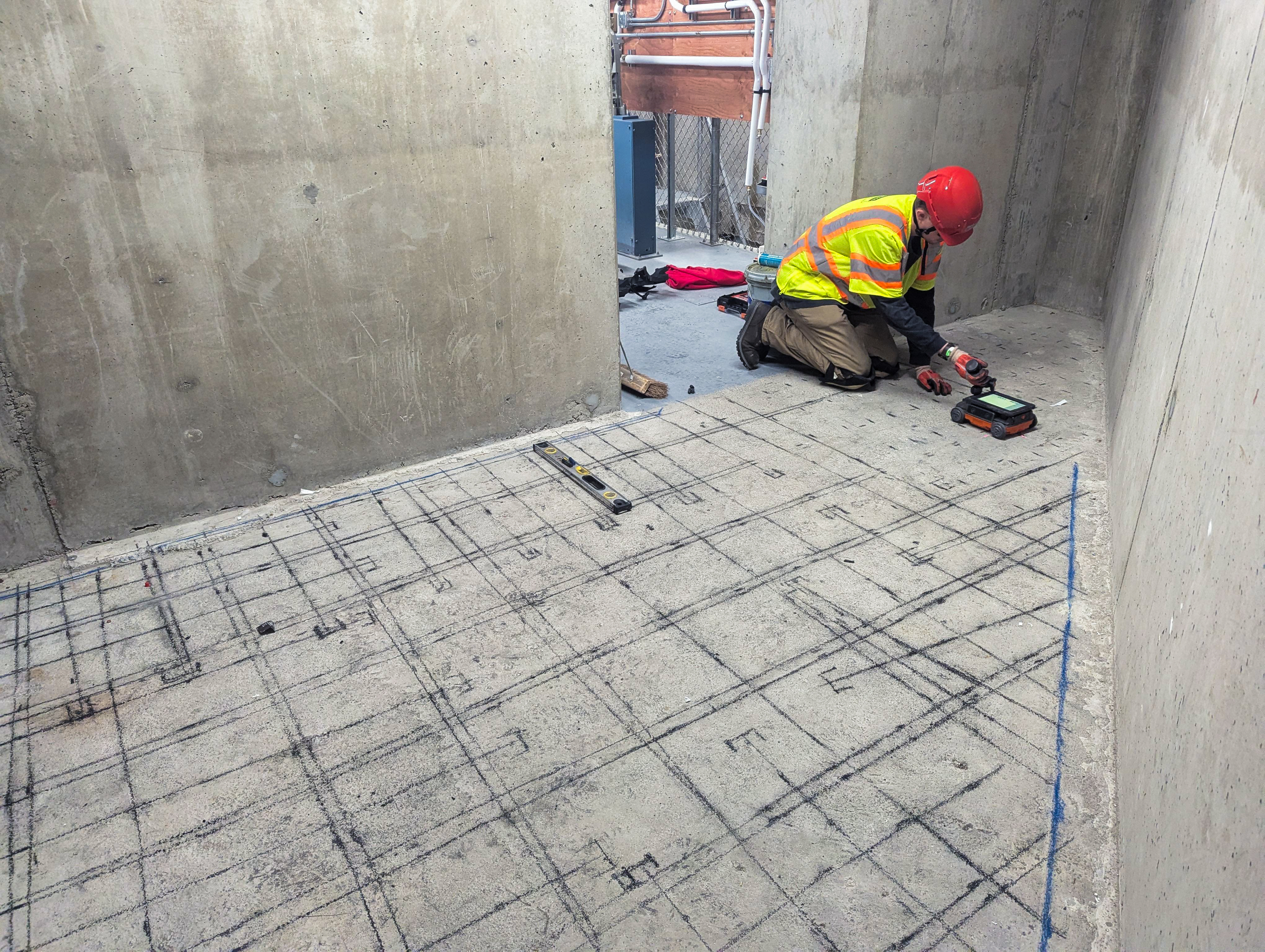
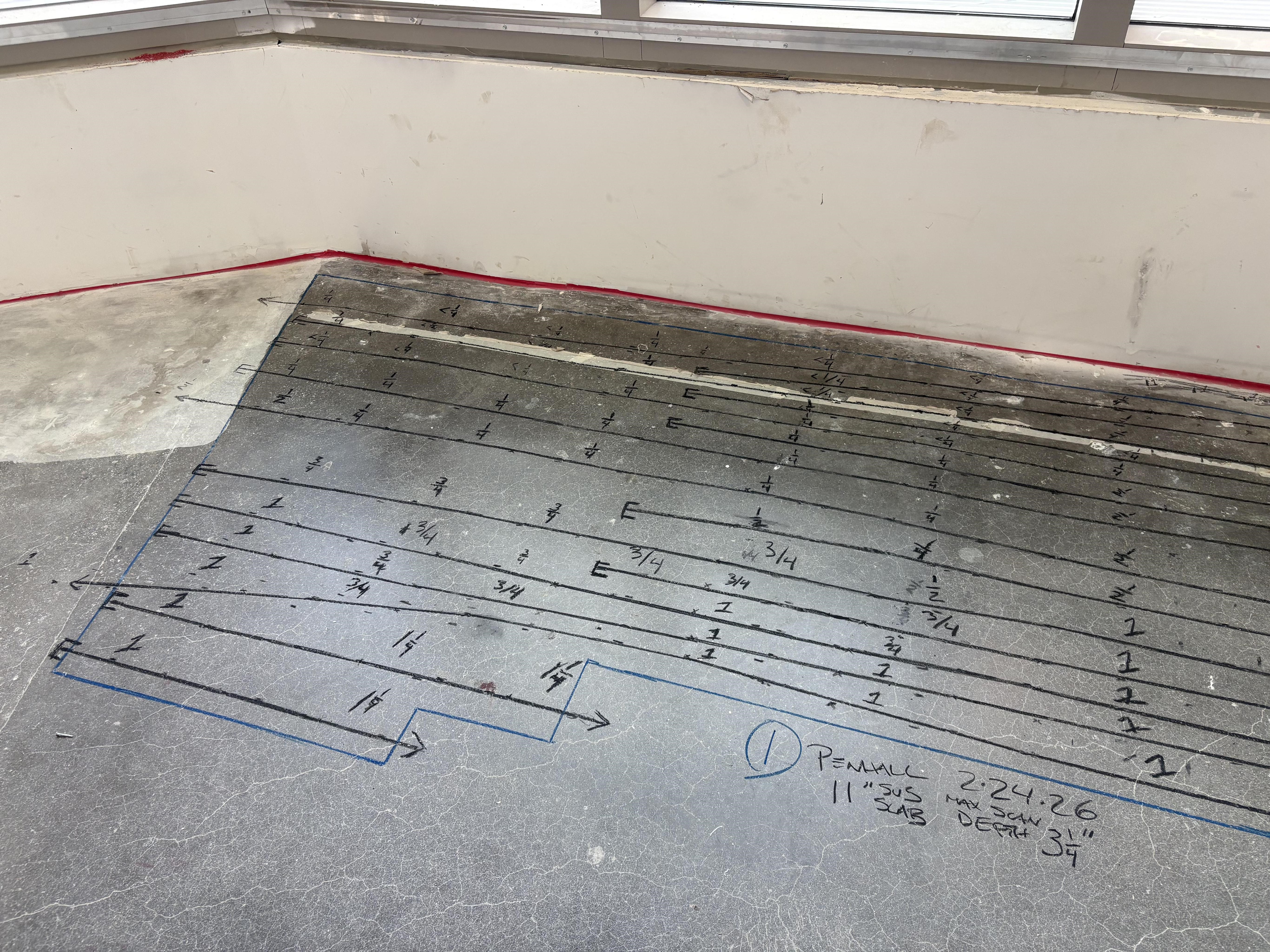
Step 5: Surface marking. As each embedded object is identified, the technician marks its position on the concrete surface with spray paint or chalk. For rebar, this typically means a short line along the bar's centerline axis, with depth noted beside it. For PT cables, a distinct marking color or symbol is used to distinguish them from passive rebar. Proposed drill or cut locations that are confirmed clear are marked with a positive indicator.
Step 6: Crew briefing. After completing the scan of the work area, the technician briefs the lead crew member on findings: where the rebar runs, where PT cables are present, which locations are clear, and any areas where the data was ambiguous or where additional caution is warranted. This verbal handoff is as important as the surface markings.
What Rebar Locating Reveals Beyond Just Rebar
Rebar scanning services based on GPR do not selectively detect only rebar. The scan detects all embedded objects that produce a dielectric contrast with the surrounding concrete. In practice, this means a rebar scan on a standard commercial floor will also reveal:
This is one of the most important practical advantages of professional rebar locating services over simple electromagnetic detectors. The crew gets not just a rebar map, but a complete picture of everything inside the slab that could affect the safety or outcome of the planned work. A conduit that was not on any drawing, a hydronic tube that runs directly through the proposed core location, a PT cable in a slab the GC assumed was conventionally reinforced: all of these are findings that a GPR scan surfaces before the work begins rather than during it.
What the Rebar Scan Deliverable Looks Like in the Field
The primary output of a rebar scanning service is not a report. It is a marked surface. Here is what that looks like in practice, and why it is designed the way it is.
Spray Paint and Chalk Markings
The technician uses spray paint in high-visibility colors (typically orange or yellow for rebar, red for PT cables and live utilities, green for confirmed-clear locations) to mark the concrete directly. The markings are applied with the antenna still in hand, often within seconds of completing a scan pass, so the crew can see the picture taking shape in real time as the scan progresses.
Standard marking conventions used in rebar locating services include:
- Parallel lines along a rebar bar centerline, with bar depth noted in inches. For example, a line marked "4" beside it indicates the bar center is 4 inches below the surface.
- A series of dashes or dots along the path of a PT cable run, connecting to form a line showing the cable's direction of travel. PT markings are typically made in red and may include a notation such as "PT" to confirm the identification.
- A circle or X at each proposed drill or anchor location that is confirmed clear, indicating the crew can proceed at that point.
- Hydronic heating tubing, if installed in the slab.
- A different symbol, an X with a line through it or a red spray mark, at proposed locations that fall over detected rebar or utilities and need to be repositioned.
- Depth annotations next to key objects, particularly PT cables and utilities, so the crew knows how much clearance exists above the detected object.
The goal of the marking convention is to be immediately interpretable by the drill operator or saw crew without needing to consult a separate document. The marked slab is the working tool. A foreman who can read the spray marks on the floor should be able to position every anchor and core location correctly without additional explanation.
Crew Briefing
Before leaving the site, the scanning technician briefs the lead crew member directly. This briefing covers the key findings: where reinforcement is heavier than expected, where PT cables were detected and what that means for the planned work, which proposed locations are confirmed clear, and any areas of the scan where confidence was lower due to congested reinforcement, surface conditions, or other factors.
This verbal component of the deliverable is not a formality. It is the transfer of interpretive judgment from the person who read the scan data to the person who will act on it. The spray marks show where things are. The briefing communicates confidence levels, identifies the findings that carry the most risk, and gives the crew the context they need to make good decisions when they encounter something in the field that was not anticipated.
Written Scan Reports
On larger projects, in post-tensioned structures, or where documentation is required by the project engineer or owner, the scan deliverable also includes a written report. A standard rebar scanning services report includes the project information and site description, the scan methodology and equipment used, representative radargram images annotated to identify key reflectors, a summary of findings by zone or location, and any recommendations for work sequencing or locations that require structural engineer review before proceeding.
Written reports are standard on structural assessments, bridge deck investigations, parking structure condition surveys, and projects where the scan findings will be incorporated into engineering documentation. For routine pre-work rebar locating on trade work scopes, the marked surface and crew briefing are typically the deliverable, and a written report is provided on request.
The Cost of Skipping Rebar Scanning Services
The decision to skip a rebar scan is usually made for one of two reasons: time pressure or the assumption that the slab is probably fine. Both are understandable on a busy job site. Neither holds up well against the actual cost of the events that rebar scanning services are designed to prevent.
| What Was Hit | Immediate Consequence | Downstream Cost | Safety Risk |
|---|---|---|---|
| Rebar (unexpected) | Blade or bit destroyed mid-cut | Tooling replacement, delay, rework to reposition | Low to moderate |
| Dense rebar mat | Multiple blade failures on single cut line | High tooling cost, schedule impact, potential rework | Moderate |
| PT cable (unbonded) | Violent cable release on strike | Structural damage, emergency stop-work, injury or fatality | Severe |
| Live electrical conduit | Electrical arc, circuit damage | Electrocution risk, facility downtime, repair costs | Severe |
| Pressurized water line | Immediate flooding at drill/cut location | Water damage, emergency shutdown, repair and dry-out | High |
| Gas line | Gas release at work area | Evacuation, emergency response, explosion risk | Severe |
| Data/fiber conduit | Network or communications outage | Operational disruption, emergency splice repair | Moderate to high |
Tooling Damage and Replacement Cost
Diamond blades and core bits are precision tooling, not commodity items. A quality diamond blade for a wall saw or flat saw represents a meaningful line item in the project tooling budget. A core bit in a larger diameter is more expensive still. When a blade or bit hits unexpected rebar mid-cut, the damage is immediate: segments are torn from the blade, the bit is forced off-center, and the tooling is often destroyed outright. Replacing it requires stopping work, sourcing a replacement, and potentially waiting for delivery if the right size is not on the truck.
In heavily reinforced concrete where the crew proceeds without scanning, multiple tooling failures on a single cut line can turn a half-day scope into a two-day problem. The rebar scan that would have mapped the reinforcement and allowed the crew to select the right blade configuration costs a fraction of two destroyed blades.
Failed Anchor Placements and Rework
An anchor that cannot be installed because rebar is in the path is not just a delay. Depending on the anchor specification, the location may need to be re-engineered. The slab needs to be patched. The new location needs to be verified. The work has to be re-permitted or re-inspected in some cases. What started as a ten-minute anchor installation becomes a multi-day coordination problem.
On large anchor bolt patterns, the math is straightforward. If 10 percent of proposed anchor locations fall over rebar that would have been identified by a pre-work scan, and each failed placement costs two hours of rework plus materials, a 50-anchor-bolt project accumulates five failed placements, ten hours of rework, and the cost of patching and re-drilling. A rebar scan typically identifies those five conflicts in advance and allows them to be repositioned before drilling starts.
PT Cable Strikes: The Non-Negotiable Case for Scanning
No amount of tooling savings math applies to a PT cable strike. The stored energy in a single stressed PT tendon is not a cost variable. It is a life-safety event. A worker in the immediate area of a PT cable strike is at risk from the cable itself, from concrete fragments, and from the structural consequences of abrupt PT force release.
Post-tensioned construction is not rare or exotic. It is the standard structural system in a large proportion of commercial buildings, parking structures, high-rise towers, and infrastructure built in the past 40 years. A crew that proceeds without rebar scanning services in a commercial concrete environment is not operating in a low-PT-probability situation. They are operating with unknown PT probability. That distinction matters.
Rebar Scanning Services by Work Type
Anchor Drilling
Anchor drilling is the single most common trigger for rebar scanning services. Equipment anchors, structural steel connections, racking systems, MEP support brackets, seismic restraints, and fall protection anchors all require drilling into concrete at specific locations. Rebar scanning before anchor drilling confirms which proposed locations are clear, allows conflicts to be repositioned before drilling starts, and identifies PT cables that require structural engineer review before any drilling proceeds in the vicinity.
For large anchor bolt patterns, a comprehensive rebar scan of the full anchor field is typically more efficient than a location-by-location scan because the technician can cover the entire area in a systematic grid, identify all conflicts at once, and brief the crew on the full picture before any drilling begins.
Core Drilling for Utility Penetrations
Core drilling for mechanical, electrical, plumbing, and data penetrations requires placing a circular hole at a specific location defined by the MEP design. That location is determined by the routing requirements of the system being installed, not by the reinforcement layout of the slab. Rebar scanning before core drilling identifies which proposed core locations fall over rebar and need to be adjusted within the allowable tolerance, and which fall over PT cables and require special handling.
Scanning concrete for rebar before core drilling also allows the crew to select core bit diameter and reinforcement-rated tooling configuration based on actual conditions rather than assumptions, reducing mid-bore surprises and bit failures on the first pass through a reinforced slab.
Saw Cutting
Saw cutting for slab removal, trench definition, selective demolition, and control joint installation runs a diamond blade through whatever is embedded along the cut line. Rebar scanning before saw cutting maps the reinforcement layout along the proposed cut path, allowing the contractor to select the right blade specification for the rebar size and spacing encountered, plan cut lines to minimize rebar crossings where design tolerances allow, and identify PT cables that fall in the cut path and require structural assessment before cutting proceeds.
On projects where the cut line is fixed by the design and cannot be adjusted, the rebar scan still provides critical information: it tells the saw operator exactly where rebar hits will occur, how many there are, and what size reinforcement to expect, allowing for proactive blade and tooling management rather than reactive blade replacement mid-cut.
Overhead Core Drilling
Overhead core drilling, drilling up through a slab from below, presents a unique risk profile. Anything in the slab directly above the drill point falls toward the operator when the core punches through: water, debris, or in the worst case, a pressurized utility that begins discharging directly at the person holding the drill. Rebar scanning from above the slab before overhead drilling begins confirms the drill path is clear and identifies utilities that require isolation or relocation before the work proceeds.
Overhead coring in post-tensioned slabs carries all the same PT cable risks as coring from above, with the additional complication that the cable release, if triggered, occurs directly above the operator. Rebar scanning services before overhead coring in any PT structure are non-negotiable.
Renovation and Selective Demolition
Renovation scopes involving selective slab removal, new openings in concrete walls, and partial demolition expose more embedded objects to cutting and breaking tools than any other work type. Rebar scanning before renovation work provides a comprehensive picture of the reinforcement and utility layout across the full work zone, allowing the demolition sequence to be planned around the embedded content and preventing uncontrolled utility strikes during concrete removal.
For post-tensioned structures undergoing renovation, rebar scanning services should be conducted before any concrete removal is planned, and the scan findings should be reviewed by the structural engineer of record to confirm the proposed removal sequence is compatible with the PT system’s structural behavior. Penhall’s selective demolition services include coordination with structural engineers and pre-work scanning as standard components of the project scope.
GPR vs. Simple Rebar Detectors: Choosing the Right Tool
The term rebar detector in concrete covers a range of technologies with very different capabilities. Understanding which tool is appropriate for which situation prevents the common mistake of using an inexpensive cover meter when a GPR-based rebar scanning service is what the job actually requires.
When a Simple Rebar Detector Is Sufficient
Handheld electromagnetic cover meters are appropriate in a narrow set of circumstances: measuring concrete cover depth over a known bar for quality control purposes, confirming rebar is present at a specific location before applying a surface treatment, or locating a single shallow bar in a simple, lightly reinforced slab where the reinforcement layout is already known from drawings and the only question is local cover depth.
In these specific use cases, a cover meter is faster, cheaper, and easier to deploy than a full GPR scan. The tool is appropriate for the question being answered.
When GPR-Based Rebar Scanning Services Are Required
GPR is required whenever the question being answered is more complex than cover depth over a known bar. Specifically, GPR-based rebar scanning services are the appropriate choice when:
- The reinforcement layout is unknown and needs to be mapped before penetrating work begins.
- Multiple rebar layers are present and need to be individually identified and located.
- PT cables may be present in addition to conventional rebar.
- Embedded utilities (conduit, pipes, data lines) may be present in the slab.
- The depth of embedded objects exceeds the range of electromagnetic cover meters.
- A documented scan deliverable is required for engineering review or project records.
- The consequences of a missed detection (PT cable, live utility) justify the higher capability of GPR.
For virtually all commercial and infrastructure concrete work involving penetrations or cuts, GPR-based rebar scanning services are the appropriate standard of care. The cost difference between a cover meter reading and a professional GPR scan is small relative to the project scope. The capability difference is substantial.
Penhall's Rebar Scanning and Concrete Scanning Services
Penhall Company provides professional rebar scanning and concrete scanning services using GPR equipment calibrated for construction and infrastructure applications. Penhall's scanning technicians are trained specifically for rebar locating in commercial and industrial concrete environments, with particular expertise in identifying PT cables, distinguishing rebar from conduit in complex reinforcement environments, and communicating findings clearly to field crews.
Penhall provides rebar scanning as a standard pre-work service before concrete cutting, coring, and demolition, and as a standalone service for structural assessments, renovation planning, and pre-construction investigations. Because Penhall provides both the scanning and the concrete work, the results of the scan are handed directly from the scanning technician to the crew executing the work, eliminating the gap between scan delivery and field application.
Penhall's full service offering for projects requiring rebar scanning services includes:
GPR concrete scanning: rebar locating, PT cable detection, utility mapping, void detection, and structural condition assessment.
Concrete cutting: flat sawing, wall sawing, wire sawing, and hand sawing in all reinforcement conditions.
Concrete coring: precision core drilling from 1 inch to 60-plus inches in diameter, in all reinforcement conditions..
Hydrodemolition: high-pressure water concrete removal for large-scale rehabilitation.
Selective demolition: controlled removal of reinforced and post-tensioned concrete with structural coordination.
Structural repair: concrete restoration and repair following cutting, coring, or demolition.
With locations across the country, Penhall can mobilize quickly for rebar scanning and concrete work in any region.