
At a Glance
Slab scanning, floor scanning, and concrete slab scanning all mean the same thing: using GPR to image the interior of a concrete slab from the surface, without drilling, cutting, or causing any damage.
The purpose is to locate what is inside before any penetrating work begins: rebar, post-tension cables, conduit, pipes, voids, and embedded objects that are invisible from the surface.
The most common triggers are anchor drilling, core drilling for utility penetrations, saw cutting for slab removal or joint work, and slab trenching. Each involves penetrating concrete where undetected objects create safety and operational risk.
In post-tensioned slabs, a scan is not optional. PT cables are under extreme tension and cutting through one without detection causes violent cable release and serious injury. There are documented fatalities associated with undetected PT cable strikes.
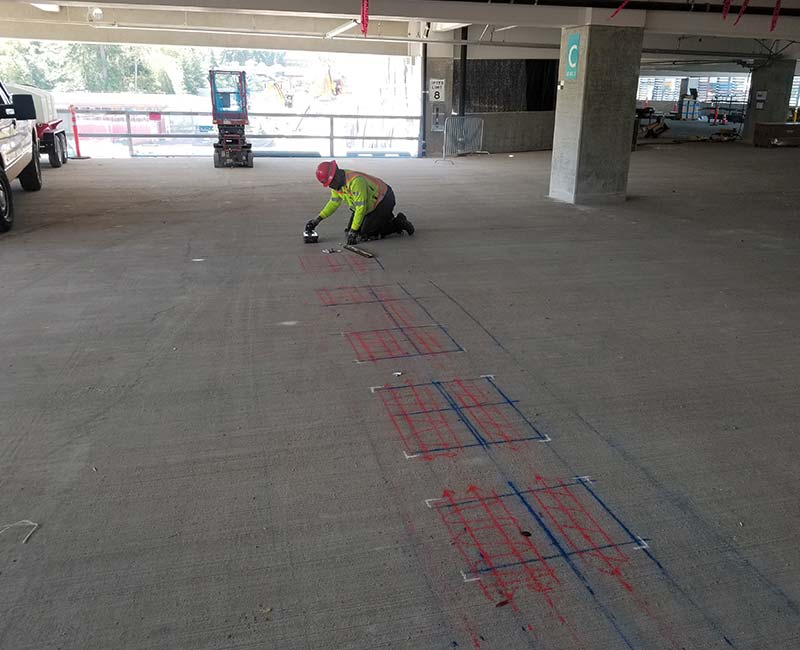
The primary deliverable is a marked surface: spray-painted or chalked lines showing the location and depth of detected objects directly on the concrete, immediately usable by the work crew.
A slab scan is fast. A typical pre-drill or pre-core location can be scanned, interpreted, and marked in 5 to 20 minutes, at a fraction of the cost of a single missed utility or PT cable strike.
What Is Slab Scanning?
Slab scanning is the use of Ground Penetrating Radar (GPR) to non-destructively image the interior of a concrete slab. A GPR antenna, held at or near the slab surface, transmits short pulses of high-frequency electromagnetic energy into the concrete. When those pulses encounter embedded objects with different material properties than the surrounding concrete, they reflect back to the antenna. The system records the timing and character of each reflection, building a continuous cross-sectional image of what is below the surface.
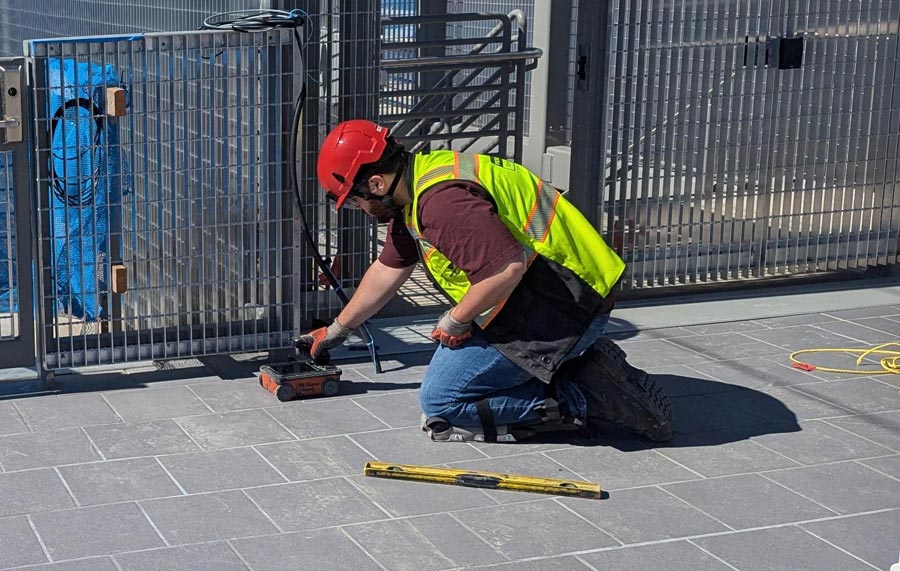
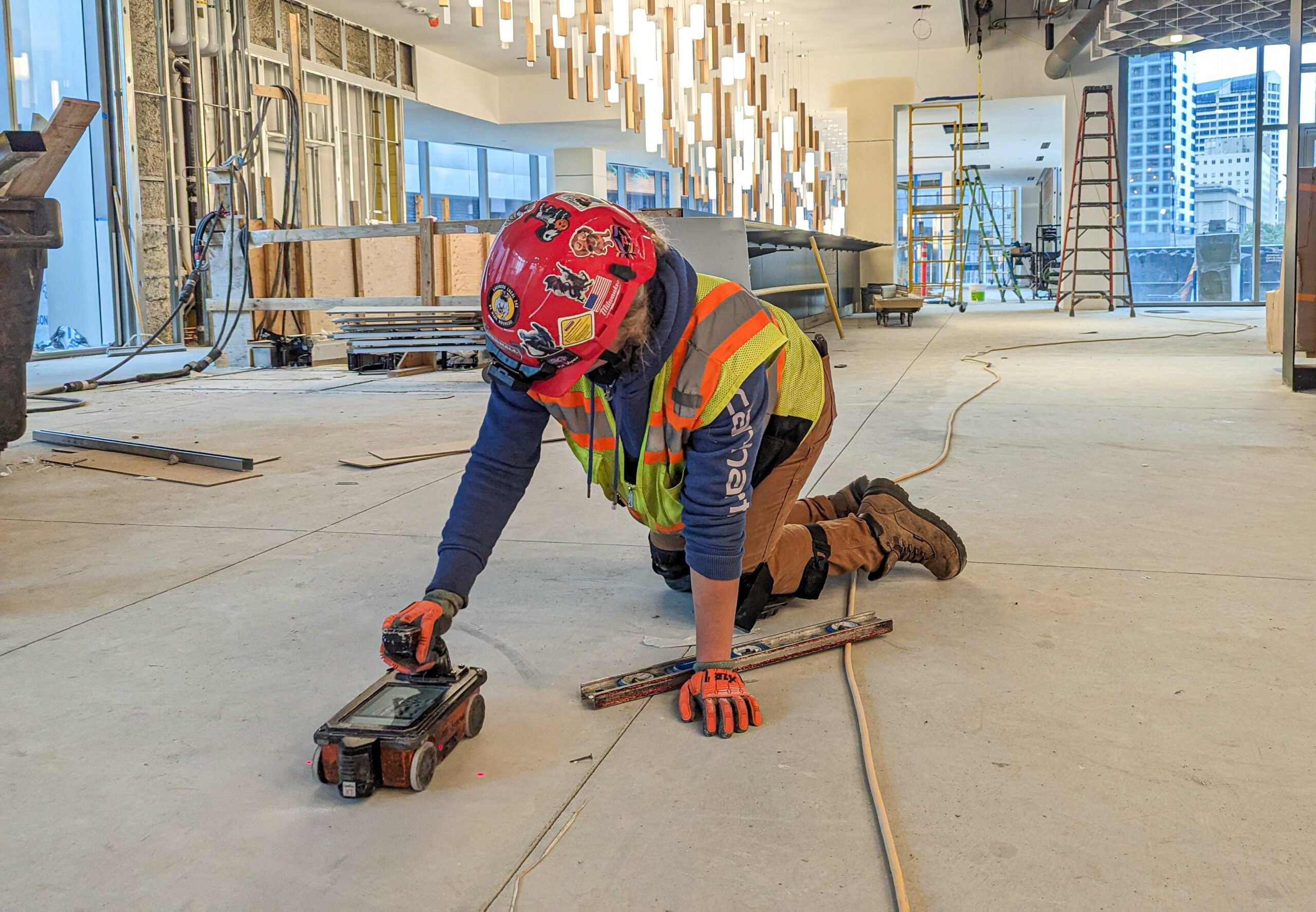
The result is a radargram: a two-dimensional image showing the depth and character of reflecting objects beneath the scan line. A trained GPR technician reads this image in real time as the antenna is moved across the slab surface, identifying rebar bars, PT cables, conduit runs, pipes, voids, and other embedded features. The technician then marks the locations of those objects directly on the concrete surface, giving the drilling, cutting, or coring crew a clear visual guide to what is inside the slab before they start work.
The terms slab scanning, floor scanning, and concrete slab scanning are all used by contractors and facility managers to describe this same process. The terminology varies by trade and region, but the method is consistent: GPR-based non-destructive subsurface imaging of horizontal concrete surfaces. Some crews also use the term slab scan as a shorthand for a single-location pre-drill investigation, as distinct from a full-area grid scan of an entire floor.
Regardless of what it is called on the purchase order, the work is the same and the purpose is the same: to know what is inside the concrete before the blade, bit, or drill enters it.
Why the Terminology Matters for Getting the Right Scope
One of the most common sources of confusion on job sites is the gap between what a buyer asks for and what the scan actually needs to cover. "I need a floor scan before we drill" is a reasonable starting point, but it leaves critical details unspecified that affect the time, cost, and value of the scan delivered.
Slab Scan vs. Full Floor Scan
A slab scan in the strictest sense can refer to a targeted investigation of a small area, such as scanning the immediate vicinity of a proposed anchor bolt or core hole location. This is fast, focused, and requires only a few passes with the antenna over the proposed work area. It answers one question: is this specific location clear?
A full floor scan, by contrast, involves systematically scanning an entire floor area in a grid pattern to produce a comprehensive map of all embedded objects across the full area. This is a longer, more involved process that produces a plan-view depth map of the entire floor, useful for renovation planning, structural assessments, and projects involving many drill or cut points distributed across a large area.
Both are legitimate and valuable, but they are not the same service. Specifying which one is needed, and communicating the total number of proposed work locations and the size of the area to be covered, allows the scanning contractor to scope the work accurately and ensures the crew has the information they actually need.
What "Floor Scanning" Typically Includes in Practice
When a general contractor or facility manager requests "floor scanning" before a concrete work scope, the practical service typically includes:
- GPR scan passes across the proposed cut, core, or drill locations, covering an area sufficient to identify all embedded objects that could be encountered during the planned work.
- Real-time interpretation of scan data by a trained technician, identifying rebar, PT cables, conduit, pipes, voids, and other reflectors in the data as the scan progresses.
- Surface marking of all detected objects, with spray paint or chalk applied directly to the concrete surface to indicate object location and, where relevant, depth and object type.
- Verbal briefing of the work crew by the scanning technician, confirming what was found, where it is marked, and any areas of uncertainty or concern that warrant additional caution.
The Most Common Triggers for a Slab Scan
Most slab scans are initiated by one of a small number of specific work triggers. Understanding which type of work is planned, and what it puts at risk, clarifies why scanning is the appropriate first step in each case.
| Work Type | Why a Slab Scan Is Needed | Risk Without Scanning |
|---|---|---|
| Anchor drilling | Locate rebar and PT cables before each hole is drilled | Rebar damage, PT cable strike, failed anchor placement |
| Core drilling | Confirm clear path for pipe, conduit, or drain penetration | Utility strike, PT cable release, structural damage |
| Saw cutting | Map rebar and PT layout along proposed cut lines | Accelerated blade wear, PT cable strike, utility hazard |
| Slab trenching | Identify all utilities and reinforcement in trench corridor | Electrical, plumbing, or gas line strike; PT hazard |
| Overhead core drilling | Confirm no utilities in overhead slab before drilling up | Electrocution, flooding, or gas release above work area |
| Renovation/demo | Establish full subsurface picture before removing any material | Uncontrolled utility damage, structural instability |
| Structural assessment | Map rebar layout, measure slab thickness, detect voids | Uninformed repair scope; missed delamination or corrosion zones |
Anchor Drilling
Anchor drilling, whether for equipment anchorage, structural attachments, racking systems, or expansion anchors, requires drilling into the concrete slab to a specified depth and diameter at precise locations. Rebar or PT cable in the drill path means the anchor cannot be installed as designed. More critically, in a post-tensioned slab, driving a drill bit through a PT tendon releases the cable's stored energy violently.
A slab scan before anchor drilling confirms whether each proposed anchor location is clear, allows repositioning of anchors that fall directly over rebar, and identifies any PT cables that require special handling. On large anchor bolt patterns, a scan that takes an hour can prevent days of rework and a potentially catastrophic safety incident.
Core Drilling for Utility Penetrations
Core drilling to create penetrations for pipes, conduit, drains, sleeves, and other circular openings is one of the most common reasons a concrete slab scan is ordered. The required opening must be positioned at a specific location determined by the mechanical or electrical design, but that location may fall directly over rebar, conduit, or a PT cable.
A concrete slab scan before core drilling confirms the path through the slab is clear or identifies what must be avoided. For post-tensioned slabs, it is also the only reliable method of confirming PT cable location before the core bit is committed to a path through the slab. GPR scanning before coring in PT concrete is not a best practice recommendation, it is a safety requirement.
Saw Cutting
Saw cutting for slab removal, trench definition, joint installation, or selective concrete removal requires running a diamond blade through the concrete along a defined line. Every inch of that line passes through whatever is embedded in the slab.
A slab scan before saw cutting maps the rebar and PT cable layout along the proposed cut line, allowing the contractor to plan the cut path to minimize reinforcement encounters, identify PT tendons that require structural assessment before cutting, and select the appropriate blade configuration for the reinforcement density present. Without a scan, a saw cutting crew may destroy multiple blades on unplanned rebar hits and, in a PT slab, create a potentially fatal cable strike.
Slab Trenching
Trenching through a concrete slab to install new utility runs, drainage systems, or below-grade conduit involves removing a continuous strip of slab material, including everything embedded in it. Electrical conduit, plumbing, gas lines, and PT cables may all run through the trench corridor.
A concrete slab scan of the full trench corridor before any saw cutting or breaking begins maps all embedded objects in the affected zone. This allows the scope to be planned around existing utilities, prevents undetected strikes during concrete removal, and gives the project team the information needed to coordinate utility relocations before the trench is opened.
H3: Renovation and Demolition Work
Renovation scopes that involve breaking up sections of slab, removing concrete for new openings, or demolishing existing structures put the largest variety of embedded objects at risk. In older buildings especially, the as-built condition of the slab may differ significantly from the original drawings, with utilities added during previous renovation cycles running in locations that are not documented anywhere.
A full-area concrete slab scan before renovation or demolition work begins provides the most complete possible picture of what is inside the slab across the full work zone. This is the scope where investing in a comprehensive grid scan, rather than a targeted point scan, most often pays for itself by preventing costly and dangerous surprises during demolition.
What a Slab Scan Can Find
GPR is effective at detecting a range of embedded objects in concrete slabs. Understanding what is and is not detectable helps set accurate expectations for what the scan deliverable will cover.
Rebar and Welded Wire Reinforcement
Mild steel rebar and welded wire reinforcement are the most reliably detected targets in a concrete slab scan. Steel has a very different dielectric constant than concrete, producing strong, easily interpreted hyperbolic reflections in the radargram. Individual rebar bars can be located horizontally within 1 to 2 inches in typical concrete conditions, and their depth can be estimated to within 10 to 15 percent of the actual depth when the concrete's dielectric properties are known or calibrated.
In heavily reinforced slabs with multiple rebar layers, the upper layer of reinforcement can shadow deeper objects by reflecting much of the signal energy before it penetrates to greater depth. In these conditions, objects below the top mat may be difficult or impossible to reliably detect.
Post-Tension Cables and Tendons
PT cables are among the highest-priority targets in any concrete slab scan. They are detectable by GPR and produce reflections that experienced technicians can distinguish from conventional rebar by their characteristic spacing, layout pattern, and depth. In unbonded PT systems (the most common type in building construction), the cable runs inside a plastic sheath with grease, and the sheath itself is also detectable in favorable conditions.
Bonded PT systems (more common in bridge and infrastructure applications) use grouted ducts and produce different reflection characteristics. In either case, locating PT cables by GPR scan before any cutting or coring is the standard protocol for working safely in post-tensioned concrete.
Electrical Conduit and Embedded Utilities
Metallic conduit, whether rigid steel, IMC, or EMT, produces clear reflections in a concrete slab scan and is reliably detectable. Plastic conduit is detectable when it contains a metallic tracer wire, when it is air-filled (creating a dielectric contrast with the surrounding concrete), or when it runs at sufficient depth to produce a clean reflection without surface interference.
Plumbing pipes, whether copper, steel, or cast iron, produce strong reflections and are reliably detectable. PVC pipes are detectable under favorable conditions but may not produce a clear reflection in all concrete and burial configurations. Hydronic heating tubing embedded in a slab is detectable when it produces sufficient dielectric contrast, though smaller-diameter tubing can be difficult to resolve.
Voids and Delamination
Voids beneath a slab surface and delamination zones within the concrete body produce strong reflections because of the large dielectric contrast between concrete and air. Detecting voids and delamination is an important application of concrete slab scanning in structural assessment contexts, helping identify areas of subsurface deterioration that are not visible at the surface and that could affect the slab's load capacity and service life.
Slab Thickness
When the slab's bottom surface produces a clear reflection, GPR can measure slab thickness non-destructively. This is useful when construction drawings are not available, when slab thickness may have changed in previous renovation work, or when verifying that the slab has the structural depth required for the anchor or penetration being planned.
What GPR Cannot Reliably Detect
Slab scanning has important limitations that should be communicated to the work crew. GFRP (fiberglass) rebar does not produce reliable reflections because its dielectric properties are similar to concrete. Plain plastic conduit without metallic content may not be detectable. Very small-diameter objects, objects in conductive or moisture-saturated concrete, and objects directly beneath a dense rebar mat may all fall below the detection threshold. These limitations mean a slab scan reduces risk dramatically but does not eliminate it entirely. Proceeding with reasonable caution even after a clear scan is always appropriate.
What the Scan Deliverable Looks Like on Site
Understanding what to expect from a slab scan deliverable helps project teams use the results effectively and communicate scan requirements accurately to the scanning contractor.
The Marked Surface
For the vast majority of pre-work slab scans, the primary deliverable is the marked concrete surface. As the technician completes the scan of each proposed work area, they use spray paint (typically in a high-visibility color such as orange, yellow, or red) or chalk to mark the location of detected objects directly on the concrete. Common marking conventions include:
- Parallel lines marking the centerline of a detected rebar bar or conduit run, often with depth noted in inches next to the line.
- A series of marks along the path of a PT cable run, connected to indicate the cable's direction of travel across the scan area.
- An X or circle marking a proposed drill point that is confirmed clear, sometimes accompanied by a notation of the nearest detected object and its distance.
- A different color or symbol (often red) for PT cables or live utilities, to distinguish them from passive rebar reinforcement.
These markings are applied directly to the work surface and are visible to the drill, saw, or core operator without any translation or interpretation required. The marked slab is the tool the crew uses. It is immediate, intuitive, and exactly as accurate as the scan data that produced it.
The Verbal Briefing
A good scanning technician does not simply mark the surface and leave. After completing the scan of a work area, the technician briefs the lead crew member on what was found: where the reinforcement runs, where the PT cables are, whether any proposed work locations are clear or need to be repositioned, and any areas where the scan data was ambiguous or where caution is specifically warranted.
This verbal handoff is as important as the surface markings. Markings indicate what was detected. The briefing communicates the confidence level of those findings and flags any areas where the data was less conclusive, allowing the crew to make informed decisions about where to proceed with full confidence and where to proceed with additional caution.
The Written Scan Report
On larger projects, in post-tensioned structures, or where the project owner or engineer requires documentation, the scan deliverable also includes a written report. A standard concrete slab scan report includes:
- Project information: site address, slab location, date and time of scan, equipment used, antenna frequency.
- Scan methodology: grid spacing, scan direction, calibration information, and any surface conditions that affected scan quality.
- Radargram images: representative cross-sectional images from the scan, annotated to show the location and interpreted identity of key reflectors.
- Findings summary: a description of the objects detected, their estimated depths, and any anomalies or areas of concern.
- Plan-view maps: for grid scans of larger areas, a top-down map showing the spatial distribution of detected objects across the scan area, useful for renovation planning and permitting documentation.
The written report is not always required for routine pre-work scanning, but it is standard practice for structural assessments, bridge deck condition surveys, parking structure evaluations, and any project where the scan findings will inform engineering decisions or be included in project documentation.
How Long It Takes
Scan time depends on the number of proposed work locations, the size of the area to be covered, and the complexity of the subsurface conditions. As a general reference:
- A single proposed core or anchor location: 5 to 15 minutes to scan, interpret, and mark.
- A set of 10 to 20 proposed locations in the same floor area: typically 1 to 3 hours for scanning, interpretation, marking, and crew briefing.
- A full grid scan of a 5,000 to 10,000 square foot floor: typically 3 to 6 hours, depending on grid spacing and required reporting.
- A full grid scan of a large industrial floor or parking deck: typically a full day or more, with reporting delivered within 24 to 48 hours.
In most cases, the scanning technician is not the bottleneck on the project schedule. A scan conducted the morning of the work scope typically allows the drilling or cutting crew to begin within the same half-day. Scheduling the scan and the concrete work in close sequence minimizes mobilization cost and eliminates the scheduling gap between scan delivery and work execution.
Penhall's Concrete Slab Scanning Services
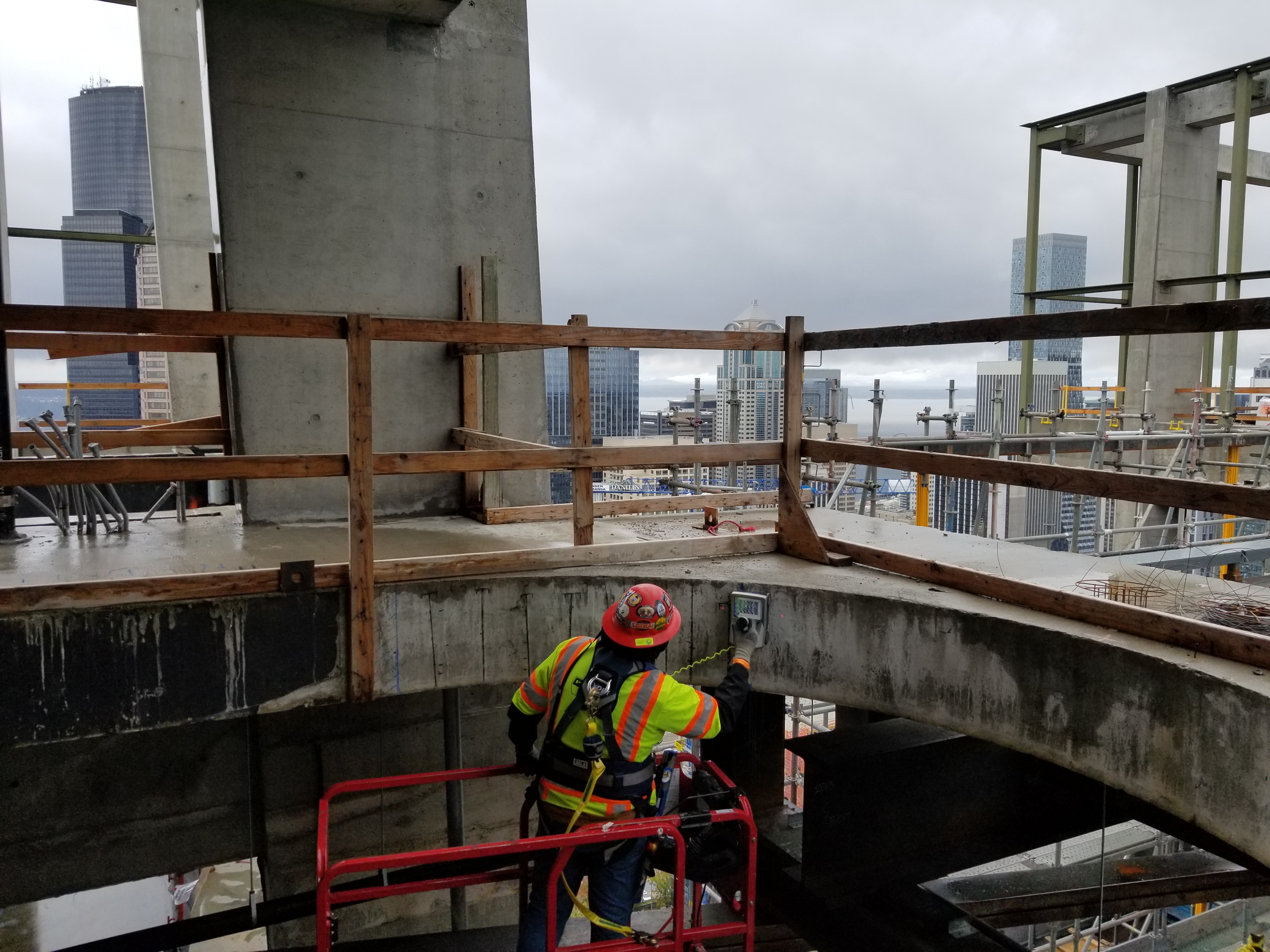
Penhall Company provides GPR concrete slab scanning as a standard pre-work service before concrete cutting, coring, and demolition projects, as well as a standalone service for structural assessments, renovation planning, and pre-construction investigations.
Because Penhall provides both the scanning and the concrete work, the gap between scan delivery and work execution is eliminated. The technician who scans the slab briefs the crew that cuts or cores it. The scan findings are not a document that travels from one contractor to another, they are a live handoff from the person who read the data to the person acting on it. This integration is one of the most practical advantages of working with a contractor who provides both services.
Penhall's scanning technicians are trained specifically for construction and infrastructure applications, with particular expertise in identifying post-tension cables, distinguishing rebar from conduit in dense reinforcement environments, and communicating scan findings clearly to field crews. Every scan is backed by Penhall's Behavior-Based Safety (BBS) program, which treats pre-work scanning as a non-negotiable safety step rather than an optional line item.
Penhall's full concrete services offering includes:
GPR concrete scanning: slab scanning, wall scanning, and structural condition assessments.
Concrete cutting: flat sawing, wall sawing, wire sawing, and hand sawing.
Concrete coring: 1-inch to 60-inch diameter cores in any orientation and reinforcement condition.
Hydrodemolition: high-pressure water concrete removal for large-scale rehabilitation.
Selective demolition: controlled removal of reinforced and post-tensioned concrete.
Structural repair: concrete restoration and repair following cutting, coring, or demolition.
With locations across the country, Penhall can mobilize quickly for slab scanning and concrete work in any region.