
At a Glance
- Each phase of a commercial concrete project builds on the last. What scanning and mapping reveal in Phase 1 directly shapes how cutting, coring, and demolition are executed in every phase that follows.
- Subsurface utility locating and utility mapping come first: they establish what is buried below grade and embedded in the structure before any tool enters the concrete.
- GPR utility locating is the standard non-destructive method for detecting buried pipes, conduit, cables, and rebar without excavation.
- As-built construction drawings document what was built, but are frequently incomplete or outdated. GPR scanning is required to verify actual conditions when as-builts cannot be confirmed.
- Hydroexcavation exposes buried utilities non-destructively before mechanical excavation begins, eliminating the strike risk that conventional digging equipment creates.
- Coring concrete, cutting, and demolition depend on what the pre-work phases reveal. Complete pre-work intelligence is what makes the execution phases fast, safe, and predictable.
Why the Phases of a Concrete Project Are Interconnected
Complex concrete projects fail in predictable ways. A utility that was not mapped gets struck during excavation, triggering an emergency shutdown. A PT cable that was not scanned gets cut during saw cutting, causing a violent energy release. A core that was placed without confirming the drill path hits rebar, destroying the bit and requiring relocation. A demolition sequence that did not account for the PT tendon layout in a structure causes progressive structural damage when tendons are cut in the wrong order.
In every case, the failure occurred not because the crew was incompetent or the project was too difficult. It occurred because information that was available in an earlier phase of the project was not carried forward to the phase where it mattered. The utility location data was not shared with the excavation crew. The GPR scan findings were not reviewed by the drilling crew before work started. The structural drawings that showed the PT layout were not in the hands of the demolition contractor.
This information gap between phases is one of the most common and most preventable sources of delay, cost overrun, and safety incident on commercial construction projects. It is especially prevalent when each phase of the concrete work scope is performed by a different specialty contractor, each operating within their own scope without full visibility into what the others found and what it means for their work.
The concrete construction process, done right, is a continuous chain of discovery and informed execution. Each phase generates information. That information shapes the next phase. A project team that carries full knowledge of the subsurface from the first GPR scan through the final repair pour makes better decisions at every step, avoids the surprises that drive change orders and delays, and executes the work more safely because they know what they are working in.
The Concrete Project Lifecycle: Phase by Phase
| # | Phase | What Happens | What It Enables |
|---|---|---|---|
| 1 | Utility mapping & GPR locating | Underground utility mapping, subsurface utility locating, as-built verification | Safe excavation, informed cut/core positioning, PT cable identification |
| 2 | Pre-work concrete scanning | GPR slab scanning for rebar, PT cables, conduit, and voids at proposed work locations | Accurate tool selection, safe penetration placement, no mid-job surprises |
| 3 | Hydroexcavation (if applicable) | Vacuum excavation to expose utilities or excavate near existing infrastructure | Non-destructive utility exposure, confirmed utility location before mechanical work |
| 4 | Concrete cutting | Flat sawing, wall sawing, wire sawing for openings, slab removal, or trench definition | Clean-edged removal zones, structural member separation, trench access |
| 5 | Coring concrete | Core drilling for utility penetrations, anchor locations, test samples | Utility routing, MEP installation, structural test data, anchor installation |
| 6 | Selective demolition | Hydraulic breaking, crushing, wire sawing, demolition robot operations | Concrete removal to scope without collateral damage to adjacent structure |
| 7 | Restoration and repair | Concrete repair, overlay, FRP strengthening, and surface preparation | Restored structural integrity, prepared surface for new systems, closeout |
Phase 1: Underground Utility Mapping and Subsurface Utility Locating
The first phase of any concrete project that will penetrate, cut, or disturb the ground or an existing structure is establishing what is already there. Underground utility mapping and subsurface utility locating are the processes that answer that question before any work begins.
What Is Utility Mapping?
Utility mapping is the systematic process of locating, identifying, and recording the position and depth of underground utilities (pipes, conduit, cables, tanks, and other infrastructure) within a defined project area. The goal is to produce a subsurface utility map accurate enough that work crews can excavate, cut, drill, or demolish within the area without striking undetected utilities.
On commercial and infrastructure projects, utility mapping typically involves a combination of methods:
- Review of available records, including as-built drawings, utility company records, and prior survey data.
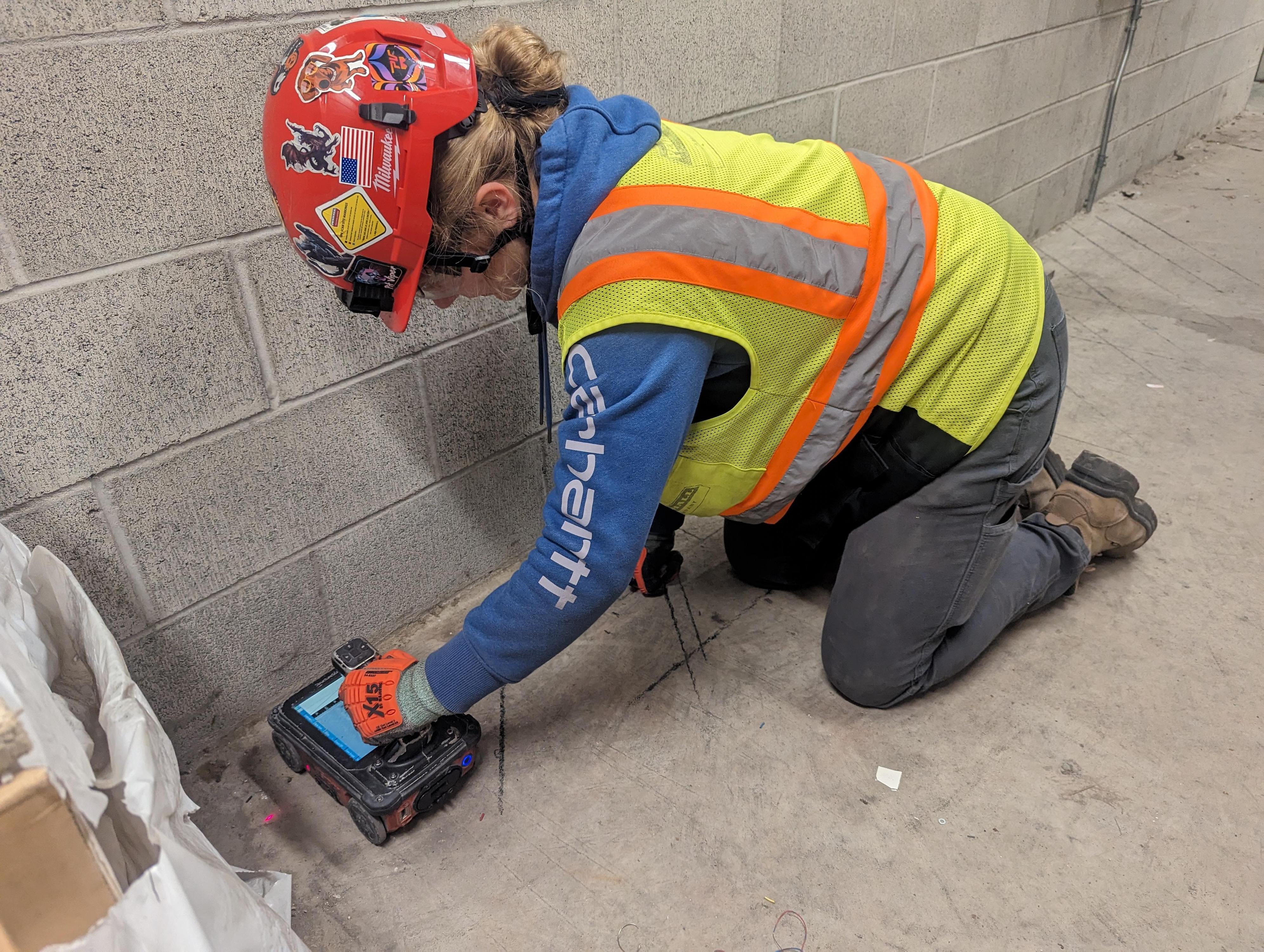
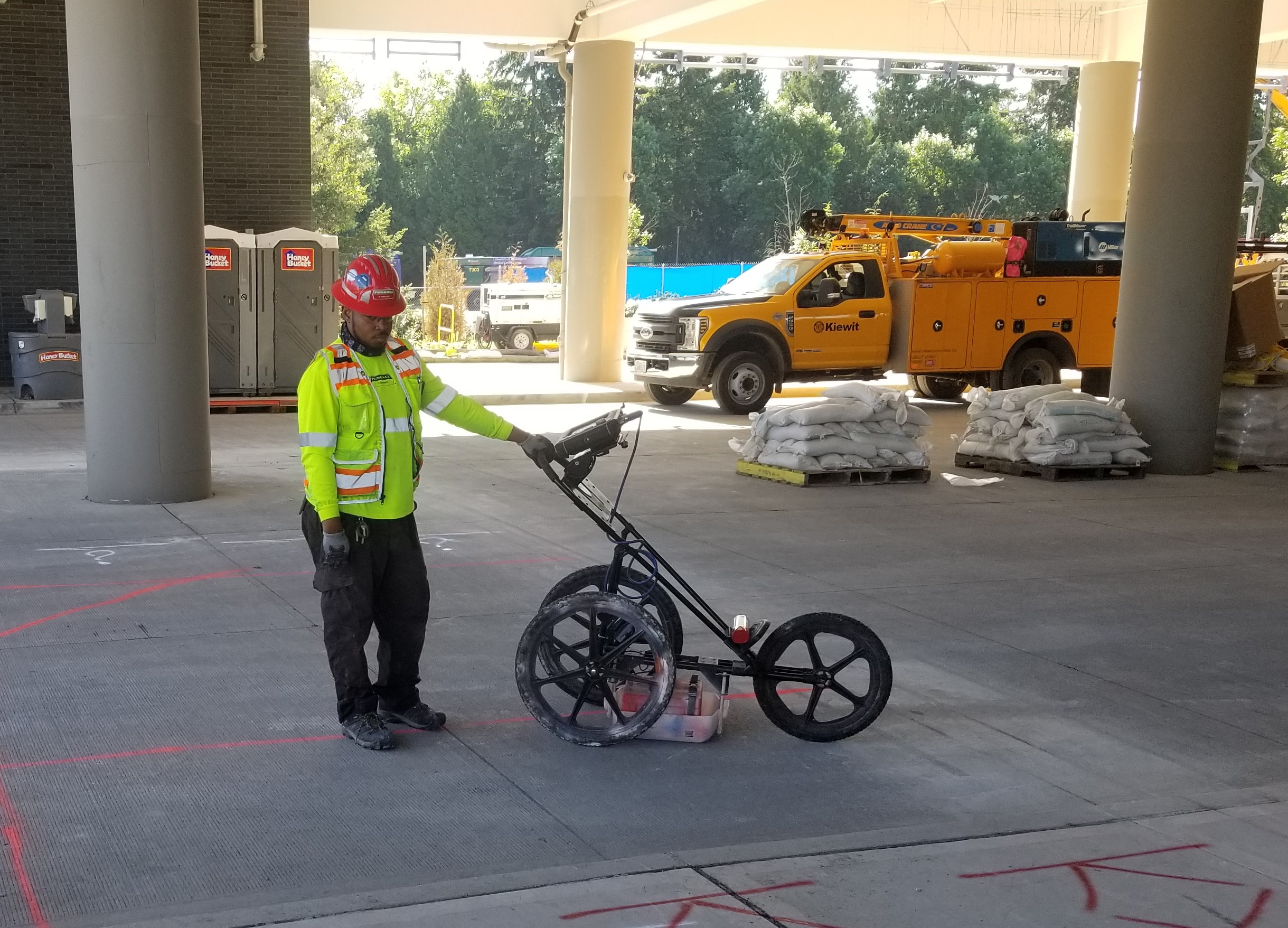
- GPR utility locating: Ground Penetrating Radar scanning of the ground surface or slab to detect buried utilities.
- Electromagnetic induction: used to locate and trace metallic utilities by inducing a signal on the utility and detecting it at the surface.
- Ground-truthing: confirmation of detected utilities by careful hand excavation or hydroexcavation at selected locations.
The ASCE 38 Standard for the Collection and Depiction of Existing Subsurface Utility Data defines four quality levels for utility location data, from Quality Level D (record information only, no field verification) to Quality Level A (precise horizontal and vertical location confirmed by excavation). Professional subsurface utility locating services are designed to achieve Quality Level B (non-destructive field detection using surface geophysics including GPR) or Quality Level A (physical verification) for utilities in the project work zone.
GPR Utility Locating
GPR utility locating is the primary non-destructive technology for underground utility mapping on most commercial sites. A GPR antenna moved across the ground or slab surface transmits radar pulses that penetrate the material and reflect off buried utilities. The reflections are recorded and displayed as a radargram showing the depth and position of detected objects.
GPR utility locating is effective for detecting metallic utilities (steel pipe, copper, cast iron, EMT conduit) and many non-metallic utilities (plastic pipe with tracer wire, air-filled conduit, water-filled pipe where the water creates sufficient dielectric contrast). It can also detect structural features within concrete slabs and walls that would be missed by electromagnetic-only approaches.
The limitations of GPR utility locating are the same as for any GPR application: signal attenuation in conductive soils limits depth in some conditions, and non-metallic utilities without tracer wire may not produce a clear reflection. Combining GPR with electromagnetic induction methods provides a more complete picture than either alone, which is why comprehensive utility mapping engagements typically use both technologies.
What Are As-Builts, and Why Can't You Always Trust Them?
As-builts (also called as-built drawings or record drawings) are revised construction drawings that document the actual position of structural elements, utilities, and systems as installed in the field, as distinguished from the original design drawings. As-built construction documents reflect field changes, substitutions, and adjustments that occurred during construction and that may differ from the original design intent.
On paper, as-built drawings should provide a complete and accurate record of what is in the ground and embedded in concrete structures. In practice, their reliability varies widely. Common reasons as-built construction documents cannot be fully trusted include:
- Field changes made during construction were not consistently recorded in the as-built documents.
- Renovation work performed after original construction added utilities, conduit, or reinforcement not reflected in the original as-builts.
- Original as-builts were never produced or were lost over the building's ownership history.
- The structure is old enough that as-built documentation predates current drawing standards and may be imprecise or incomplete.
- Utility layouts were changed by the utility owner after original construction without updating the building's as-built records.
For these reasons, as-built drawings should be treated as a starting point for subsurface utility mapping, not as a substitute for field verification. A GPR scan confirms what the as-builts say, identifies where reality departs from the drawings, and provides the location data needed to proceed confidently with cutting, coring, or excavation work.
What Utility Mapping Produces
The output of a utility mapping engagement is a set of marked up plans, field markings, and in more comprehensive engagements, a Geographic Information System (GIS) layer or drawing overlay showing detected utilities with their positions and depths. For projects where work will occur in the mapped area, field markings (color-coded spray paint or flags following the APWA Uniform Color Code) are applied to the surface to give work crews an immediate visual reference.
The APWA color code for utility markings is:
- Red: electric power lines, cables, conduit, and lighting cables.
- Yellow: gas, oil, steam, petroleum, or gaseous materials.
- Orange: communications, alarm, signal lines, cables, or conduit.
- Blue: potable water.
- Green: sewers and drain lines.
- Purple: reclaimed water, irrigation, and slurry lines.
- White: proposed excavation limits or route.
- Pink: temporary survey markings, unknown or unidentified facilities.
These markings are the field crew's primary guide to what is below the surface, and they are the direct output of the utility mapping process that makes the rest of the project safe to execute.
Phase 2: Pre-Work Concrete Scanning for Embedded Objects
Once the below-grade utility picture is established, the next step is establishing what is already inside the concrete structure itself. While utility mapping focuses on buried infrastructure below the slab, pre-work concrete scanning addresses the rebar, post-tension cables, embedded conduit, and utilities that are cast into the concrete and that cannot be detected from a surface-level utility map.
Pre-work concrete scanning uses the same GPR technology as utility locating, but with higher-frequency antennas optimized for the shorter depths and finer resolution required to image objects inside a concrete slab (typically 4 to 24 inches thick) rather than utilities buried several feet below grade. The concrete scanning process for pre-work investigation follows the same basic workflow: scan, interpret, mark, and brief.
What Pre-Work Scanning Finds
In a typical commercial slab pre-work scan, the technician identifies and marks:
- Rebar layout: bar position, spacing, depth, and orientation. This information drives blade and bit selection and allows anchors and cores to be positioned to avoid or minimize rebar encounters.
- Post-tension cables: PT tendon location, spacing, and depth. This is the highest-priority finding for safety. Any proposed cut or core that falls within the PT cable field requires structural review before work proceeds.
- Embedded conduit and utilities: metallic conduit, water or gas lines, and other utilities cast into the slab that were not captured in the below-grade utility map.
- Voids and delamination: subsurface air spaces that may indicate structural deterioration, subgrade erosion, or prior repair failures.
- Slab thickness: when the bottom reflection is visible, GPR can confirm the slab depth without coring.
The surface markings produced by the concrete scan, combined with the utility markings from the below-grade mapping phase, give the cutting, coring, and demolition crews a complete picture of the subsurface and embedded environment in the work zone before any penetrating tool enters the material.
How Scan Findings Shape the Execution Phases
The value of pre-work scanning is not just safety. It is efficiency. When the crew knows exactly where the rebar is before they start coring concrete, they can position the core bit in the clear window between bars on the first attempt. When they know the PT cable layout before saw cutting, they can select a blade configuration matched to the reinforcement density they will actually encounter. When they know what utilities are in the slab before demolition, they can plan the isolation and removal sequence without stopping work for emergency discoveries.
Every piece of information gathered in Phases 1 and 2 directly reduces the probability of a mid-scope surprise in Phases 3 through 7. This is why the pre-work phases are not overhead. They are the work that makes all the subsequent work faster, safer, and more predictable.
Phase 3: Hydroexcavation for Non-Destructive Utility Exposure
On projects where below-grade utilities must be exposed before mechanical excavation, utility connections, or repair work proceeds, hydroexcavation provides a non-destructive alternative to digging with mechanical equipment.
What Is Hydroexcavation?
Hydroexcavation (also called hydrovac excavation or vacuum excavation) is a method of soil excavation that uses pressurized water to break up and liquefy the soil and a powerful industrial vacuum to remove the resulting slurry, excavating to a precise depth and profile without any mechanical cutting or digging tool contacting the soil. Because there is no blade, bucket, or drill in contact with the excavation zone, hydroexcavation cannot damage buried utilities that fall within the excavated area.
The pressurized water used in hydroexcavation can be either cold water (standard for most applications) or heated water (used in frozen ground conditions to thaw and excavate simultaneously). The vacuum removes the slurry to an onboard tank for transport and disposal. The excavation walls are clean and precise, and the soil removal is limited to the targeted zone without the over-excavation common with mechanical digging.
When Hydroexcavation Is Used in the Concrete Construction Process
Hydroexcavation is most commonly deployed at the intersection of utility mapping and mechanical work. After GPR utility locating has identified the presence and approximate position of buried utilities, hydroexcavation is used to expose those utilities precisely, confirming their exact depth and condition before mechanical excavation begins nearby. This is Quality Level A verification under the ASCE 38 standard: physical exposure that confirms what the GPR found.
Common triggers for hydroexcavation on commercial concrete projects include:
- Daylighting utilities before mechanical excavation to confirm clearance and prevent utility strikes.
- Excavating in congested utility corridors where the density of buried infrastructure makes mechanical digging impractical without unacceptable strike risk.
- Slot trenching for new utility installations in areas where multiple existing utilities are present and must be preserved.
- Potholing to verify utility depth and condition at specific points before horizontal directional drilling or casing installation.
- Exposing existing infrastructure for connection, repair, or tie-in work.
- Cold-weather excavation where ground is frozen and mechanical breaking would damage utilities.
The information that hydroexcavation produces is not just a safety confirmation. It feeds back into the project knowledge base, updating the utility map with precise, ground-truthed positions that the cutting, coring, and demolition phases can rely on.
Phase 4: Concrete Cutting for Openings, Removal Zones, and Trench Definition
With utility mapping, concrete scanning, and any required hydroexcavation complete, the project moves into the execution phases. Concrete cutting is typically the first execution phase for scopes involving slab removal, opening creation, or trench definition. It produces the clean-edged cuts that define removal zones, create new openings in slabs and walls, and establish the boundaries of demolition scopes.
How Pre-Work Intelligence Shapes the Cutting Scope
The findings from the utility mapping and concrete scanning phases are directly applied during cutting. The surface markings showing rebar position and PT cable layout are visible on the slab as the saw operator works. Proposed cut lines that were confirmed clear of PT cables during scanning can be executed with standard protocols. Cut lines that approach or cross PT tendon zones have been flagged for structural review and are handled under engineer-directed protocols.
Rebar density information from the scan allows the crew to select the appropriate blade specification for the actual reinforcement conditions, avoiding under-specified blades that fail prematurely on dense reinforcement and over-specified blades that waste cost on lightly reinforced material. This is a direct, quantifiable efficiency benefit of the pre-work scanning investment.
Cutting Methods by Project Phase
Different cutting methods serve different roles in the project execution sequence:
- Flat sawing defines slab removal zones, trench boundaries, and joint lines on horizontal surfaces.
- Wall sawing creates precise openings in vertical concrete surfaces: walls, columns, and elevated slab soffits.
- Wire sawing cuts through structural members of any thickness and in configurations that blade-based saws cannot reach, including post-tensioned members under engineer-directed controlled conditions.
- Hand sawing handles detail cuts, edge work, and confined locations that machine-mounted saws cannot access.
Phase 5: Coring Concrete for Penetrations and Test Samples
Coring concrete creates the circular penetrations required for utility routing, mechanical and electrical installations, anchor systems, and structural test sample extraction. Concrete coring is typically sequenced alongside or immediately after cutting, using the same mobilization and often the same crew.
What Coring Concrete Produces
The output of coring concrete is a clean, cylindrical penetration of a specific diameter and depth. For utility installations, this provides a precisely dimensioned path through the concrete for a pipe, conduit, sleeve, or drain body. For structural anchoring, it creates the hole geometry required for the anchor system specification. For testing, the cylindrical core extracted by the drill is submitted to a laboratory for compressive strength testing, petrographic analysis, or chloride content measurement.
Core diameter selection is driven by the component being installed. Standard utility penetrations commonly use 3-inch to 8-inch diameter cores for piping and conduit. Large-diameter infrastructure penetrations (manholes, pump housings, large pipes) may require cores of 12 inches to 36 inches or more. Structural test cores are typically 4 inches in diameter, the standard size for ASTM C42 testing.
How Scanning Findings Protect the Coring Scope
The pre-work concrete scan is what makes coring concrete safe and efficient in reinforced and post-tensioned slabs. Without it, every core location is a guess about what is in the drill path. With it, the crew knows before the first bit turns whether each proposed location is clear, whether rebar is present and at what depth, and whether any PT cables run through the vicinity.
For post-tensioned slabs specifically, coring concrete without a prior GPR scan is not an acceptable risk. The core bit that hits a PT cable does so with full rotational force, severing the tendon and releasing its stored energy through the rig. The core drill operator is in the direct line of that energy release. This is a preventable event with a single pre-work step.
Coring for Structural Test Samples
In renovation, rehabilitation, and infrastructure assessment projects, coring concrete for structural test samples is often one of the first execution steps, occurring before any cutting or demolition begins. The compressive strength data from core tests informs the structural engineer's assessment of the existing slab, confirms whether the concrete has the capacity assumed in the renovation design, and identifies zones of reduced strength that need to be removed or reinforced before new work proceeds.
Core test data is also used to calibrate the GPR scan's depth estimates. By comparing the GPR-measured depth to a core extracted at the same location, the technician can refine the dielectric constant used in the scan calibration and improve depth accuracy for subsequent scan interpretations in the same area.
Phase 6: Selective Demolition and Concrete Removal
After the cut lines and core penetrations have defined the boundaries of the removal scope, selective demolition removes the concrete within those boundaries.
How Pre-Work Intelligence Guides Demolition Sequencing
The utility map and concrete scan findings are not just safety inputs to demolition. They are sequencing inputs. Utilities that must remain active need to be isolated and protected before demolition of surrounding material begins. PT tendons identified by scanning must be de-stressed in a defined sequence before the slab section they serve can be removed. Rebar that connects the removal zone to adjacent structural elements must be cut in the sequence that preserves the load path of the surrounding structure.
A demolition team that has full access to the utility map and concrete scan data from Phases 1 and 2 plans the demolition sequence with complete information. A demolition team that receives only a verbal description of the scope and a set of drawings that may not reflect current conditions is making sequencing decisions with incomplete information, and the gaps in that information are where delays, incidents, and change orders originate.
Concrete Demolition Equipment Selection
Equipment selection for the demolition phase is informed by the pre-work findings. Rebar density from the concrete scan determines whether a hydraulic breaker plus crusher combination is sufficient or whether additional shear or cutter capacity is needed for reinforcement processing. PT tendon locations from the scan define the areas requiring wire sawing under engineering direction rather than impact breaking. Embedded utility locations define the areas requiring hand tools, demolition robot operations, or careful saw cutting rather than excavator-mounted hydraulic breakers.
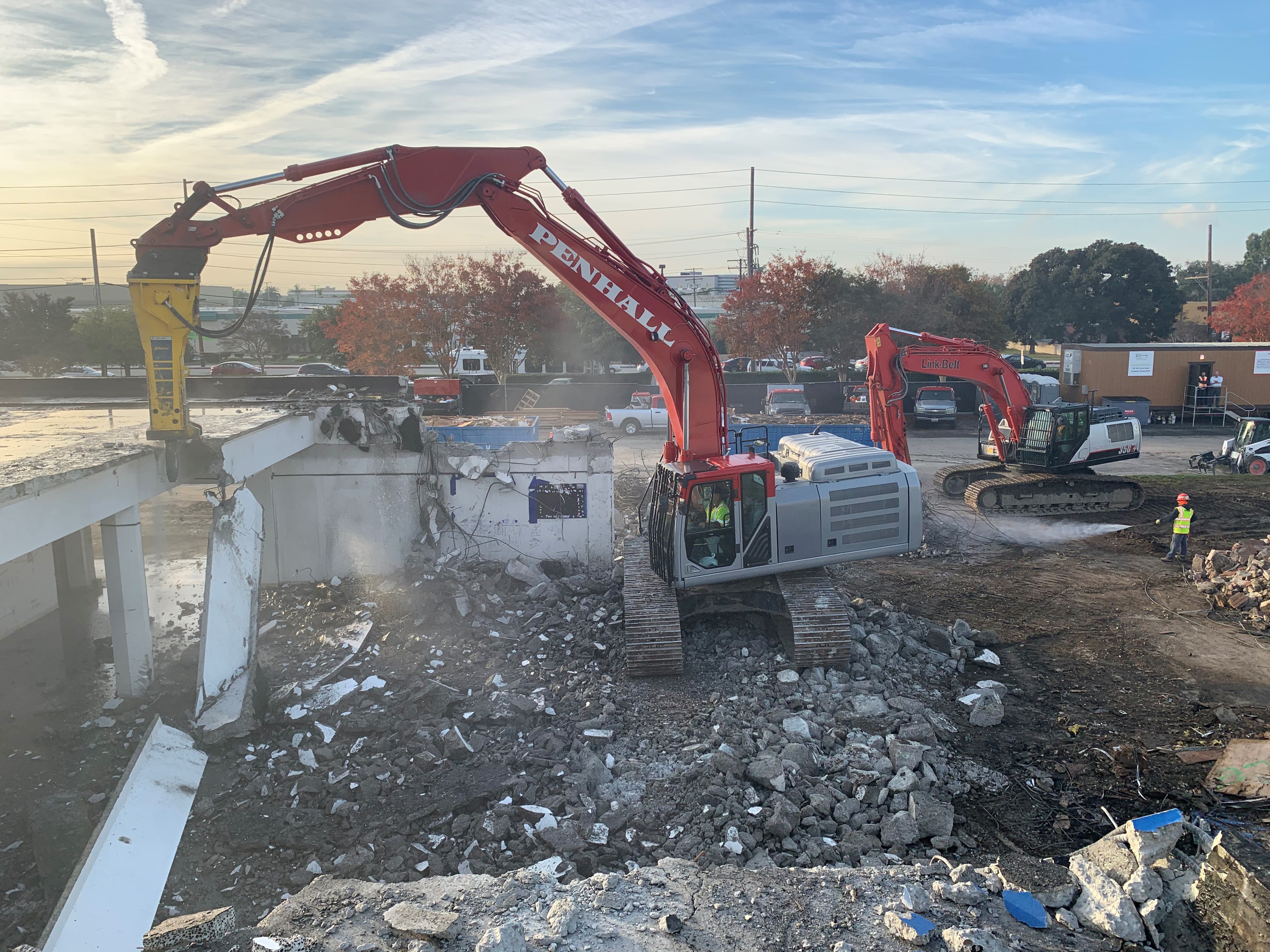
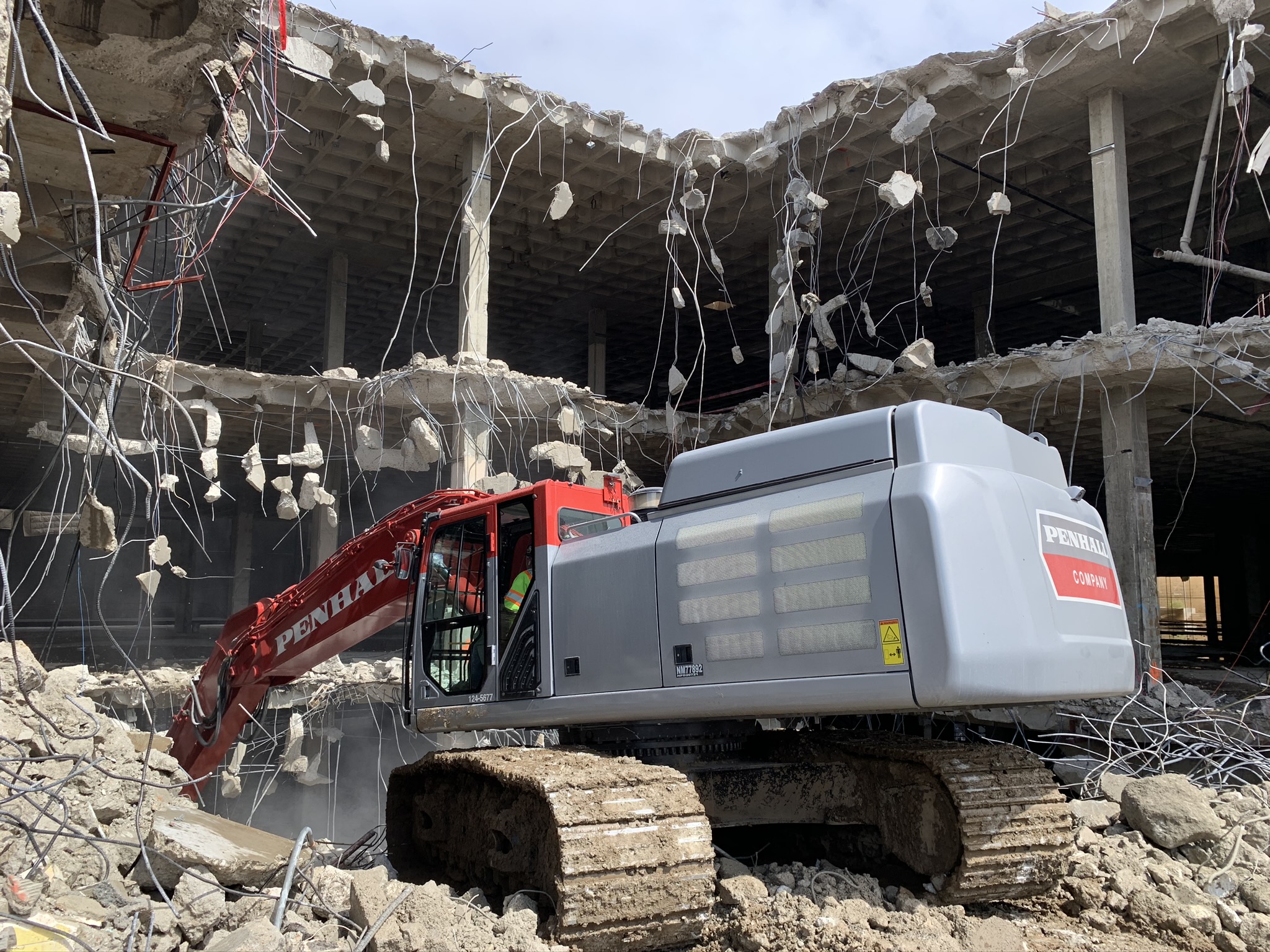
The most common concrete demolition equipment sequence on a commercial project involves hydraulic breakers for primary breaking of the slab within the defined removal zone, concrete crushers for processing broken material and separating rebar, wire saws or concrete cutters for structural member separation at defined cut planes, and demolition robots for any areas that excavator-mounted equipment cannot access.
For large-scale surface removal on bridge decks, parking structures, and other infrastructure rehabilitation projects, hydrodemolition is often the preferred method, replacing or complementing mechanical demolition by selectively removing deteriorated concrete while leaving sound material and rebar intact and providing a microfracture-free bonding surface for new overlay placement.
Phase 7: Structural Repair and Restoration
The final phase of the concrete construction process closes the scope by restoring the structural integrity and serviceability of the elements affected by cutting, coring, and demolition work. Structural repair work includes concrete placement and finishing in opened or demolished zones, repair mortar installation in surface preparation areas, overlay system application, and where required, Fiber Reinforced Polymer (FRP) strengthening to restore or enhance the capacity of elements from which reinforcement has been removed.
The quality of the repair phase is directly dependent on the quality of the surface preparation that precedes it. Concrete surface preparation, whether by scarifying, grinding, or hydrodemolition, must produce the surface profile (CSP rating) specified by the repair material manufacturer. An overlay or repair mortar placed on an inadequately prepared surface will delaminate regardless of its quality.
On post-tensioned structures, the repair phase also includes re-grouting of any PT tendons that were exposed during demolition, replacement of PT components where existing cables were intentionally cut, and structural re-assessment by the engineer of record to confirm that the repaired section meets the required structural performance criteria.
The Integration Advantage: Why a Single Contractor Changes the Project
Every phase described in this guide can be, and on many projects is, performed by a different specialty subcontractor. A utility locating company does the mapping. A scanning company does the concrete scan. A core drilling subcontractor does the coring. A cutting subcontractor does the saw cuts. A demolition contractor does the removal. A repair contractor closes the scope.
This fragmented model has a structural problem: the information each phase generates is supposed to flow to the next phase, but in practice it often does not. The utility locating company produces a report that the core drilling subcontractor may or may not receive, may or may not read, and may or may not have on the job site when they start drilling. The concrete scan findings are in a document that was emailed to the GC, who may or may not have transmitted them to the saw cutting crew. The demolition contractor who arrives three weeks after the scan was performed may be working from memory of a verbal briefing they received secondhand.
Each gap in this information chain is a potential failure point. Not a theoretical one. A common one.
When a single contractor performs all phases of the concrete work scope, the information chain is internal. The scanning technician briefs the cutting crew directly. The utility map is in the hands of the crew that drills adjacent to the mapped utilities. The structural findings from Phase 1 and Phase 2 are owned by the same organization that executes Phases 3 through 7. There is no handoff. There is no translation. There is no version control problem.
This is the integration advantage: not just cost savings from reduced mobilization, though that is real. It is the elimination of the coordination gaps that cause the most expensive problems on complex commercial and infrastructure projects.
Penhall's Integrated Concrete Services
Penhall Company provides all phases of the concrete construction and demolition process under a single contractor relationship. From the first GPR utility locating scan through final structural repair, Penhall brings the equipment, the expertise, and the organizational depth to execute complex multi-phase concrete scopes as a true integrated partner.
Penhall's service offering covers every phase described in this guide:
GPR concrete scanning and utility locating: subsurface utility mapping, rebar and PT cable location, embedded utility identification, void detection, and slab thickness measurement.
Concrete cutting: flat sawing, wall sawing, wire sawing, and hand sawing for all project phases and reinforcement conditions.
Concrete coring: precision core drilling for utility penetrations, anchor installations, and structural test sample extraction.
Hydrodemolition: robotic high-pressure water concrete removal for bridge decks, parking structures, and large-scale rehabilitation projects.
Selective and full demolition: hydraulic breaking, crushing, wire sawing, demolition robot operations, and controlled PT demolition with structural engineering coordination.
Structural repair: concrete restoration, surface preparation, FRP strengthening, and repair following cutting, coring, or demolition.
Penhall's Behavior-Based Safety (BBS) program and over 65 years of concrete industry experience ensure that every phase of a complex multi-phase scope is executed with the professionalism and safety discipline that commercial and infrastructure projects require.
With locations across the country, we can mobilize quickly for any phase of the concrete construction and demolition process in any region.